


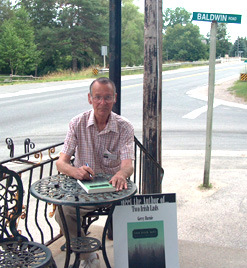
Recently, I had the pleasure of being interviewed by Jamie Lake, author and blogger, on the Jamie Lake Books Blog. Drop around to see what Jamie and I had to discuss, and learn about his books. Click on the above photo to move.
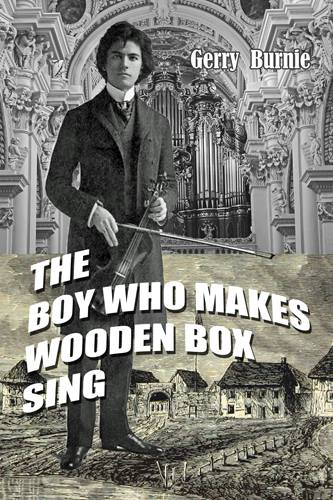
A fascinating history of a region as told by its myths and legends.

 A non-fiction exploring some of Northern Canada’s greatest forgotten mysteries- the stories and legends surrounding the watershed of the South Nahanni River.
Deep in the heart of the Canadian North lies a mysterious valley shrouded in legend. Lured by tales of lost gold, prospectors who enter it tend to lose their heads or vanish without a trace. Some say that the valley is cursed- haunted by an evil spirit whose wailings echo in the canyons. Others claim that it is home to monsters- relics of its prehistoric past. What secrets could the valley be hiding? What mysteries lie buried beneath its misty shroud?
***
Review by Gerry Burnie
My motto, and my firm belief, is that Canada has a rich and colourful history that is waiting to be discovered.
Doing his best to rectify this shortcoming is a prolific Canadian writer – and fiddler – Hammerson Peters. Peters has several books covering a variety of topics, from ‘Legends of the Nahanni valley’ and ‘Mysteries of Canada,’ to that perennial conundrum ‘Oak Island.’
The Nahanni Valley is (and has been) a place of mystery well before Europeans arrived on its doorstep. The Natives of the region – the Dene, etc. – have for centuries talked about the monsters and evil spirits that inhabited this mist-shrouded locale, as well as the fierce Nahanni tribe apparently led by a white queen.
White men too have their own tales of headless prospectors being found and of a lost mine that is somewhere in the valley.
At over 500 pages (divided into sixteen tales) this is a major work, yet it never bogs down or exhausts the senses, and – what I like about it – it can be picked up and put down without losing the trend; which is a fascinating history of a region as told by its myths and legends.
To purchase, go to: https://www.amazon.com/s?k=legends+of+the+nahannni&ref=nb_sb_noss_2
***

To order a copy, go to: https://www.amazon.com/s?k=gerry+burnie&ref=nb_sb_noss_1
They said that it couldn’t be done…
Non-fiction works of this kind are not star-rated
 A defining moment in Canadian military history. A much-needed Allied victory. A show of valour and heroism. The battle of Vimy Ridge in April 1917 saw Canadian troops storm a strategic 14-kilometre long escarpment that was believed to be impregnable. This was the first time in the nation’s history that a corps-sized formation fought together as a unit under its own meticulous planning. Canadian troops persevered under heavy fire to take the ridge, demonstrating incredible discipline and bravery. The battle became a symbol of sacrifice for the young nation and a turning point in its role in the global theatre of war.
Amazing Stories Series–Altitude Press, 2007
 Tom Douglas, an award-winning journalist and author, lives in Oakville, Ontario with his wife Gail, also an author in the Amazing Stories series. Tom’s father, Sgt. H.M. (Mel) Douglas, was part of the Invasion Force that stormed the beaches of Normandy on D-Day, June 6, 1944. Tom is a member of the Royal Canadian Legion, worked as a Communications Advisor for Veterans Affairs Canada, and has written speeches for the Minister of National Defence. Recently, he self-published a book, Some Sunny Day about his family’s experiences in Northern Ontario following his father’s return from World War II.

Review by Gerry Burnie
They said it couldn’t be done, and thousands of French and English had tried it, but four battalions of Canadians succeeded; not without 10,602 Canadian casualties, including 3,598 fatalities, however.
It was known as the “Great War,” and “The war to end all wars,” but history has proven that World War I was not the war that ended all wars. What it was, was a bitter, bloody conflict with over 15 million (combatants and civilians) killed, and 22 million wounded between July 28, 1914 and November 11, 1918.
This conflagration started with the assassination of an obscure prince, heir to the Austro-Hungarian throne, which led to posturing between two, now forgotten states—Austro-Hungary and Serbia. Serbia’s ally, Russia, then began to assemble troops, which brought in Germany as ally to Austro-Hungary. England and France then came to the aid of Russia, and this automatically brought Canada—as a dominion of England—into the fray.
Nevertheless, a nationalist fervour gripped Canada to aid the “Mother Land,” even though the militia numbered just over 3,000—and volunteers poured into recruiting stations so that by September of 1914, more than 30,000 set sail for England; making it the largest convoy to cross the Atlantic.
However, these patriotic young men who had dreamed of glory in a far off land soon learned that they had been sold a bill of goods, and that there was nothing glorious about existing like an animal in filthy, disease-ridden trenches that scarred the landscape, or seeing your friend—or lover—blown to bits by an enemy mortar shell.
Indeed, the recruiting posters showing clean-cut lads in freshly pressed uniforms sipping wine at outdoor cafés in Paris didn’t contain any scenes of a corpse-strewn no-man’s land—that stretch of barren ground that separated the trenches between the two opposing sides. “Nor were there any close-ups of a diseased rat crawling over your face as you tried to grab a few hours’ sleep before having to go “over the top” to raid the enemy trench just a few metres away from yours.”
“No mention of German snipers waiting for you to emerge from the relative safety of a muddy shell hole so that he could blow your head off. No depiction of life in the trenches, where foot rot, lice, and the stench of death were your constant companions,”
Vimy Ridge was a promontory near the River Aisne where, after a failed attempt to take Paris, the Germans were ordered to dig in to protect themselves. When the allies realized that the German trenches were a formidable obstacle, they dug in as well.
“After a few months the opposing trenches stretched from the North Sea to the Swiss frontier. For the next three years, neither side was able to advance more than a few kilometres along the line that came to be known as the Western Front. But living conditions in what amounted to little more than deep ditches wasn’t anything like the cozy bungalows or college dorms or rural family homesteads the young Canadians had left behind.”
Life in the Trenches
As part of this introduction to the battle, Author Tom Douglas describes the conditions:
“[N]o story about World War I—and in particular the magnificent achievement of the Canadians at Vimy Ridge—would be complete without a basic understanding of these inhuman and seemingly insurmountable obstacles that had to be overcome on the road to victory.
“The excavations along the Western Front were built in threes—the front line, support, and reserve trenches. This trio of long, snake-like ditches covered between 220 and 550 metres of ground from front to back and could wind for several kilometres across the terrain parallel to the enemy fortifications.”
“Running perpendicular to these channels were communication trenches for fresh troops, equipment, and supplies to move up the line and wounded soldiers to be taken to the rear.”
The trench was too deep to allow its occupants to be seen over the top, so a small ledge called a fire-step was added. The soldiers would crouch down on this protrusion, then pop up to take potshots at the enemy before ducking down quickly to avoid having their heads blown off by a camouflaged sniper who’d been lying motionless for hours in no man’s land.”
“The front-line trenches were protected by gigantic bales of barbed wire placed far enough forward to prevent the enemy from getting within grenade-lobbing distance. So impenetrable and tangled were these obstacles that they acted like the steel web of a monstrous spider, impaling any hapless soldier who came close enough to get tangled in the trap. Before a battle troops would be sent out with wire cutters to chop a path through the razor-sharp wire. It was one of the more hazardous duties to perform because of those ever-present snipers.”
To make matters more difficult the Germans occupied the high ground, forcing the attacking allies to charge uphill while loaded down with weapons and equipment. Moreover, the allies—French, British and Canadians—were only a few feet above sea level, and would frequently find themselves standing ankle deep in water.
“Waterlogged trenches meant wet feet for days and weeks on end—and wet feetled to frostbite or the dreaded trench foot that, if left untreated, could result in amputation.”
“Dysentery was another killer that accounted for thousands of death in the trenches. Needless to say, sanitary conditions in these waterlogged ditches were appalling. Latrines were dug behind the lines, but these soon filled up and spilled into the trenches. In addition, many of those excavations had been dug in areas were corpses from earlier battles had been hastily buried, and the decaying bodies were another source of deadly germs.”
“A steady diet of canned beef, mouldy biscuits, boiled sweets, and coffee made from ground turnips left the men susceptible to boils, scabies, and other skin eruptions.”
As the author points out, a great number of soldiers suffered from mental illness after weeks and months of living under such conditions. The term “shell shock” was coined to describe this condition, but many officers and even doctors refused this as a reason to remove the victims from the battle front.
“The rallying cry “for king and country” soon took on a cynical overtone.”
The Author then goes on to document the charge up Vimy Ridge from the personal perspective of the soldiers and officers who took part; many of them being awarded the Victoria Cross for bravery—some posthumously.
At this time of remembrance, this is Canadian history that should not—cannot be forgotten. If a country’s history forms its heritage, then this is what we are all about.
NOW AVAILABLE
(Put a little Irish in your Christmas giving!)
Two Irish Lads: Second Edition
by Gerry Burnie
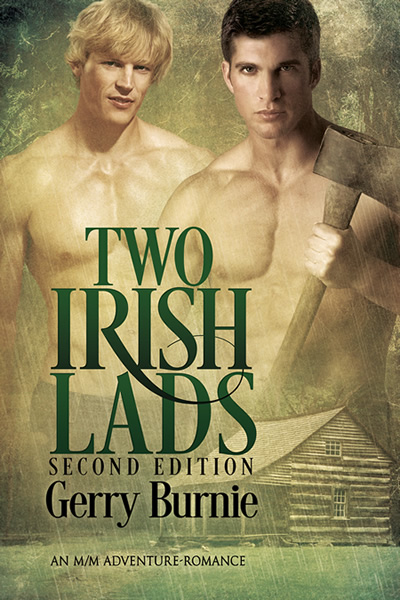
Available on Amazon in Print. Kindle, and Nook formats
WATCH FOR IT!
What happens when Two Irish Lads set off for an adventure of a lifetime in the wildness of Upper Canada?
Adventure, discovery, comedy, and pathos!
From the time Cousins Sean and Patrick McConaghy board the Lovely Nelly in Ireland, travel up the Mighty St. Lawrence by voyageur canoe, and find themselves surrounded by primeval forest in Upper Canada, it is adventure and discovery on every +page.
Then, just as they are about to despair at the seemingly impossible task ahead, a champion appears in the person of a calculating squire with two unmarried daughters on hand. The problem is that Sean and Patrick are already in love – with one another. The scene is then set for an adventure of different kind.
Also appearing are a gossipy storekeeper; a hard-drinking blacksmith who befriends them; a talented but misunderstood schoolboy; a draconian priest; a sinister claim jumper who haunts the vicinity; and a loveable wolf cub by the name of “Canada.”
Adventure awaits at every turn in Two Irish Lads: Second Edition, so come along for the fun of it!


click on cover to order.
Story blurb: The American West, especially between 1865 and the turn of the century, was an unforgiving and brutal place to be. Tempers flared as men continued to fight the Civil War on their own terms long after it had been decided. Meanwhile, natives, such as the Lakota Sioux, continued to resist being dispelled from their homelands. The Thunderhead trilogy is a historically accurate approach to the western genre. It is mixed with real and imaginary characters and takes place in the Dakota and Wyoming Territories between 1876 and 1877. Wild Bill Hickok, Calamity Jane, Jack McCall, Colorado Charlie Utter, California Joe Milner, Tim Brady, Wyatt Earp, and other figures are alive and well amid three fictional protagonists. Al Franklin, a photograph artist, befriends Hickok during his last days. “Spittoon” Nicky, a sporting girl, falls for an outlaw and follows him and his cohorts from mining town to mining town. Harvey McCafferty, a bounty hunter, relentlessly endeavors to collect the reward on those traveling with Nicky. Nicky’s companions are a gang of road agents lead by the bloodthirsty Quick Maggie DeMarco, a formerly-abused young woman hellbent on finding and killing the man who murdered her family fourteen years ago. When Maggie DeMarco finally meets up with Maguire in Book Three, will she seek the revenge that has eluded her, or will she be content to walk away?

Review by Gerry Burnie
I received a call to review this book sometime ago, but regretfully it is only now that I have had a chance to read it. I say ‘regretfully’ because Thunderhead, Book One: Tales of Love, Honor, and Vengeance in the Historic American West by B A Braxton is such rich and luscious reading that I am surprised it hasn’t attracted more attention.
The story is an amalgam of fiction and history, with a slight bias toward history – especially the three primary characters: Al Franklin, a photograph artist, “Spittoon” Nicky, a sporting girl, and Harvey M. McCafferty, a bounty hunter.
What jumps out at you right from the beginning is the due research Ms Braxtion has compiled behind the scenes. It is evident in every character, and frequently in the background scenes as well. This may have intimidated others, but it is very much my cup of tea.
Al Franklin is a hard-working 20-year-old who has made his way from Boston to Deadwood, South Dakota, during the summer of 1876. Al is a talented ambrotype photographer, and is met with all types people, outlaws as well, eager to have their likenesses taken. When Wild Bill Hickok comes to town at the same time as Calamity Jane and Colorado Charlie Utter, Al devises a money-making scheme with Bill to put his picture on cabinet cards to sell to the eager citizens in town. Because of Wild Bill’s reputation as a shootist, a law officer, and one of the stars of Buffalo Bill Cody’s show, the cabinet cards sell very well. And thus a friendship is established between them during Wild Bill’s final days.
“Spittoon” Nicky is a sporting girl who plies her trade out of a saloon called Hootie’s Lager House. Nicky meets up with an outlaw named Chad DeMarco and they fall in love. However, when things get too dangerous for him in Deadwood, Chad asks Nicky to travel with him and his cohorts so they can stay together. The most brutal and bloodthirsty of Chad’s companions is his sister Maggie who seems to live just to find the man who murdered her mother and father when she was very young.
Harvey McCafferty is a former Confederate soldier, now a bounty hunter, whose driving force in life is to get rich as quick. He therefor sets his sights on tracking down the DeMarco gang for the considerable bounty on their heads: Chad, Luke, Ray, and Otto, and in Harvey’s mind, dead or alive usually means dead.
Written in a colourful vernacular that matches the rustic time and setting, it is an enthralling story in the classic western style. Four and a half bees.
♠♠♠
Viewers to Gerry B’s Book Reviews – 78,678
♠♠♠
Interested in Canadian history?
Want to learn more? Then visit my new page: In Praise of Canadian History. It is a collection of people, facts and events in Canadian history, and includes ba ibliography of interesting Canadian books as well. Latest post: Keish (“Kaysh”): “Skookum Jim” Mason: co-discoverer of the Klondike gold.

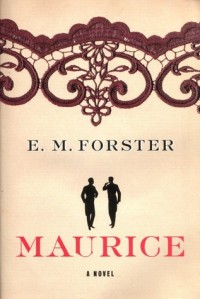
Click on cover to order.
Set in the elegant Edwardian world of Cambridge undergraduate life, this story by a master novelist introduces us to Maurice Hall when he is fourteen. We follow him through public school and Cambridge, and on into his father’s firm, Hill and Hall, Stock Brokers. In a highly structured society, Maurice is a conventional young man in almost every way, “stepping into the niche that England had prepared for him”: except that his is homosexual.
Written during 1913 and 1914, after an interlude of writer’s block following the publication of Howards End, and not published until 1971, Maurice was ahead of its time in its theme and in its affirmation that love between men can be happy. “Happiness,” Forster wrote, “is its keynote….In Maurice I tried to create a character who was completely unlike myself or what I supposed myself to be: someone handsome, healthy, bodily attractive, mentally torpid, not a bad businessman and rather a snob. Into this mixture I dropped an ingredient that puzzles him, wakes him up, torments him and finally saves him.”
Review by Gerry Burnie
I chose this timeless classic to emphasize that a story does not lose its enjoyment factor with old age. Moreover, it does not lose its genuine respect or literary value because it deals with adolescent youth; at least to start.
Maurice, by E.M. Forster [W. W. Norton & Company, 2005 (first published 1971)] has been reviewed from every angle imaginable, and yet one can still find interesting things to say about it: The adherence to time and place (Edwardian England), the depth of the characters, the subtle genius of the plot, and the smoothness of line and phrase. It is all there like a textbook for the young –or old- author to follow.
Regarding the time and place, it is very Edwardian: Stolid, staid, regimented, and a bit pompous – A place for everyone, and everyone in their place.
This describes Maurice as well. He’s conservative, a bit of a snob, not very interested in the muses and rather dull. Indeed, he’s ‘every man’ except that he’s living with a secret that affects his entire life. And the story is how he deals with it in his secretive relationship with his Cambridge friend Clive Durham.
That relationship stalls at intimacy – a wall that says “no further.” Instead, Clive chooses a ‘respectable’ marriage – albeit, somewhat loveless – leaving Maurice even more confused regarding the secret he harbours inside him.
It is perhaps for this reason that he finds himself in the arms of Scudder, the gamekeeper. A crossing of social class lines, for certain, but Scudder’s simple acceptance of his homosexuality is a revelation to Maurice – one he needs to experience – but before he can reach that point he goes through a personal hell, looking at his sexual orientation as an abomination, a disease that has no cure. This would be all quite normal for the day and age, including the angst of class difference, but Forester ingeniously works the plot around to achieve a happy ending.
This was a book written well before its time. The style of English is so refreshing: A style and mastery that has been long since forgotten. It flows and melts coming from an era where every word was carefully picked and every sentence construction built with precision.
There are, of course, no explicit sex scenes, but the artistry of words more than makes up for it. Highly recommended: Five bees.
♠♠♠
Viewers to Gerry B’s Book Reviews – 78,507
♠♠♠
Interested in Canadian history?
Want to learn more? Then visit my new page: In Praise of Canadian History. It is a collection of people, facts and events in Canadian history, and includes a bibliography of interesting Canadian books as well. Latest post: Keish (“Kaysh”): “Skookum Jim” Mason: co-discoverer of the Klondike gold.

Click on the logo to learn about my books to datre
Notice to all those who have requested a book review Thank you for your interest, and my apologies for not responding to your request individually. I’m getting there, but the numbers have been overwhelming. Please extend your patience just a bit longer. Thanks again!
Thanks for dropping by! I’ll have another novel ready for next week, same URL, so drop back soon.

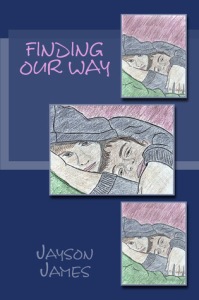
Click on the cover to order.
Justin Parker and Derrick Wilson have been best friends since meeting back in middle school. Currently they are in their junior year at Chandler High School, and living the good life as teenagers. They have great girlfriends, plenty of close friends, their own cars, and parents who are well off. As nice as things might look to an outsider, something is missing from each of their lives.
Justin has become the invisible son in the midst of his parents failing marriage. In an effort to get his parent’s attention, Justin keeps getting into trouble. So far he has been able to get away with anything without facing any repercussions, while Derrick is feeling distant and tired of what he feels is a too “perfect family”. He just wants to have a normal social life and spend time with his friends without the pressures from his family to spend time with them. With blurring the lines of friendship in the process to realizing what was missing and discovering who they really are.
Justin and Derrick take turns narrating the story of their junior year in high school and all of the events that take place in their lives. Being a teenager can be tough. Being gay can be tougher. For Derrick and Justin they are both, and life cannot get any more complicated.
What happens when two best friends cross the boundaries of friendship? Will they be able to be happy together? Will they keep their secret?
Review by Gerry Burnie
Ah, the sweet adventures of youth.
That about sums up –in a positive way – Jayson James’ debut novel, Finding Our Way (Finding Our Way #1) [Published February 25th 2013 by CreateSpace Independent Publishing Platform].
There is little in the way of uniqueness about the plot – the theme of burgeoning love has been worked and reworked from every imaginable angle; however, it is James’ ability to capture the wonderment of it, as seen from the perspective of two boys, that makes it appealing.
The devices he uses are quite effective: A tentative, step-by-step-pace; shifting narrative voices; and the ultimate realization of what they have created, all work to keep the plot credible. I also liked the way he muted the angst to a believable level.
From a personal perspective, I liked the scene where they made out in the back seat of a car: Many happy memories there.
There are a few editing problems, but nothing major. Four stars.
♠♠♠
Viewers to Gerry B’s Book Reviews – 78,417
♠♠♠
Interested in Canadian history?
Want to learn more? Then visit my new page: In Praise of Canadian History. It is a collection of people, facts and events in Canadian history, and includes a bibliography of interesting Canadian books as well. Latest post: Keish (“Kaysh”): “Skookum Jim” Mason: co-discoverer of the Klondike gold.

Click on the logo to learn about my books to datre
Notice to all those who have requested a book review Thank you for your interest, and my apologies for not responding to your request individually. I’m getting there, but the numbers have been overwhelming. Please extend your patience just a bit longer. Thanks again!
Thanks for dropping by! I’ll have another novel ready for next week, same URL, so drop back soon.

Clockmaker by day and thief by night, Arthur Winfield is used to charming his way into the homes and pocket books of London’s wealthiest patrons. He robs the rich to fund projects designed to help those in need and uses the nobility of his goal as an excuse for the continuation of his thieving. Little does he know that his latest mark may well be his last.
Lord Percival Brien’s wealth has acquired him a reputation for being one of the richest men in London. Solicited to ferret out the thief who robbed his uncle, he walks into Arthur’s shop with one purpose: divining whether or not the man he is looking for is the pretty-faced clockmaker in front of him. As he builds a friendship with Arthur, he may find that their tastes run to more intimate tracks than steam trolleys and airships.
817 kb, 47 pages.
Review by Gerry Burnie
What in hell is ’streampunk?’
Anyway, whatever it is, Clockwork Romance by Skye Dragen [Starving Artists Ink; 2 edition, May 10, 2015] apparently is an example.
Not being conversant ith these trendy labels, and even less of an adherent, I simply found it a short read – which suited my hectic schedule this week – and reasonably creative.
Arthur Winfield is a clever clockmaker, which talent he uses to bemuse wealthy patrons sometime in the 19th century. Once inside their defences, he then pilfers a bauble or two for the benefit of the poor (a sort of Edwardian Robin Hood.)
Meanwhile, along comes Lord Percival Brien, an amateur sleuth, who is on the trail of a thief who robbed his uncle. Needless to say, Arthur and Lord Percival develop an attraction for one another, but the stumbling block is set in place when Arthur’s sideline is revealed. The story then becomes one of finding a compromise that the two men can live happily ever after with.
It is a bemusing little story. The writing is smooth, and the clockmaker’s trade is one that hasn’t been used before in my experience. Four bees.
♠♠♠
Viewers to Gerry B’s Book Reviews – 78,278
♠♠♠
Interested in Canadian history?
Want to learn more? Then visit my new page: In Praise of Canadian History. It is a collection of people, facts and events in Canadian history, and includes a bibliography of interesting Canadian books as well. Latest post: A Tribute to the Husky Dog… An educational film made by the Province of Ontario in 1925.

Click on the logo to learn about my books to datre
Notice to all those who have requested a book review Thank you for your interest, and my apologies for not responding to your request individually. I’m getting there, but the numbers have been overwhelming. Please extend your patience just a bit longer. Thanks again!
Thanks for dropping by! I’ll have another novel ready for next week, same URL, so drop back soon.
He can run, but he can’t hide…
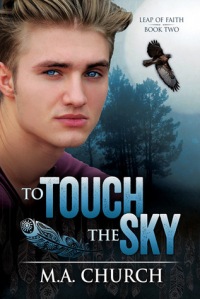
click on cover to order
Centuries ago, Hawk made a terrible mistake which has haunted him since. Fear of responsibility and feelings of unworthiness leads him to denying the mate Wha-tay showed him in a vision. So now Hawk runs his bar, has casual sex, and never, ever dates men with blond hair and brown eyes. But then Simon walks into his bar, and the future he’s feared is about to end up in a brawl if Hawk doesn’t do something—fast.
Simon Carter has a smart mouth and a bulldog temperament. So when Hawk runs, Simon pursues the sexy man, only to be rejected. Just as Simon decides to give up, someone—or something—visits him to change his mind… and scares him to death. Now Simon is backpedaling, and Hawk is in pursuit.
Desperate to reassure Simon and keep him safe, Hawk is forced to reveal his secrets before he’s ready. Can Simon learn to accept things aren’t always as they seem? Is the connection between them strong enough to help Hawk overcome centuries of pain? The only way the two men will move beyond Hawk’s past is for both of them to take a leap of faith.
Review by Gerry Burnie
I am always intrigued by Native American stories, particularly if they include some of the fascinating mythology that has been handed down for centuries. To Touch the Sky (Leap of Faith #2) by M.A. Church is one such a story.
The story opens in a time before the Europeans came to the land, and so the old ways prevailed. Hawk, or Chetan as he was called, was a hawk shifter – meaning he could transform himself into a hawk at will. However, he was also human, and that is where things went wrong when he spurned his mate Wha-tay, a blonde-haired, brown-eyed beauty.
Through the centuries Hawk has had time to regret his weakness, and so he has adopted a set of self-punishing standards that include not dating a blonde haired man with brown eyes.
That is … Until blonde-haired, brown-eyed Simon walked into his bar and his life. Simon is somewhat the opposite of Hawk inasmuch as he is a free spirit (few rules) and rejects the idea of being dominated.
Nonetheless, they gradually form a bond: First, by sharing men’s pursuits, and then by sex.
It is a gentle story with very little angst, and it moves along at a quiet pace. I would have liked to see more mythology – particularly as it applied to Hawk’s shifter abilities and his shifter clan – but that sort of thing may have in the author’s previous book. Four bees.
♠♠♠
Viewers to Gerry B’s Book Reviews – 78,162
♠♠♠
Interested in Canadian history?
Want to learn more? Then visit my new page: In Praise of Canadian History. It is a collection of people, facts and events in Canadian history, and includes a bibliography of interesting Canadian books as well. Latest post: A Tribute to the Husky Dog… An educational film made by the Province of Ontario in 1925.
Notice to all those who have requested a book review Thank you for your interest, and my apologies for not responding to your request individually. I’m getting there, but the numbers have been overwhelming. Please extend your patience just a bit longer. Thanks again!
Thanks for dropping by! I’ll have another novel ready for next week, same URL, so drop back soon.
Interesting Characters and engaging story
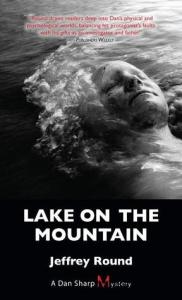
Click on cover to order.
Story Blurb: Dan Sharp, a gay father and missing persons investigator, accepts an invitation to a wedding on a yacht in Ontario’s Prince Edward County. It seems just the thing to bring Dan closer to his noncommittal partner, Bill, a respected medical professional with a penchant for sleazy after-hours clubs, cheap drugs, and rough sex. But the event doesn’t go exactly as planned.
When a member of the wedding party is swept overboard, a case of mistaken identity leads to confusion as the wrong person is reported missing. The hunt for a possible killer leads Dan deeper into the troubled waters and private lives of a family of rich WASPs and their secret world of privilege.
No sooner is that case resolved when a second one ends up on Dan’s desk. Dan is hired by an anonymous source to investigate the disappearance, twenty years earlier, of the groom’s father. The only clues are a missing bicycle and six horses mysteriously poisoned.
About the author: Jeffrey Round’s first Dan Sharp mystery, Lake on the Mountain, won the Lambda Literary Award in 2013. It was followed by Pumpkin Eater in 2014 and The Jade Butterfly in 2015. Jeffrey’s first two novels, A Cage of Bones and The P’town Murders, were listed on AfterElton’s Top 100 Gay Books. Jeffrey is also author of the Bradford Fairfax comic mysteries and a book of poetry, In the Museum of Leonardo da Vinci. His blog, A Writer’s Half-Life, has been syndicated online. He lives in Toronto.
Review by Gerry Burnie
As you are probably aware, I am a great promoter of Canadian books and authors, and so when I saw that Lake on the Mountain: A Dan Sharp Mystery (Dan Sharp Mystery #1) by Jeffrey Round [Dundurn, February 21, 2012] was set in Ontario, I naturally had to read it.
 For those of you not familiar with Prince Edward County, it is an almost island community located on the north shore of Lake Ontario near Bellleville, Ontario. It dates back to the American War of Independence when The United Empire Loyalists fled north to receive land from the British government. It is a jewel of a community featuring wine and history in equal portions.
The story is told from the point of view of Dan Sharp, a private investigator specializing in missing persons, and a gay, single father to a teenage son, Ked.
What I like about Dan is that he is a good man with flaws, and that makes him credible in my mind – especially since many of his flaws are understandable. He is a former graduate of the school of hard knocks, growing up gay in Sudbury, to un-approving parents, and then escaping to the streets of Toronto. Therefore, one can forgive him for his edginess and over-indulgence at times.
His love life isn’t so hot, either. He has been dating a doctor for about a year, but the medic is a bit of a tramp with a taste for raunchy clubs and after-hours hangouts.
Through it all, Dan maintains his decency and his duty to Ked; even though Ked returns his support to his father as well.
The plot takes place during on a wedding cruise on Lake Ontario, when one of the guests disappears overboard, and Dan is called upon to investigate a suspected murder. Nonetheless, the murder mystery is really secondary to Dan’s coming to grips with his personal ‘demons,’ which he inevitably does.
Mention should be made as well of the interesting characters one meets along the way. Jeffrey Round has a talent for developing notable characters, and this is no exception. Four bees.
♠♠♠
Viewers to Gerry B’s Book Reviews – 78,065
♠♠♠
Interested in Canadian history?
Want to learn more? Then visit my new page: In Praise of Canadian History. It is a collection of people, facts and events in Canadian history, and includes a bibliography of interesting Canadian books as well. Latest post: Marie-Anne Lagimodière (née Gaboury) –Grandmother of Louis Riel
Notice to all those who have requested a book review Thank you for your interest, and my apologies for not responding to your request individually. I’m getting there, but the numbers have been overwhelming. Please extend your patience just a bit longer. Thanks again!
A short story that is ahead of its time

 Story blurb: A warrior from the Northlands purchases a young man for purposes both secret and perhaps sinister.
About the author: A distinct voice in gay fiction, multi-award-winning author JOSH LANYON has been writing gay mystery, adventure and romance for over a decade. In addition to numerous short stories, novellas, and novels, Josh is the author of the critically acclaimed Adrien English series, including The Hell You Say, winner of the 2006 USABookNews awards for GLBT Fiction. Josh is an Eppie Award winner and a three-time Lambda Literary Award finalist.
Author’s note: Once upon a time, a long time ago, I really, really wanted to write fantasy and speculative fiction. This dusty little story was my first published attempt. I believe I had plans to follow Faro’s adventures in the Northlands over the course of several stories, but I think at this point we will just have to take it for granted that everything eventually worked out.
“Wizard’s Moon” is old school fantasy and certainly not what I would write these days, but I think it’s still sort of fun and I hope you enjoyed it.
Review by Gerry Burnie
Quite a while ago (June 2013) I reviewed Josh Lanyon’s Cards on The Table, and commented that it was, “Not too long, not too short, but just right!” Unfortunately, I can’t say the same thing about Wizard’s Moon [JustJoshin Publishing, Inc., March 8, 2015]. At 44-pages, for a story like this, it is just too short. In fact it is just too everything: Too dark, too angst-driven, too under-develop, and too sketchy.
I agree with one other reviewer who observed that perhaps this story shouldn’t have been released in its present form. You are as good as your last book, and for anyone but an established writer like Layon it could have been career damaging.
That said, the author did move the story along at a good pace, which kept the pages turning, and the promise of a good story was there with a bit more development, but it just wasn’t enough to fully satisfy.
To fill you in on the plot: Faro is a young slave working at a brothel as a servant and bookkeeper, but not one of the interns. He does have a casual affair with the keeper until he is sold to the Jaxom – a warrior from ‘The Northlands.’
The high king has died, and now the kingdom has been divided into a number of mini-kingdoms, and from the time of his arrival Faro is thrust into an atmosphere of murder and intrigue.
Things resolve by the ending of the story, but it leaves the reader wanting. Two and one-half bees, which I will round up to three because it is Lanyon.
♠♠♠
Viewers to Gerry B’s Book Reviews – 77,931
♠♠♠
Interested in Canadian history?
Want to learn more? Then visit my new page: In Praise of Canadian History. It is a collection of people, facts and events in Canadian history, and includes a bibliography of interesting Canadian books as well. Latest post: Marie-Anne Lagimodière (née Gaboury) – Grandmother of Louis Riel
Notice to all those who have requested a book review Thank you for your interest, and my apologies for not responding to your request individually. I’m getting there, but the numbers have been overwhelming. Please extend your patience just a bit longer. Thanks again!

click on cover to order.
Story blurb: When failed actor Cal Parsons travels to rural New York to claim the estate of his famous and estranged ex-partner he discovers something he wasn’t expecting…the ghost of his ex! And, worse, his ex invites Cal to join him for all eternity. Now. As Cal attempts to rid himself of the ghost by any means he begins to fall for the attractive attorney representing the estate. Will Cal be able to begin a new relationship or will he be seduced into the ever after?
About the author: Marshall Thornton is an award-winning novelist, playwright and screenwriter living in Long Beach, California. He is best known for the Boystown detective series, which has been short listed for a Rainbow Award three times and has been a finalist for the Lambda Award for gay mystery twice. Other novels include the erotic comedy The Perils of Praline, or the Amorous Adventures of a Southern Gentleman in Hollywood, The Ghost Slept Over and Full Release. Marshall has an MFA in screenwriting from UCLA, where he received the Carl David Memorial Fellowship and was recognized in the Samuel Goldwyn Writing awards. He has also had plays produced in both Chicago and Los Angeles and stories published in The James White Review and Frontier Magazine.
Review by Gerry Burnie
Those of you who follow this blog will know that I have been ruminating (ad nauseam) about the general lack of humour in GBLT literature, and then, lo-and-behold, along comes The Ghost Slept Over a romantic comedy by Marshall Thornton [Createspace, January 8, 2015]
Indeed, there is hardly any angst in it, whatsoever, but what there is n abundance is slightly farcical humour; loads of witty dialogue; and a zany cast of characters – including a B-rated actor, a self-centred ghost, and a small town lawyer.
The storyline revolves around Cal Parsons, the actor, but it is also shared with the other characters by giving them each a chapter.
Cal’s relationship with his ex, successful playwright McCormack Williams, broke up years ago when McCormack dumped him for a career in New York, so it is somewhat of a surprise when Cal learns that he in the sole beneficiary of MCormack’s estate.
The catch is that McCormack hasn’t quite moved out – not in the ordinary sense – and is still sort of hanging around, so-to-speak. Moreover, he wants Cal to join him in the hereafter.
Handling the estate is a small town lawyer, Dewey, who at first comes across as a bit staid; however, as the story progresses he gets with the programme – especially where Cal is concerned.
There is nothing particularly new about this plot line: The deceased lover who comes back to watch over their ex has been used several times before, but what makes this story fresh is the brilliantly written, witty dialogue. Not to mention the madcap mayhem that prevails throughout.
On the quibble side, the pace is somewhat uneven: Especially in the opening chapters; however, as the story progresses it picks up to a rollicking tempo.
I am also not a great fan of changing points of view or flashbacks, although I must say that in this case they almost work.
A great story, though, brilliantly written and a barrel of laughs. Four bees.
♠♠♠
Viewers to Gerry B’s Book Reviews – 77,821
♠♠♠
Interested in Canadian history?
Want to learn more? Then visit my new page: In Praise of Canadian History. It is a collection of people, facts and events in Canadian history, and includes a bibliography of interesting Canadian books as well. Latest post: Northern Dancer … The little horse that could.
Right now I’m listening to Swisssh Radio. Click on the banner ad to join me.

Swisssh online radio is where it’s at for promoting your products, big or small: World-wide coverage; 24/7; top professional service; and reasonable rates. Click on the logo to learn more.

For those of you who have requested a review. thank you for your interest, and my apologies for not responding to your request individually. I’m getting there, but the numbers have been overwhelming. Please extend your patience just a bit longer.Thanks again!
Thanks for dropping by. See you next week … Same time, same URL.
A credible rendering of a fascinating period in history.
 Story blurb: Martin Archer’s “The Archers” saga is set in rough and dangerous medieval Britain. It’s a dull and brutal place which forces many Englishmen to go abroad and join the crusades to escape their fates and seek their fortunes. It is based upon the tales and histories in the newly discovered parchments found under some rubble in the basement of the Bodleian Library.
The action packed books in “The English Archer” saga begin with “The Archer’s Quest.” It follows young man who joins a company of English archers when his older brother Thomas leaves the monastery to take him crusading with King Richard. Years later William himself is leading the company’s handful of survivors as they attempt to fight their way home past corrupt church officials and slave-taking Moslem pirates in a desperate effort to return to England.

Review by Gerry Burnie
While The Archer: A novel of medieval England (The Archers #1) by Martin Archer is listed under ‘gay adventure’ on Amazon, it must be working with a different definition of ‘gay’ than I am. Nonetheless, I was drawn by the fact that it is primarily a male adventure set in the medieval era around the time of crusades (1095 – 1291), one of my favourite periods in history, and also features a company of yeoman archers – one of my favourite set of characters as well.
The story takes the guise of a recently discovered chronicle that recalls the adventures of William, Captain of the English archers, as recorded by his friend and scribe Yoram of Damascus.
The tales are many, but for the most part they capture the essence of the time fairly well. The crusades were an ill conceived, poorly organized, avaricious campaign that had little to do with Christ, and more to do with wealth and plunder. Nonetheless, as the author emphasizes, they were a relief from the drudgery of toiling thanklessly for the divine right of kings, noblemen and clergy.
The fact that they were also a complete and utter disaster only adds to the literary possibilities.
My comments
As far as I can tell, the author has done his homework regarding the grottiness of the period, and I am glad to see he didn’t try to gloss it over in Hollywood style. Life was truly nasty, brutish, and short for the burdened classes, and the avarice of the upper classes didn’t help alleviate the situation.
That said, there are some editing issues, and at times the dialogue doesn’t fit the character – i.e. where the kid says “…My arse is sore.” Considering it is said in the presence of his uncle, a monk, the expression seems questionable.
Ancillary items
Product descriptions: Something I found off-putting about this book had nothing to do with the story itself; rather, it had to do with the business surrounding it. In my opinion, product descriptions (i.e. ‘blurbs’) should describe what readers can expect from the novel at hand – not all the other novels in an author’s repertoire.
And while we’re on the topic, generally, I’ll decide if a novel is ‘exciting’ or ‘action-packed,’ so hyperbole is utterly wasted on me until I have read the story.
♠♠♠
Viewers to Gerry B’s Book Reviews – 77,702
♠♠♠
Interested in Canadian history?
Want to learn more? Then visit my new page: In Praise of Canadian History. It is a collection of people, facts and events in Canadian history, and includes a bibliography of interesting Canadian books as well. Latest post: Northern Dancer … The little horse that could.
Right now I’m listening to Swisssh Radio. Click on the banner ad to join me.
Swisssh online radio is where it’s at for promoting your products, big or small: World-wide coverage; 24/7; top professional service; and reasonable rates. Click on the logo to learn more.
For those of you who have requested a review. thank you for your interest, and my apologies for not responding to your request individually. I’m getting there, but the numbers have been overwhelming. Please extend your patience just a bit longer.Thanks again!
A good read and well recommended.
Sequel to “Two Sides of the Same Coin.”
 Despite the celebrity their recent cracking of a cattle rustling ring has brought, Jeff Connelly and his partner, Mike Guidry, are ready to settle down and start the dude ranch they’ve always dreamed of. Following your dreams isn’t always easy, though-between a troubled new ranch hand who propositions Jeff and Mike’s past suddenly confronting him, emotions are already running high.
Then a sadistic serial killer nicknamed the West Coat Cutter starts slicing a trail though Jeff and Mike’s territory. As the body count rises, they begin to suspect that the killer may in fact be someone they know-a suspicion that is only strengthened by a sudden rash of threatening notes addressed to Jeff. Can they escape the West Coast Cutter before the worst happens?

Review by Gerry Burnie
I gave in to my love for western-genre novels this week, even though it is a contemporary version. Twisted (Lucky Jeff Ranch #2) by Jake Mactire [Dreamspinner Press; 1 edition, July 24, 2011] is a continuation of Mactire’s “Lucky Jeff Ranch” series, and, although I haven’t read Two Sides of the Same Coin, this sequel stood alone fairly well.
Jeff Donnelly became the proprietor of ‘Lucky Jeff Ranch’ upon the untimely death of his father in a car accident. Mike Guidry was one of the ranch hands who came with it, but eventually – after a number of adventures together – they became loving partners, and now they have plans afoot to convert ‘Lucky Jeff’ into a dude ranch.
Thus begins the adventures in Twisted.
To thicken the plot, a ranch hand by the name of Smitty asks if his younger brother (Jason) can come work with them. Gay and troubled, his brother wants to make a new start in a fresh environment, and Smitty feels that Jeff and Mike would make positive role models. Moreover, there is a recent threat that is stalking the gay community in town: A serial killer dubbed the ‘West Coast Cutter’ who is preying on gay men like Jason.
Then, unexpectedly, Mike’s father appears on the scene contritely making apologies for rejecting his son when he was sixteen. Jeff views this with a certain amount of scepticism, but for Mike’s sake he stands aside to allow him to reconnect with his estranged mother, brother and sister.
However, when a body is discovered nearby, there is no question the ‘West Coast Cutter’ is close at hand.
My comments
It is well written and easy to read: A good start.
The plot features some clever twists and turns (another plus), but for me it is clichéic. I think this is because it is angst driven – the gay but troubled brother; Mike’s expulsion from the family circle; the homophobic but contrite father – have all been done before.
I hasten to add that it is not a major issue, and it is subjective, but for someone who has read and analyzed over three hundred books for this blog, I thirst for something original – like comedy.
Nonetheless, it is a good read and well recommended. Four bees.
♠♠♠
Viewers to Gerry B’s Book Reviews – 77,594
♠♠♠
Interested in Canadian history?
Want to learn more? Then visit my new page: In Praise of Canadian History. It is a collection of people, facts and events in Canadian history, and includes a bibliography of interesting Canadian books as well. Latest post: Northern Dancer … The little horse that could.
Right now I’m listening to Swisssh Radio. Click on the banner ad to join me.
Swisssh online radio is where it’s at for promoting your products, big or small: World-wide coverage; 24/7; top professional service; and reasonable rates. Click on the logo to learn more.
|
Thank you for your interest, and my apologies for not responding to your request individually. I’m getting there, but the numbers have been overwhelming. Please extend your patience just a bit longer. Thanks again! |
Thanks for dropping by! I’ll have another novel ready for next week, same URL, so drop back then.
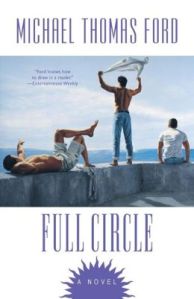
Click on cover to order
Story blurb: History professor Ned Brummel is living happily with his partner of twelve years in small-town Maine when he receives a phone call from his estranged friend–Jack–telling him that another friend–Andy–is very ill and possibly near death. It is news that shatters the peace of his world for many reasons. And as Ned boards a plane to Chicago on his way to his friend’s bedside, he embarks on a another journey into memory, examining the major events and small moments that have shaped his world and his relationships with two very different, very important men.
About the author: Michael Thomas Ford is the author of more than fifty books, for both young readers and adults, in genres ranging from humor to horror, literary fiction to nonfiction. As a writer for young adults he is the author of the popular “Circle of Three” series (writing as Isobel Bird); nonfiction books about spirituality (Paths of Faith), the AIDS crisis (Voices of AIDS), and the gay community (The World Out There and Speaking Out); and the novels Suicide Notes and Z (forthcoming in 2010).
His work for adult readers includes the best-selling novels Last Summer, Looking for It, Full Circle, Changing Tides, and What We Remember, and Jane Bites Back. His work has been nominated for 12 Lambda Literary Awards, twice winning for Best Humor Book, twice for Best Romance Novel, and most recently for Gay Men’s Mystery. He was also nominated for a Horror Writers Association Bram Stoker Award (for his novel The Dollhouse That Time Forgot) and a Gaylactic Spectrum Award (for his short story “Night of the Werepuss”).

Review by Gerry Burnie
I hadn’t read any previous novels by Michael Thomas Ford until I came across Full Circle [Kensington, August 1, 2007]. His credentials are certainly impressive, but what appealed to me is the era – the liberation movement of the sixties, to the AIDS epidemic of the 80s and 90s. My era exactly, so it was like a walk down memory lane.
It is told from the perspective of two men, involving a third, and through their eyes we experience the assassination of JFK; protests surrounding the Vietnam War, the Stonewall Riots, and the identification of the Acquired Immune Deficiency Syndrome (AIDS). Probably one of the most eventful chapters in gay-American life in the 20th century.
The writing is professional through-and-through, as one would expect from a 50-time published author, but what impressed me most was his seemingly effortless ability to balance the viewpoints (memories) of the three main characters – like a Troika – while remaining focussed on the events surrounding them.
It is truly a textbook example of in-control writing.
For those of you who were born in a later time, you are bound to find Ned and Jack’s reminiscences engaging, as are their personalities, and if you are students of history (as we all are, whether we like it or not) this is a history lesson I think you will enjoy. Five bees.
♠♠♠
Viewers to Gerry B’s Book Reviews – 77,458
♠♠♠
Interested in Canadian history?
Want to learn more? Then visit my new page: In Praise of Canadian History. It is a collection of people, facts and events in Canadian history, and includes a bibliography of interesting Canadian books as well. Latest post: Northern Dancer … The little horse that could.
Right now I’m listening to Swisssh Radio. Click on the banner ad to join me.

Swisssh online radio is where it’s at for promoting your products, big or small: World-wide coverage; 24/7; top professional service; and reasonable rates. Click on the logo to learn more.

| Thank you for your interest, and my apologies for not responding to your request individually. I’m getting there, but the numbers have been overwhelming. Please extend your patience just a bit longer. Thanks again! |
Thanks for dropping by! I’ll have another novel ready for next week, same URL, so drop back then.

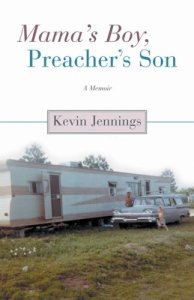
Click on ghd cover to order
Story blurb: Growing up poor in the South, Kevin Jennings learned a lot of things, especially about how to be a real man. When his father, a fundamentalist preacher, dropped dead at his son’s eighth birthday party, Kevin already knew he wasn’t supposed to cry.
He also knew there was no salvation for homosexuals, who weren’t “real men” – or Christians, for that matter. But Jennings found his salvation in school, inspired by his mother. Self-taught, from Appalachia, her formal education had ended in sixth grade, but she was determined that her son would be the first member of their extended family to go to college, even if it meant going North. Kevin, propelled by her dream, found a world beyond poverty. He earned a scholarship to Harvard and there learned not only about history and literature, but also that it was possible to live openly as a gay man.
But when Jennings discovered his vocation as a teacher and returned to high school to teach, he was forced back into the closet. He saw countless teachers and students struggling with their sexual orientation and desperately trying to hide their identity. For Jennings, coming out the second time was more complicated and much more important than the first–because this time he was leading a movement for justice.
Review by Gerry Burnie
| I’m a bit late tonight, folks. I Had an unexpected but important project pop up earlier in the day, so this review will be brief. |
Kevin Jenning’s life, as fascinatingly retold in Mama’s Boy, Preacher’s Son: A Memoir [Beacon Press, May 15, 2007], is a slice everyone’s life who grew up poor – and conscious of it: The clean but threadbare clothes; the avoidance of bringing your friends home; the white lies about how prosperous your father was; and the constant feeling of being ‘second-class’.
Jennings shares all of this for us to share, but throughout there is an ever-present love, and hope, and inspiration. His mother’s love and sacrifice, for example.
The other phenomenon that spoke to me is the drive to succeed that is so often manifested in poorer children: The will to be not only better, but to be the best at whatever they do. This was demonstrated by Jennings drive to win his scholarship to Harvard, and then to become a leader in the gay rights movement.
On the quibble side, I found it just a trifle self-indulgent in places. Not an unusual shortcoming in autobiographies. Four bees.
♠♠♠
Viewers to Gerry B’s Book Reviews – 77,337
♠♠♠
Interested in Canadian history?
Want to learn more? Then visit my new page: In Praise of Canadian History. It is a collection of people, facts and events in Canadian history, and includes a bibliography of interesting Canadian books as well. Latest post: Louis Cyr… The ‘strongest man in the world.’
Right now I’m listening to Swisssh Radio. Click on the banner ad to join me.
Swisssh online radio is where it’s at for promoting your products, big or small: World-wide coverage; 24/7; top professional service; and reasonable rates. Click on the logo to learn more.
Click on the logo to learn about my books to datre
| Thank you for your interest, and my apologies for not responding to your request individually. I’m getting there, but the numbers have been overwhelming. Please extend your patience just a bit longer. Thanks again! |
Thanks for dropping by! I’ll have another novel ready for next week, same URL, so drop back then.
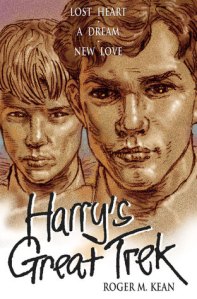
To order, click on the above cover.
What do you do when the person you have loved in secret since your schooldays finds happiness with another, leaving your heart bereft and your future a bleak, lonely prospect?
For Harry Smythe-Vane, junior officer serving in the British army at the end of the failed campaign to rescue Gordon of Khartoum from the Mahdist siege of 1885, finding childhood friends Richard and Edward united in love spells the end of a dream he knows was doomed from the start—more so, a dream condemned by society at large: the love of two men for each other.
Harry must now pluck up the courage to pursue an uncertain quest for an elusive new soulmate—his great trek to attain fulfillment.
From dangerous missions on India’s wild North-West Frontier to the deserts of Sudan, Harry forges a career and experiences fleeting friendships, but when a spell of leave takes him to London his heart is struck. He meets his almost-forgotten godson Jolyon Langrish-Smith, a troubled teenager in Oscar Wilde’s louche circle. It’s an encounter that pitches Harry headlong on a turbulent journey of emotional involvement, of hurt and joy.
Painting a vivid panorama of the British Empire at its height, with its multi-faceted but rigid society hovering on the brink of change, Harry’s Great Trek is an epic saga of love and war—alive with an engaging cast of the humble and the famous, the honorable and the scoundrels—which climaxes in 1900 amid the carnage of the Boer War. There Harry’s future is decided as one quest ends and a new journey begins…
Review by Gerry Burnie
One of the most grievously overlooked genres in GBLT fiction is ‘the gay adventure story’. That is not to say there are none. There are – and good ones, too – but they are few and far between.
One of the best writers in this genre is Roger Kean, and his latest offering Harry’s Great Trek (The Empire Series #3) [Reckless Books, February 1st 2015] is proof positive of this estimation.
His Empire Series has taken us through the hot spots of Imperial Britain’s golden age of domination and plunder (always for ‘their’ own good, of course.) Nevertheless, it remains one of my favourite eras for an overall commitment to ‘God and Empire’. It is probably the last example of a people willingly committed to a state that was ‘politely’ corrupt and exploitive, through-and through.
The blurb provides as good a synopsis of the story as I could write; therefore, I will contain my comments to some of the highlights as I see them.
First of all, I like the cover art and design by Oliver Frey. It has a rugged, masculine look about it that suits this type of novel. With a few notable eceptions, adventure novels tend to be written by male authors, and so anything less rugged wouldn’t have met my expectations.
I also love Kean’s choice of names, i.e. Harry Smythe-Vane, and Jolyon Langrish-Smith. How delicious zany! I have often observed that authors don’t give enough attention to names – especially historical names – but these certainly do add a ‘stuffiness’ to the era that fits.
The introduction of certain celebrities of the day – especially young Winston Churchill – added a whole new dimension to the already interesting historical events. There are also some who also say that Baden-Powell had an interest in boys beyond scouting, and so these characters can add wonderful fodder to a story.
The writing is, of course, top notch (if, perhaps, a bit over-expansive), and so I am going to award this novel with a five-bee rating.
♠♠♠
Viewers to Gerry B’s Book Reviews – 77,162
♠♠♠
Interested in Canadian history?
Want to learn more? Then visit my new page: In Praise of Canadian History. It is a collection of people, facts and events in Canadian history, and includes a bibliography of interesting Canadian books as well. Latest post: Louis Cyr… The ‘strongest man in the world.’

Swisssh online radio is where it’s at for promoting your products, big or small: World-wide coverage; 24/7; top professional service; and reasonable rates. Click on the logo to learn more.

Click on the logo to learn about my books to date
| Thank you for your interest, and my apologies for not responding to your request individually. I’m getting there, but the numbers have been overwhelming. Please extend your patience just a bit longer. Thanks again! |
Thanks for dropping by! I’ll have another novel ready for next week, same URL, so drop back then.
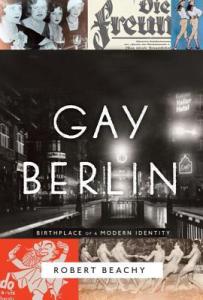
Click on cover to order
Synopsis: An unprecedented examination of the ways in which the uninhibited urban sexuality, sexual experimentation, and medical advances of pre-Weimar Berlin created and molded our modern understanding of sexual orientation and gay identity.
Known already in the 1850s for the friendly company of its “warm brothers” (German slang for men who love other men), Berlin, before the turn of the twentieth century, became a place where scholars, activists, and medical professionals could explore and begin to educate both themselves and Europe about new and emerging sexual identities. From Karl Heinrich Ulrichs, a German activist described by some as the first openly gay man, to the world of Berlin’s vast homosexual subcultures, to a major sex scandal that enraptured the daily newspapers and shook the court of Emperor William II—and on through some of the very first sex reassignment surgeries—Robert Beachy uncovers the long-forgotten events and characters that continue to shape and influence the way we think of sexuality today.
Chapter by chapter Beachy’s scholarship illuminates forgotten firsts, including the life and work of Dr. Magnus Hirschfeld, first to claim (in 1896) that same-sex desire is an immutable, biologically determined characteristic, and founder of the Institute for Sexual Science. Though raided and closed down by the Nazis in 1933, the institute served as, among other things, “a veritable incubator for the science of tran-sexuality,” scene of one of the world’s first sex reassignment surgeries. Fascinating, surprising, and informative—Gay Berlin is certain to be counted as a foundational cultural examination of human sexuality.
About the author: Robert Beachy (born January 5, 1965, Aibonito, Puerto Rico) is associate professor of history at Goucher College in Baltimore, Maryland. He received his Ph.D. from the University of Chicago in 1998. Beachy specializes in the intellectual and cultural history of Germany and Europe, and is known for his work on the history of sexuality in the Weimar Republic, under the Nazis, and in Germany after the Second World War. ~ Wikipedia.
Review by Gerry Burnie
While many think that ‘gay openness’ had its naissance with Oscar Wilde, or perhaps “Stonewall” or the “Bathhouse Raids” in Toronto, Canada, but Robert Beachy makes the very convincing case in Gay Berlin: Birthplace of a Modern Identity [Knopf; 1st edition, November 18, 2014] that it actually started in Prussia as early as the 1860s.
Along the way he reveals a fascinating history of pre-Weimar Germany, refuge for notables like Christopher Isherwood, etc. Indeed, the first spokesman for gay rights was almost unquestionably a lawyer by the name of Karl Heinrich Ulrichs. In a speech before Sixth Congress of German Jurists, he urged the repeal of laws forbidding sex between men.
Outrage followed, but not to the degree that one might have expected, and so the wedge of liberation had been introduced.
What followed was quite extraordinary (for the time), and has been admirably synopsized by Alex Ross of the The New Yorker magazine, January 26, 2015:
In 1869, an Austrian littérateur named Karl Maria Kertbeny, who was also opposed to sodomy laws, coined the term “homosexuality.” In the eighteen-eighties, a Berlin police commissioner gave up prosecuting gay bars and instead instituted a policy of bemused tolerance, going so far as to lead tours of a growing demimonde. In 1896, Der Eigene (“The Self-Owning”), the first gay magazine, began publication. The next year, the physician Magnus Hirschfeld founded the Scientific-Humanitarian Committee, the first gay-rights organization. By the beginning of the twentieth century, a canon of gay literature had emerged (one early advocate used the phrase “Staying silent is death,” nearly a century before AIDS activists coined the slogan “Silence = Death”); activists were bemoaning negative depictions of homosexuality (Thomas Mann’s “Death in Venice” was one target); there were debates over the ethics of outing; and a schism opened between an inclusive, mainstream faction and a more riotous, anarchistic wing. In the nineteen-twenties, with gay films and pop songs in circulation, a mass movement seemed at hand. In 1929, the Reichstag moved toward the decriminalization of homosexuality, although the chaos caused by that fall’s stock-market crash prevented a final vote.
Magnus Hirschfeld and two cross-dressers, outside the Institute for Sexual Science.
High praise is reserved by Beachy for the aforementioned Magnus Hirschfeld. A year before his founding of the Scientific-Humanitarian Committee, Hirschfield able disappear. “Through Science to Justice” was his group’s motto.
During the arguably ‘golden years’ preceding 1933, when Adolf Hitler became Chancellor, gays and lesbians achieved an almost unprecedented level of visibility not seen since Grecian era. in popular culture. They could see themselves onscreen in films like “Different from the Others”—a tale of a gay violinist driven to suicide, with Hirschfeld featured in the supporting role of a wise sexologist.
Pejorative representations of gay life were not only lamented but also protested; Beachy points out that when a 1927 Komische Oper revue called “Strictly Forbidden” mocked gay men as effeminate, a demonstration at the theatre prompted the Komische Oper to remove the offending skit.
Altogether, it is a most fascinating and informative read. Five bees.
♠♠♠
Viewers to Gerry B’s Book Reviews – 77,010
♠♠♠
Interested in Canadian history?
Want to learn more? Then visit my new page: In Praise of Canadian History. It is a collection of people, facts and events in Canadian history, and includes a bibliography of interesting Canadian books as well. Latest post: The Great Rogers Pass Avalanche – March 4, 1910
Swisssh online radio is where it’s at for promoting your products, big or small: World-wide coverage; 24/7; top professional service; and reasonable rates. Click on the logo to learn more.

Ciick on ad to purchase. Also available in Kindle format.
| Thank you for your interest, and my apologies for not responding to your request individually. I’m getting there, but the numbers have been overwhelming. Please extend your patience just a bit longer. Thanks again! |
Thanks for dropping by! I’ll have another novel ready for next week, same URL, so drop back then.

| This is a bargain book on Amazon, with prices ranging from .01¢ to $1.00. Bargain books are new but could include a small mark from the publisher and an Amazon.com price sticker identifying them as such. Details |

click on the above cover to order.
Story blurb: Lust. Infidelity. Betrayal. Murder. On a summer evening in Stratford, Ontario, the errant thrust of a gardener’s spade slices a telephone cable into instant silence. The resulting disconnection is devastating. With the failure of one call to reach a house, an ambitious young actor becomes the victim of sexual blackmail. The blocking of a second call leads tragically to murder. And when a Bell Canada repairman arrives to mend the broken line, his innocent yet irresistible male beauty has explosive consequences.
In Spadework, Timothy Findley, master storyteller and playwright, has created an electric wordplay of infidelity and morality set on the stage of Canada’s preeminent theater town. In this fictional portrait, intrigue, passion, and ambition are always waiting in the wings. Findley peoples the town with theater folk, artists, writers, and visitors (both welcome and unwelcome), and with lives that are immediately recognizable as “Findley-esque” – the lonely, the dispossessed, and the sexually troubled.
A story that ripples with ever-widening repercussions, a sensual, witty, and completely absorbing novel, Spadework is another Timothy Findley winner.
About the author: Timothy Irving Frederick Findley (October 30, 1930 – June 21, 2002) was a Canadian novelist and playwright. He was also informally known by the nickname “Tiff” or “Tiffy,” an acronym of his initials.
He was raised in the upper class Rosedale district of Toronto, attending boarding school at St. Andrew’s College (although leaving during grade 10 for health reasons). He pursued a career in the arts, studying dance and acting, and had significant success as an actor before turning to writing. He was part of the original Stratford Festival Company in the 1950s, acting alongside Alec Guinness, and appeared in the first production of Thornton Wilder’s The Matchmaker at the Edinburgh Festival. He also played Peter Pupkin in Sunshine Sketches, the CBC Television adaptation of Stephen Leacock’s Sunshine Sketches of a Little Town.
Findley’s first two novels, The Last of the Crazy People (1967) and The Butterfly Plague (1969), were originally published in Britain and the United States after having been rejected by Canadian publishers. Findley’s third novel, The Wars, was published to great acclaim in 1977 and went on to win the Governor General’s Award for English-language fiction. It was adapted for film in 1981.
Timothy Findley received a Governor General’s Award, the Canadian Authors Association Award, an ACTRA Award, the Order of Ontario, the Ontario Trillium Award, and in 1985 he was appointed an Officer of the Order of Canada. He was a founding member and chair of the Writers’ Union of Canada, and a president of the Canadian chapter of PEN International.
Review by Gerry Burnie
As you can readily see, I went looking for Canadian content this week, and it doesn’t get any more Canadian than the late and lamented Timothy Findley.
Originally published by Harper Collins in 2001 (a year before Findley’s death), Spadework by Timothy Findley is set in the otherwise quaint little town of Stratford, Ontario [home of the Stratford Shakespearean Festival], and is primarily told from the point of view of Jane Kincaid, a southerner from Louisiana. She left the south to escape her conservative-minded family, and also adopted an new persona when she met her husband, Griffin Kincaid.
Griffin is a hunk, and also a rising young Shakespearean actor. Otherwise, they lead quite an ordinary, suburban life, with an ordinary house, a kid, a live-in housekeeper/nanny, and a dog named “Rudyard.”
Nevertheless, Griffin’s ‘hunkyness’ is the catalyst that gives rise to a number strange (bizarre) events. Jane begins to suspect other women might be coveting him as well: principally Zoë Walker, his on-stage partner.
Meanwhile, one of Jane’s former boyfriends shows up to jerk off all over her face and dress, and then goes out to be killed in a car accident. In addition, the town is stunned by the shocking rape and murder of two women by an addict, Jesse Quinlan, who (because he cannot reach his support in life, his nephew Luke – the gardener who severed the telephone line) he goes on a drug-fuelled rampage until he takes his own life. And, if all this wasn’t enough, Jane receives a cryptic letter from her mother to say her sister has recently committed suicide.
In some way lack of communication figures into all these events, but the crucial stroke comes when the gardener Luke inadvertently plunges a spade through the main communication line. Thus, his uncle Jesse has his meltdown, but, in addition Griffin cannot reach his director, Johnathon Crawford, with his answer to an ultimatum – the ultimatum being that he either enter into a sexual relationship with Crawford or lose out on a coveted, leading role.
The result is that he loses out, but he agrees when he is offered a second meeting with Crawford.
Meanwhile, a veritable Adonis of a telephone repairman has arrived on Jane’s scene, and in no time has agreed to pose for a nude portrait.
Lack of communication and sexual desires figure prominently in this novel, but in spite of the resulting chaos things do settle down with a return to a happy ever after ending.
My thoughts
Findley’s prestigious awards speak for themselves. He was a brilliant writer, and there are flashes of this in Spadework, but considering that it was published so close to his death I cannot help speculating there might have been other things on his mind.
It’s only a hunch, but this, his last novel, seems rushed to me: As though finishing it was the overriding priority.
Mind you, it is still a good read with all of Findley’s intricate plot twists present, and for the embarrassingly low price of .01¢ you can hardly go wrong. Three bees.
♠♠♠
Viewers to Gerry B’s Book Reviews – 76,732
♠♠♠
Interested in Canadian history?
Want to learn more? Then visit my new page: In Praise of Canadian History. It is a collection of people, facts and events in Canadian history, and includes a bibliography of interesting Canadian books as well. Latest post: The Great Rogers Pass Avalanche – March 4, 1910

Theatre Orillia is a community based theatre company located in Orillia, Ontario – the setting of Stephen Leacock’s Sunshine Sketches of a Small Town. As is not usual for community theatres, it could use a helping hand, financially. If you would care to be a theatre ‘angel’, just navigate to the following URL: https://www.kickstarter.com/projects/886814721/theatre-orillia-summer-season-2015?ref=email.

Click on the logo to learn about my books to datre
| Thank you for your interest, and my apologies for not responding to your request individually. I’m getting there, but the numbers have been overwhelming. Please extend your patience just a bit longer. Thanks again! |
Thanks for dropping by! I’ll have another novel ready for next week, same URL, so drop back then.
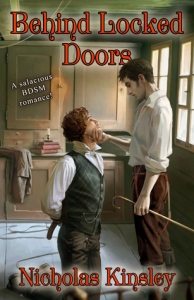
click on the above cover to purchase.
Story blurb: Edward Taylor is a man torn between his honourable façade and his forbidden carnal desires. Outwardly a proper Victorian family man, Edward secretly craves pain and lusts after men. Isaac Sinclair is a struggling writer forced by poverty to supplement his income with less savory pursuits, including discreetly inflicting “professional punishments” upon wealthy gentlemen. When Edward catches Isaac in an act of petty theft, the chance meeting seems to offer an ideal opportunity for both men. Neither man, however, is prepared for the escalation of social and personal risk occasioned by falling in love.
About the author: Nick Kinsley has been writing since a very young age. After going through school focused on computer science, he discovered that he would rather be a professional author. He grew up with few friends and a love of books, and hopes to create worlds in which others can find enjoyment. Kinsley currently attends community college in Maryland and plans to study abroad and major in Literature. He also plays guitar, and loves music.
Review by Gerry Burnie
Bondage, Domination, Submission and Masochism (BDSM), seems to be quite popular these days – due to the release of a movie based on that other BDSM book (which I read, but chose not to review), so I decided to offer one that is a superior story in many ways.
Behind Locked Doors by Nicholas Kinsley [Fantastic Fiction Publishing, February 17, 2015] is Kinsley’s debut novel, and a worthy effort it is, too. I would also add that I classify it as “sexy” as apposed to “hard-core” S&M.
Edward Taylor is a respected Edwardian, upper-middle class gentlemen, although he was born a bastard. However, because his biological father did the right thing, he is now a prosperous factory owner with money enough for dalliances – like Isaac Sinclair, a struggling writer who supports his ‘addiction’ by servicing gentlemen with special, exotic pleasures – i.e. BDSM.
His chance encounter with Sinclair comes about when he witnesses the latter stealing bread, and in a rather mutually agreed arrangement he coerces Sinclair into partaking of his services.
This continues, commercially at first, but as time goes by it becomes deeper – emotionally – until they are both inextricably in love.
Complicating matters is the fact that Taylor is married with a son. It is a rather odd arrangement whereby he married a French girl on a fling in Paris, thinking he would have to marry eventually – for appearances sake as much as anything else – and out of it came a somewhat estranged son.
The son is a sub-plot, for in loving Sinclair he also learns to love his son.
Overall, it is an engrossing story with strong main characters. Both Taylor and Sinclair are credible, and the story is plot-driven as apposed to sliding along on a stream of sperm. Likewise, the S&M is judiciously used as a piquant, rather than a gratuitous kink.
The insights into 19th-century mores are also well created, which suggests some research.
On the quibble side, flashbacks (retro-views) are tricky. I’ve read dozens of books that have used them, but only a few have done it well. I can’t say don’t use them, because it depends on how necessary the past is to explain the present, but otherwise use some other device, like a prologue.
Another quibble is the ‘fee’ Sinclair apparently charged for his services. Fifty pounds in the 19th century was a significant amount of money. For example, a skilled engineer might earn £110 per year if fully employed.
Which, I suppose is the other lesson this review might bring: Write about flying monsters and horned aliens with impunity, but miss a fact by a day or an inch and someone is bound to catch you up on it.
A solid read. Four bees.
♠♠♠
Viewers to Gerry B’s Book Reviews – 76,510
♠♠♠
Interested in Canadian history?
Want to learn more? Then visit my new page: In Praise of Canadian History. It is a collection of people, facts and events in Canadian history, and includes a bibliography of interesting Canadian books as well. Latest post: Jay Silverheels – a.k.a. “Tonto”
Click on the logo to learn about my books to datre
| Thank you for your interest, and my apologies for not responding to your request individually. I’m getting there, but the numbers have been overwhelming. Please extend your patience just a bit longer. Thanks again! |
Thanks for dropping by! I’ll have another novel ready for next week, same URL, so drop back then.

Click on the above cover to purchse.
Story blurb: Dick Hardesty is pressed into service when someone starts burning down gay bars all over town and the police chief (nicknamed ‘the butcher’) shrugs the whole thing off. Then drag queens and female impersonators get into the act and Dick is required to sleuth out who is hot and who is not.
Also available in audio-book format.
About the author: If it is possible to have a split personality without being schizophrenic, Dorien Grey qualifies. When long-time book and magazine editor Roger Margason chose the pseudonym “Dorien Grey” for his first book, it set off a chain of circumstances which has led to the comfortable division of labor and responsibility. Roger has charge of day-to-day existence, freeing Dorien—with the help of Roger’s fingers—to write. It has reached the point where Roger merely sits back and reads the stories Dorien brings forth on the computer screen.
Review by Gerry Burnie
I’m feeling lazy this week, so it’s time to dip into my reserve pile of authors and books that ‘go without saying.’
Dorien Grey is one such author, and the introduction to his Dick Hardesty series, The Butcher’s Son [Untreed Reads, January 20, 2015], is the novel I have chosen.
As I have implied above, you really can’t go wrong with a Dorien Grey novel. The plot is generally clever, with well-conceived twists and turns, and his insightful witticisms are scattered like pearls along the way, i.e. “The voice was warm, sincere, and confident – the kind of voice that makes me want to check and see if my wallet’s still there.” For those of you who share my vintage, this line could be right out of the style of Mickey Spillane.
High praise indeed, for in my opinion the really good, popular mystery-writer’s craft, ended with him.
In this story, Hardesty is hired by a rather pretentious PR firm to ‘package’ a homophobic cop seeking election to the governor’s mansion. Quite a package, since this cop’s background includes a gay son who was murdered for his gayness, and another son who is a hell-fire-and-brimstone preacher dead set against homosexuals.
The ‘hell fire’ in this case starts seeping out to burn some of the most popular gay bars in town, and so Hardesty is drawn in to investigating these occurrences as well.
Not surprisingly, the cop and his son are prima facie suspects, and so the juxtaposition of Hardesty the PR person, and Hardesty the sleuth, forms an interesting twist to the story.
Masterfully written, as one might expect, I rate it as four and one-half bees.
♠♠♠
Viewers to Gerry B’s Book Reviews – 76,313
♠♠♠
Interested in Canadian history?
Want to learn more? Then visit my new page: In Praise of Canadian History. It is a collection of people, facts and events in Canadian history, and includes a bibliography of interesting Canadian books as well. Latest post: Jay Silverheels – a.k.a. “Tonto”

Click on the logo to learn about my books to datre
| Thank you for your interest, and my apologies for not responding to your request individually. I’m getting there, but the numbers have been overwhelming. Please extend your patience just a bit longer. Thanks again! |
Thanks for dropping by! I’ll have another novel ready for next week, same URL, so drop back then.
Click on the above cover to purchase.
“A bigger fool the world has never known than I – a coarse fellow with no business to clutch a brush and scribble. I only know the scrawl, because my master took pleasure in teaching me between my chores. Not many men are so cursed . . .” Thus begins the tale of Li K’ai-men as told by his faithful, but mischievous servant, K’u Ko-ling – a tale of 12th Century China, where state service meant a life long journey across a landscape of turmoil and bliss. A tale of sacrifice, love, war and duty – a fragile balance between rituals and passions. Here begins the legacy of the Jade Owl and its custodian as he holds true to his warrants. The Academician is the first of four books in the Southern Swallow series, capturing the turbulence of the Sung Dynasty in transition. Spanning the silvery days under the Emperor Hui to the disasters that followed, The Academician is a slice of world events that should never have been forgotten.
Review by Gerry Burnie
I am always in the search of a unique story, that is a story or setting that is off the beaten path, and The Academician (Southern Swallow #1) by Edward C. Patterson has both.
Set in 12th century China, which in itself is unique enough, The Academician is also chock full of unique characters who, in their variety, resemble a Chinois tapestry of the same period.
The story of Li K’ai-men begins as a brilliant student, top of his class, who is challenged by his renowned master, Han Lin, to fulfill a number of missions. This he does successfully, and as a result he is elevated to the position of superintendent of Su Chou. Again, he proves his metal by restoring this neglected province to its former prosperity, which in turn catches the attention of the emperor himself. Li then finds himself tutor to the emperor’s son and prince of the realm.
Of course, the history of Imperial China is fraught with wars and political unrest, and in the midst of this Li K’ai-men must protect his young protégé, the prince, and also the secrets surround the legendary Jade Owl relics.
Told from the point of view of K’u Ko-ling, Li’s faithful servant, this is a credible plunge backward in time to encompass 12th-century China with remarkable detail.
The writing is first rate, of course, but what really stands out for me is the strong character development that captures the essence of the time.
Highly recommended. Five bees.
♠♠♠
♠♠♠
Interested in Canadian history?
Want to learn more? Then visit my new page: In Praise of Canadian History. It is a collection of people, facts and events in Canadian history, and includes a bibliography of interesting Canadian books as well. Latest post: Black History settlement in Canada – A commemoration of Black History Month.

Click on the logo to learn about my books to datre
| Thank you for your interest, and my apologies for not responding to your request individually. I’m getting there, but the numbers have been overwhelming. Please extend your patience just a bit longer. Thanks again! |
Thanks for dropping by! I’ll have another novel ready for next week, same URL, so drop back then.
click on the above cover to purchase.
Training horses is dangerous–a head-to-head confrontation with a 1,000 pounds of muscle and little sense takes courage, but more importantly patience and smarts. It is these same qualities that allow John and his uncle Gus to live in the beautiful high desert of Wyoming. A black horse trainer is a curiosity, at the very least, but a familiar curiosity in these parts. It is the brutal murder of a young gay man, however, that pushes this small community to the teetering edge of fear and tolerance.
As the first blizzard of the season gains momentum, John is forced to reckon not only with the daily burden of unruly horses, a three-legged coyote pup, an escape-artist mule, and too many people, but also a father-son war over homosexuality, random hate-crimes, and—perhaps most frightening of all–a chance for love.
Review by Gerry Burnie
What is our responsibility toward those around us? That is the thought provoking question asked by Wounded, by Percival Everett [Graywolf Press; 2 edition, September 13, 2011].
Set in the ‘high desert’ region of Wyoming, and narrated by the principal character, John Hunt, this is a book of many colours: Western genre, racial and sexual intolerance, inner reflection, and social injustice.
Hunt is a Black, Berkley graduate, with an appreciation for modern art, and subsequent to the accidental death of his wife, six years previous, he has taken up the training of horses with his acerbic Uncle Gus. As such, the colour of his skin is of little consequence until other issues arise alongside of it.
A young man he has hired becomes accused of a Mathew-Sheppard-like murder of a gay man, and at first Hunt withdraws in fear of a prejudicial backlash. Nevertheless, when the accused man eventually hangs himself inside the jail cell, Hunt has reason to question his conscience.
Matters become more complex when the gay son of an old friend arrives on the scene with his lover – a gay activist intent on protesting the senseless murder.
Caught somewhat in the middle, Hunt can no longer step aside, and is therefore forced to confront some difficult questions regarding himself and the rising question his sexuality.
Returning to the opening question, this is a story of ‘fight or flight,’ and how one man chose to deal with it. The racial element was a refreshing perspective, but I am gratified that Everett did not dwell on it as the main theme. Like the angst in homosexuality, it is an aspect that has been work to the limit.
Altogether, an interesting read with strong characters and some unique plot elements. Four bees.
♠♠♠
Viewers to Gerry B’s Book Reviews – 76,005
♠♠♠
Interested in Canadian history?
Want to learn more? Then visit my new page: In Praise of Canadian History. It is a collection of people, facts and events in Canadian history, and includes a bibliography of interesting Canadian books as well. Latest post: Black History settlement in Canada – A commemoration of Black History Month.

Click on the logo to learn about my books to datre
| Notice to all those who have requested a book review Thank you for your interest, and my apologies for not responding to your request individually. I’m getting there, but the numbers have been overwhelming. Please extend your patience just a bit longer. Thanks again! |
Thanks for dropping by! I’ll have another novel ready for next week, same URL, so drop back soon.
Click on the cover to purchase.
Pompeii was a lively resort flourishing in the shadow of Mount Vesuvius at the height of the Roman Empire. When Vesuvius erupted in an explosion of flame and ash, the entire town would be destroyed. Some of its citizens died in the chaos, some escaped the mountain’s wrath . . . and these are their stories:
A boy loses his innocence in Pompeii’s flourishing streets.
An heiress dreads her wedding day, not knowing it will be swallowed by fire.
An ex-legionary stakes his entire future on a gladiator bout destined never to be finished.
A crippled senator welcomes death, until a tomboy on horseback comes to his rescue.
A young mother faces an impossible choice for her unborn child as the ash falls.
A priestess and a whore seek redemption and resurrection as the town is buried.
Six authors bring to life overlapping stories of patricians and slaves, warriors and politicians, villains and heroes who cross each others’ path during Pompeii’s fiery end. But who will escape, and who will be buried for eternity?
Review by Gerry Burnie
I have always been fascinated with Pompeii. I mean, to have a whole city and its populace frozen in time, to be discovered two thousand years later, is intriguing stuff! Likewise, to speculate on the lives of some of its citizens just before Vesuvius sealed their fates forever is equally tantalizing.
A Day of Fire: a novel of Pompeii an anthology by Stephanie Dray [Knight Media, LLC, November 4, 2014] sets out to do just that. Six historical fiction authors, with unique but similar styles, collaborate to create the lives of six fairly representative citizens as they approach the fateful day.
The story’s synopsis is laid out in the blurb, but going beyond that it is an admirable idea that was waiting to happen – combining fiction and fact surrounding 78 A.D. In addition, the six Pompeiian characters couldn’t be more different or more interesting – Rich, poor, young and old.
What I found gratifying was that, although the stories were individually authored there was a consistency about them – a thread that connected them together while on their way to calamity. It was such that the reader knew what was about to happen while the characters didn’t, and so it was all the more credible.
A very clever and well-crafted story in six parts. Five bees.
♠♠♠
Viewers to Gerry B’s Book Reviews – 75,797
♠♠♠
Interested in Canadian history?
Want to learn more? Then visit my new page: In Praise of Canadian History. It is a collection of people, facts and events in Canadian history, and includes a bibliography of interesting Canadian books as well. Latest post: “Camp X” – the unofficial name of a Second World War paramilitary and commando training installation, on the northwestern shore of Lake Ontario between Whitby and Oshawa in Ontario, Canada.

Click on the logo to learn about my books to date
| Notice to all those who have requested a book review Thank you for your interest, and my apologies for not responding to your request individually. I’m getting there, but the numbers have been overwhelming. Please extend your patience just a bit longer. Thanks again! |
Thanks for dropping by! I’ll have another novel ready for next week, same URL, so drop back soon.
 Erotic sketches, a blackmail letter, a closeted aristocrat, his ambitious lover, and a sacrificial murder. Love, betrayal, deception and vengeance in Regency London. George Rowlands, an aspiring young painter meets the charismatic Sir Henry Wallace who invites him to draw his sculpture collection and his handsome valet Gregorio Franchese. Patronised by Wallace to study at the Royal Academy, George is befriended by the aloof John McCarther, assistant to the eccentric Gothic painter, Henry Fuseli. Meanwhile, Lady Arabella Wallace becomes increasingly suspicious of her husband’s enthusiasm for his new protégé. When a male brothel, the White Swan, is exposed, Henry Wallace receives a letter of extortion in George’s handwriting. After Gregorio Franchese is found murdered, George is suspected when erotic drawings of Gregorio are discovered in his possession. Will he face the gallows? Or will self-sacrifice and truth save his fate?
Review by Gerry Burnie
The era is Regency England, 1810, and a young painter awaits his fate for the alleged murder of Gregorio Franchese, valet to aristocrat Sir Henry Wallace. Yes, The Pretty Gentleman by Max Fincher [Max Fincher, March 8, 2013], is chalk full of intrigue; the way a good Regency novel should be.
While he prepares for his demise, he reflects back on how it began: when, as a youth, he had been indulging in his favourite pastime of sketching, when he happened to capture the attention of the charismatic Sir Henry Wallace. How proud he had been when the nobleman invited him to sketch his sculptures, as well as his handsome valet, Franchese.
From there, Rowland is sent off to study at the Royal Academy about the same time as the relationship between him and Sir Henry bursts into a full and furtive affair – beyond the eyes of Lady Wallace, who, in spite of this, is becoming increasingly suspicious of its nature.
Things are brought to a head when Franchese is found dead, and a number of erotic drawings of him are found in Rowland’s possession. Rowland professes his innocence, of course, and quite legitimately, but to go beyond this would irrevocably compromise his lover’s reputation.
The resolution of this dilemma brings about the climax of the story in quite a satisfactory manner.
It is a captivating plot, and reasonably well written – if you overlook the editing issues. It doesn’t bode well for a story when there is a spelling error within the first three or four pages. However, these are to an extent offset by some beautifully descriptive passages of the grotty and quaint sides of Regency England, as well as the manners and mannerisms that prevailed. Three and one-half bees.
♠♠♠
Viewers to Gerry B’s Book Reviews – 75,590
♠♠♠
Interested in Canadian history?
Want to learn more? Then visit my new page: In Praise of Canadian History. It is a collection of people, facts and events in Canadian history, and includes a bibliography of interesting Canadian books as well. Latest post: “Camp X” – the unofficial name of a Second World War paramilitary and commando training installation, on the northwestern shore of Lake Ontario between Whitby and Oshawa in Ontario, Canada.

Click on the logo to learn about my books to datre
| Notice to all those who have requested a book review Thank you for your interest, and my apologies for not responding to your request individually. I’m getting there, but the numbers have been overwhelming. Please extend your patience just a bit longer. Thanks again! |
Thanks for dropping by! I’ll have another novel ready for next week, same URL, so drop back soon.
click on the above cover to purchase.
Story blurb: Set against the harsh reality of an unforgiving landscape and culture, The Man Who Fell in Love with the Moon provides a vision of the Old West unlike anything seen before. The narrator, Shed, is one of the most memorable characters in contemporary fiction: a half-Indian bisexual boy who lives and works at the Indian Head Hotel in the tiny town of Excellent, Idaho. It’s the turn of the century, and the hotel carries on a prosperous business as the town’s brothel. The eccentric characters working in the hotel provide Shed with a surrogate family, yet he finds in himself a growing need to learn the meaning of his Indian name, Duivichi-un-Dua, given to him by his mother, who was murdered when he was twelve. Setting off alone across the haunting plains, Shed goes in search of an identity among his true people, encountering a rich pageant of extraordinary characters along the way. Although he learns a great deal about the mysteries and traditions of his Indian heritage, it is not until Shed returns to Excellent and witnesses a series of brutal tragedies that he attains the wisdom that infuses this exceptional and captivating book.
Review by Gerry Burnie
Although published in 2000, I first read The Man Who Fell in Love with the Moon by Tom Spanbauer [Grove Press; Reprint edition (January 6, 2000)] some five years ago – which attest to my theory that because a novel is dated, it doesn’t render it any less enjoyable.
Indeed, like a fine wine, many novels grow into currency as the society matures enough to appreciate them.
The Man Who Fell in Love with the Moon is a zany novel, reminiscent of the 1960s “Hippy” culture when no subject was taboo, and “far out” meant exactly that.
It is told from the first-person perspective of Shed (short for ‘Out-in-The-Shed’), a half-blood, orphaned boy, whose birth under the front porch of a whorehouse in Excellent, Idaho, sets off a journey of self-discovery over time and across two nations – Indian and white.
The town’s characters make up a good part of the story, from Ida Richilieu – the presiding madam at the Indian Head Hotel; to the blacksmith who wore Vaseline filled gloves to keep his hands soft; to ‘something-or-other’ Dave, the town’s mentally-challenged character, who pissed himself every time he became excited.
Nonetheless, there is a compelling quest that keeps the story moving, both parenthetically and literally, when Shed goes looking for his mother’s Bannock-Indian heritage.
Not surprising, it is not what he expects to find – not ideally anyway – but the adventure answers at least part of it.
However, it is not until he returns to Excellent that the rest is revealed, and his quest is set to rest. Four bees.
A word about political correctness
A number of people have assessed this book on the basis of its non-politically-correct references to Indians and Mormons. In this regard, I found nothing that could be considered offensive to either.
In my opinion, political correctness is the antithesis of creative writing. Political correctness was an artificial construct dreamt up by a gaggle of cocktail-sipping matrons who wanted to offer ‘gentility’ to the oppressed classes. Thereby, they introduced a tyranny titles that far surpassed anything that had been in place before. Moreover, since then, it has lost any minimal relevance it may have had to become a source of division and discord.
This review does not practice political correctness, never has and never will, and will never assess creativity by any such narrow-minded constrict.
♠♠♠
Viewers to Gerry B’s Book Reviews – 75,351
♠♠♠
Interested in Canadian history?
Want to learn more? Then visit my new page: In Praise of Canadian History. It is a collection of people, facts and events in Canadian history, and includes a bibliography of interesting Canadian books as well. Latest post: The Great Snow Fight!: Toronto 1881
Click on the logo to learn about my books to datre
| Notice to all those who have requested a book review Thank you for your interest, and my apologies for not responding to your request individually. I’m getting there, but the numbers have been overwhelming. Please extend your patience just a bit longer. Thanks again! |
Thanks for dropping by! I’ll have another novel ready for next week, same URL, so drop back soon.
Click on the cover to purchase.
When you’re fighting an injustice, can it be wrong to do what’s right?
Inspired by the scandalous true story that shocked a nation at the close of WWI.
With America’s entry into World War I, the population of Newport, Rhode Island, seems to double overnight as twenty-five thousand rowdy recruits descend on the Naval Training Station. Drinking, prostitution, and other depravities follow the sailors, transforming the upscale town into what many residents—including young lawyer William Bartlett, whose genteel family has lived in Newport for generations—consider to be a moral cesspool.
When sailors accuse a beloved local clergyman of sexual impropriety, William feels compelled to fight back. He agrees to defend the minister against the shocking allegations, in the face of dire personal and professional consequences. But when the trial grows increasingly sensational, and when outrageous revelations echo all the way from Newport to the federal government, William must confront more than just the truth—he must confront the very nature of good and evil.
Certainty recalls a war-torn era when the line between right and wrong became dangerously blurred.
Review by Gerry Burnie
Certainty, by Victor Bevine [Lake Union Publishing, October 21, 2014] is at once a war story, a discourse on morals and morality, and a courtroom drama rolled into one beautifully written novel.
It is based on the “Newport Navy Vice Scandal of 1919,” a 20th-century witch hunt that made headlines for its use of ‘sexual moles’ to identify and root out practicing homosexuals: i.e. Sailors would either be recruited or coerced into participating informants to entrap friends, colleagues, and civilians in homosexual activity.
Personally, I love this type of fiction that is wrapped around an actual event. Well done, it can add flesh and blood to the characters, as well as speculative dimensions not allowed in formal biographies.
In this regard, Bevine has done a masterful job of character development, from the Reverent Samuel Neal Kent to attorney William Bartlett, so that the mindset of both are readily understandable. Likewise, the mindset of the times has, I think, been properly represented.
Another note to his credit is that Bevine never attempts to moralize. Rather, he is content to tell the story as it is, and let the reader add his/her moral adjudication.
Having found nothing but plusses on the side of Certainty, I award it a full five bees on the bee’s scale. A superb read.
♠♠♠
Viewers to Gerry B’s Book Reviews – 75,187
♠♠♠
Interested in Canadian history?
Want to learn more? Then visit my new page: In Praise of Canadian History. It is a collection of people, facts and events in Canadian history, and includes a bibliography of interesting Canadian books as well. Latest post: The Great Snow Fight!: Toronto 1881
Click on the logo to learn about my books to datre
| Notice to all those who have requested a book review Thank you for your interest, and my apologies for not responding to your request individually. I’m getting there, but the numbers have been overwhelming. Please extend your patience just a bit longer. Thanks again! |
Thanks for dropping by! I’ll have another novel ready for next week, same URL, so drop back soon.

Click on the cover to purchase
Robbie Rogers knows better than most that keeping secrets can crush you. But for much of his life Robbie lived in paralyzing fear that sharing his big secret would cost him the love of his family and his career as a professional soccer player. So he never told anyone what was destroying his soul, both on and off the field.
While the world around Robbie was changing with breathtaking speed, he knew that for a gay man playing a professional team sport it might as well be 1958. He could be a professional soccer player. Or he could be an out gay man. He couldn’t do both.
Then last year, at the age of twenty-five and after nearly stepping away from a brilliant career—one that included an NCAA Championship, winning the MLS Cup, and competing in the Olympics—he chose to tell the truth. But instead of facing the rejection he feared, he was embraced—by his family, by his teammates, and his fans.
In Coming Out to Play, Robbie takes readers on his incredible journey from terrified teenager to a trailblazing out and proud professional soccer player for the L.A. Galaxy, who has embraced his new identity as a role model and champion for those still struggling with the secrets that keep them from living their dreams.

Review by Gerry Burnie
At this stage in social history, when it is somewhat common for a professional athlete to declare his or her sexual preference, it is easy enough to dismiss this autobiography as just another coming out story. Indeed, some other reviewers have said as much. However, I believe this viewpoint ignores the uniqueness of a human drama, as well as an epoch in history that should not be forgotten.
Coming Out to Play by Robbie Rogers [Penguin Books, November 2014] tells an all too familiar story of a teenager caught in the dilemma of being ‘different’ in a world of sameness – called ‘normal.’ Nonetheless, in spite of this, and carrying the burden like a hundred-weight, he climbs the ladder of success to achieve a pinnacle of success among the demi-gods of athleticism – professional sport.
 Can you imagine the fortitude, inner-strength, and yes, Gaul, it takes to achieve stardom under such circumstances? That’s what this story is all about. The message here, to both gay and straight youths struggling for an identity is, ‘stay the course.’ It is one thing to be intimidated by others, but it is a worse to be intimidated by oneself.
Coming from a mainstream press like Penguin Books, you can be guaranteed it has been made readable. Depending on your taste, therefore, it is both an interesting and inspiring story. Four and one-half bees.
♠♠♠
Viewers to Gerry B’s Book Reviews – 75,065
♠♠♠
Interested in Canadian history?
Want to learn more? Then visit my new page: In Praise of Canadian History. It is a collection of people, facts and events in Canadian history, and includes a bibliography of interesting Canadian books as well. Latest post: Pioneer Christmases… Before commercialism spoiled them.
Click on the logo to view my books to datre
| Notice to all those who have requested a book review Thank you for your interest, and my apologies for not responding to your request individually. I’m getting there, but the numbers have been overwhelming. Please extend your patience just a bit longer. Thanks again! |
Thanks for dropping by! I’ll have another novel ready for next week, same URL, so drop back soon.
The WordPress.com stats helper monkeys prepared a 2014 annual report for this blog.

Here’s an excerpt:
The concert hall at the Sydney Opera House holds 2,700 people. This blog was viewed about 14,000 times in 2014. If it were a concert at Sydney Opera House, it would take about 5 sold-out performances for that many people to see it.
 Finally settling down with his hunky cop boyfriend, former callboy Kevin Connor is giving up the “oldest profession” for a new career: producing his mom’s TV talk show, “Sophie’s Voice.” But when their latest guest–gay porn sensation Brent Havens–ends up floating in the East River after vowing to blow the lid off the adult film industry, Kevin returns to the world of high-stakes sex to find out: Who killed the twink who had everything?
Was it the X-rated director who exploited his star–for his own desires? The bartender boyfriend who hustled more than just cocktails? Or the eye-candy co-star who left the sweet actor for a sugar daddy?
Either way, Kevin is zooming in on one twisted plot with no shortage of drama queens. But is he ready for his close-up. . .with a killer?
Review by Gerry Burnie
Unbeknownst to myself, I settled on the 3rd in the three-part series, Third You Die (Kevin Connor Mysteries #3) by Scott Sherman. It stands alone quite well, however, but in reading the reviews of others I think it would be best if you read the series in sequence.
The blurb pretty well synopsizes the story, and not having reads books 1 and 2 of the series, I will focus on what I like and didn’t like about the story.
The plot line is good, nicely set up, and – except for the ending – it is quite well paced. It starts out as a domestic scene; Keven, the main character, has retired from his call-boy profession, and is now producing his mother’s television show. In turn, this sets up a murder connection when one of the guests is found murdered, and the rest is a who-done-it with Kevin trying to track done the killer.
The character are well drawn, both main and supporting characters, but in the relationship with Tony (Keven’s cop boyfriend) Kevin comes off as a bit of a wimp – which is not good for the main character.
The mystery I thought was quite well done, but it could have been tightened in places to make it more fast-paced.
On the other hand, the ending could have used some build up. It, as others have observed, came out of the blue.
Altogether a fairly good read. Presently on sale at amazon. Four bees.
♠♠♠
Viewers to Gerry B’s Book Reviews – 74,903
♠♠♠
Interested in Canadian history?
Want to learn more? Then visit my new page: In Praise of Canadian History. It is a collection of people, facts and events in Canadian history, and includes a bibliography of interesting Canadian books as well. Latest post: Pioneer Christmases… Before commercialism spoiled them.

Click on the logo to view my books to datre
| Notice to all those who have requested a book review Thank you for your interest, and my apologies for not responding to your request individually. I’m getting there, but the numbers have been overwhelming. Please extend your patience just a bit longer. Thanks again! |
Thanks for dropping by! I’ll have another novel ready for next week, same URL, so drop back soon.

Click on cover to purchase. also available in Kindle format.
Story blurb: Andrew Bastion lost his partner to a violent and senseless criminal act. Devastated and all alone, he questioned how he would ever get through his first Christmas season without the husband he so loved. But when Drew’s best friend convinces him to “find people who need help and help them,” he finally begins to focus on something other than his own grief. And to his great surprise, he meets the one man with the ability to help heal his broken heart. Christmasing With You is a shamelessly heartwarming, upbeat holiday story that will require tissues, smiles, a box of good chocolates, and the willingness to believe that Christmas miracles really happen.
Review by Gerry Burnie
Christmas is a time for warm, fuzzy feelings, morality tales, and schmaltz – at least that’s how it appears to me. I went looking early for a representative Christmas tale, and after reading and rejecting several I finally settled on this little chestnut. Crhistmasing With You by William Neale [MLR Press, LLC, November, 2011] is a written-to-please story that neither rises to the heights nor sinks below the surface.
Andrew Bastion is a corporate lawyer who loses his partner in a tragic manner, and is now faced with spending Christmas alone with nothing but his memories to keep him company.
A good and wise friend suggests he find solace in helping others who are likewise afflicted, and this leads to a meeting with a ‘Nordic god-type,’ soup-kitchen operator, who is incidentally being sued by a pair of unscrupulous shysters.
Needless to say, Andrew puts them to route in white knight fashion, and that pretty much leads to a happy-ever-after ending.
Okay, the storyline is a bit corny, but it’s just perfect for curling up with sore feet from shopping, and a Baillie’s in hand, to just veg in the never-never-land of fantasy fiction. Three and one-half bees.
♠♠♠
Viewers to Gerry B’s Book Reviews – 74,753
♠♠♠
Interested in Canadian history?
Want to learn more? Then visit my new page: In Praise of Canadian History. It is a collection of people, facts and events in Canadian history, and includes a bibliography of interesting Canadian books as well. Latest post: Pioneer Christmases… Before commercialism spoiled them.
♠♠♠
If you would care to purchase any of my e-books for yourself or as a gift to others, there still is time. Here are two to choose from — Two Irish Lads has a lovely, Irish Christmas scene in the wilderness. Click on the cover to order.

| Notice to all those who have requested a book review Thank you for your interest, and my apologies for not responding to your request individually. I’m getting there, but the numbers have been overwhelming. Please extend your patience just a bit longer. Thanks again! |
Thanks for dropping by! I’ll have another novel ready for next week, same URL, so drop back soon.
click on the cover to purchase.
Born into a blue-collar family, John Wells beat the odds and came out a winner. As chief of staff to Patrick Donovan, a US senator and aspiring presidential candidate, he enjoys all the power and privilege of a DC insider. But while riding high on a wave of success, he’s blindsided by a series of betrayals from the people he trusts the most. In the space of a single day, John’s perfect life unexpectedly unravels when his career falters and his marriage implodes. Following a final, devastating blow, John assumes a new identity as “Peter” and flees to Provincetown, where a tight-knit community of eclectic characters slowly transforms him.
Peter finds himself drawn to Danny Cavanaugh, an enigmatic carpenter who is struggling to come to terms with his own troubled past. As they work together to renovate a local landmark, the two men forge an unlikely friendship that blossoms into love and becomes the foundation for a new life they hope to build together. But when a reversal of fortune pulls John back to DC, the treacherous world of politics he thought he’d left behind threatens to destroy his chance at true happiness.
Review by Gerry Burnie
Favorite Son [Dreamspinner, June 2014] is Will Freshwater’s debut novel, and a sterling effort it is. It reminds me of my second novel (Nor All Thy Tears: Journey to Big Sky) which features a young politician at the zenith of his career, only to be brought down by scandal.
As in my novel, Freshwater’s John Wells rises from humble beginnings to ascend the towers of Washington’s Babylonic society as the assistant to a long-standing senator. Then, in a thrice, the bottom falls out of his glamourous career, his lifestyle and his personal life.
On a whim (some might say divine guidance) he sees a ferry leaving for Provincetown, and with only an overnight bag-full of belongings, he boards it.
Moreover, he assumes a new identity as “Peter”, a transient living in a cheap accommodation. Eventually, he forms friendships with several of the locals – a colourful lot of characters with colourful characteristics – and one Danny Cavanagh, an enigmatic carpenter who is currently restoring a country chapel in the area. To occupy his time, and to get to know Danny a little further, John – now Peter – volunteers to help with the restoration.
Inevitably, they fall in love; however, this is a credibly drawn out process that suits both the characters and reality.
Having said that, Freshwater makes a comment in the book about the lack of a male point of view in GBLT novels, and I tend to agree. By a ‘male point of view’ I mean that men do things in a certain male-exclusive way, and a tentative approach to M/M relationships – not connections – is one of them. Therefore, he gets full marks from me on that point.
This novel plays out on several levels. It is at once a commentary on ‘be-careful-what-you-wish-for…’ by juxtaposing John’s chaotic life in Washington with Peter’s more idyllic life in Provincetown, and it is also a morality play on choosing the important and meaningful things in life.
The angst comes when the Washington life tries to suck him back to his former lifestyle, and so John has to make ‘la choice’.
Well written, unique plot, and an entertaining read: Five bees.
♠♠♠
Viewers to Gerry B’s Book Reviews – 74,638
♠♠♠
Interested in Canadian history?
Want to learn more? Then visit my new page: In Praise of Canadian History. It is a collection of people, facts and events in Canadian history, and includes a bibliography of interesting Canadian books as well. Latest post: Oak Island, Nova Scotia … Island of Mystery

Click on the logo to view my books to datre
♠♠♠
Save the Bala Falls!

Save Bala Falls! Click on the cover to sign the petition.
The Bala falls is the one and only iconic heritage of the charming, historic town of Bala, Ontario. It has been used as a portage by Native voyagers on their way to Lake Couchiching and back, as well as fur traders, and explorers. Its significance lies in its connection to both the past and present, and once gone it cannot be replicated or replaced.
However, now the province of Ontario, together with a ‘for-profit’ outfit, is pushing through a plan to destroy Bala Falls as we know it. Why? For the purpose of making more money.
So how much is heritage worth? To a cynical, uncaring, avaricious government, apparently not much. But to the people of Bala it is priceless.
Please sign this petition and pass it on. Thank You.
Click here to sign the petition to save Bala Falls
♠♠♠
| Notice to all those who have requested a book review Thank you for your interest, and my apologies for not responding to your request individually. I’m getting there, but the numbers have been overwhelming. Please extend your patience just a bit longer. Thanks again! |
Thanks for dropping by! I’ll have another novel ready for next week, same URL, so drop back soon.
Click on the cover to purchase.
Sam’s freaking out. He’s 30 in three weeks. And what has he done in his twenties? It’s pretty simple math: nothing exciting at all. But hey, he has three weeks right? Maybe that’s just enough time to tick his way through a 20s Must Do List . . .
Luke’s freaking screwed. He’s come out to his family, and his friends. Except there’s a certain someone who doesn’t know yet: his neighbor of 7 years. Who also happens to be his best friend. Who Luke needs to tell the truth, but he just . . . can’t . . . seem to . . .
Jeremy’s freaking over-the-moon. It’s the countdown to his 15th birthday, and his goal is simple. No matter what, he’s going to spend heaps of time with saucy Suzy. But first he needs to get his over-protective, no-girlfriend-’cause-you’ll-get-her-pregnant parents off his back. And what better way than pretending he’s gay?
Sam, Luke, and Jeremy. Three guys who have a lot of history together, and a lot of future too—
—well, if they can sort out their issues, that is.
Review by Gerry Burnie
I have often ruminated on the fact that GBLT stories, by and large tend to be depressingly angst-driven, and a little levity would be a pleasant change. Well, Anyta Sunday must have heard my words, for Taboo For You [Smashwords, June 2013] is as lighthearted as a walk in the park on a sunny day. In fact, the only thing remotely dark about this novel is the title. Indeed, there is no ‘taboo’ that I could see.
Sam, the main character, became a teenage father to his son Jeremy before his age of reason. Nonetheless, he has taken his responsibility of single parenthood seriously, and so now is fifteen years later.
However, as Sam approaches ‘the big three-o’ he is beginning to feel his age; that is to say the good times he has missed, and so he creates a list of things to be experienced before the clock strikes twelve.
One of these is to experience ‘kinky’ sex, and it just so happens that his best friend and neighbour – also secret admirer, Luke – is gay. Therefore, the ‘angsty’ part is how to get them from friends and neighbours to lovers?
‘Cleverly,’ that’s the answer, and the author is up to the challenge. Along the way, however, are some very wholesome ‘family’ scenes among the three of them that are bound to give you a case of the warm-fuzzies.
It’s a great story, not perfect mind you, but a great read. Four and one-half bees.
♠♠♠
Viewers to Gerry B’s Book Reviews – 74,508
♠♠♠
Interested in Canadian history?
Want to learn more? Then visit my new page: In Praise of Canadian History. It is a collection of people, facts and events in Canadian history, and includes a bibliography of interesting Canadian books as well. Latest post: Thalidomide! Canada’ tragedy.
| Notice to all those who have requested a book review Thank you for your interest, and my apologies for not responding to your request individually. I’m getting there, but the numbers have been overwhelming. Please extend your patience just a bit longer. Thanks again! |
Thanks for dropping by! I’ll have another novel ready for next week, same URL, so drop back soon.

Click on the cover to purchase. Also available in Kindle format.
Doctor Nikolai Hartmann represents himself as a learned man of science who believes wholly in the rational and scientific above all else. In reality, he is a man haunted by an unusual past and running from his own nature. While the Reformation transforms much of Europe, it has yet to touch Hesse-Davia; this is a land mired in superstition with cruel punishments for crimes such as witchcraft and sodomy.
While traveling to the dying king’s bedside to offer his medical expertise, Nikolai is set upon by a bandit. Reaching the king’s ancient stronghold, he discovers his mysterious brigand is the beautiful, arrogant Prince Aleksey. Aleksey is everything Nikolai is not: unguarded, passionate and willful. Despite their differences, Nikolai feels an irresistible desire for the young royal that keeps him in Aleksey’s thrall.
But Hesse-Davia is a dangerous world for a newly crowned king who wants to reform his country—and for the man who loves him.
Review by Gerry Burnie
I had difficulty deciding on what book to read this week. All the titles seemed remarkably the same, and so I finally decided on one with a hum-drum title but an interesting time and setting. A Royal Affair by John Wiltshire [Dreamspinner Press, September 2014] is set in a remote kingdom during the Reformation, with all the mix of intrigue and enlightenment that involved.
The main character, Nikolai Hartmann, is a man of science. In addition he has travelled extensively, adding to his reputation as a doctor, and so he is summoned to tend the monarch of a tiny kingdom in Mediaeval.
It is here he meets the precocious twenty-three-year-old crown prince, Aleksey. At this point Nikolai is 37, and so there is the usual conflict of ages and outlooks between them.
The banter that arises from this is quite delightful, as they thrust and parry their way into each other’s hearts – love arises out of conflict in a most natural and masculine way.
The real angst arises when the old king dies and Aleksey assumes the throne. Not surprisingly he is a young turk intent on reform, but Hesse-Davia has be isolated for centuries, with deep-rooted superstitions, phobias (particularly against sodomy), and intrigue. Therefore, the task for Aleksey, and now Nikolai, promises to be a difficult one.
This is a well-written book, with colourful characters and an interesting story line that holds the attention with clever bits of business. However, for me, the language was a bit modern, and the continuity of thought wavered from one part to another. Nevertheless, it is an enjoyable read, and well worth the money. Four bees.
♠♠♠
Viewers to Gerry B’s Book Reviews – 74,410
♠♠♠
Interested in Canadian history?
Want to learn more? Then visit my new page: In Praise of Canadian History. It is a collection of people, facts and events in Canadian history, and includes a bibliography of interesting Canadian books as well. Latest post: Thalidomide! Canada’ tragedy.

| Notice to all those who have requested a book review Thank you for your interest, and my apologies for not responding to your request individually. I’m getting there, but the numbers have been overwhelming. Please extend your patience just a bit longer. Thanks again! |
Thanks for dropping by! I’ll have another novel ready for next week, same URL, so drop back soon.
| As ‘Black Friday’ quickly approaches, with people already camped out to get first dibs on the latest bauble or gadget, I thought you might enjoy this perspective on life until you pick up your credit card bills next month. J |
Click on the cover to purchase. Also available in Kindle format.
‘As one of the last remaining survivors of the Great Depression and the Second World War, I will not go gently into that good night. I want to tell you what the world looks like through my eyes, so that you can help change it…’ ~ Harry Leslie Smith
In November 2013, 91-year-old Yorkshireman, RAF veteran and ex-carpet salesman Harry Leslie Smith’s Guardian article – ‘This year, I will wear a poppy for the last time’ – was shared almost 60,000 times on Facebook and started a huge debate about the state of society.
Now he brings his unique perspective to bear on NHS* cutbacks, benefits policy, political corruption, food poverty, the cost of education – and much more. From the deprivation of 1930s Barnsley and the terror of war to the creation of our welfare state, Harry has experienced how a great civilisation can rise from the rubble. But at the end of his life, he fears how easily it is being eroded.
Harry’s Last Stand is a lyrical, searing modern invective that shows what the past can teach us, and how the future is ours for the taking.
Harry Leslie Smith is a survivor of the Great Depression, a second world war RAF veteran and, at 91, an activist for the poor and for the preservation of social democracy. His Guardian articles have been shared over 60,000 times on Facebook and have attracted huge comment and debate. He has authored numerous books about Britain during the Great Depression, the second world war and postwar austerity. He lives outside Toronto, Canada and in Yorkshire.
*Note to copy writers: While your trendiness is noted – converting most everything into a mnemonic – the problem being that only you and a handful of others know what the hell you are talking about. Communication is still a two-way process.
Review by Gerry Burnie
Those who do not remember the past are condemned to repeat it, and Harry Leslie Smith represents nearly 100 years of history in his seminal book, Harry’s Last Stand: How the World My Generation Built is Falling Down, and What We Can Do to Save It [Icon Books, June 5th 2014].
Browsing some of the reviews already published, I notice that the majority of them make some reference to disregarding the opinions of seniors as being outdated.
Overlooking the other issues with this way of thinking (e.g. stereotyping), it is also illogical. Who best to ask other than someone who has ‘bin der, and done dat’?
This is Leslie Smith’s point as well, and so, in a non-proselytizing way he sets out to tell you his story: from first fighting a war against tyranny, and subsequently the battles to win old age retirement benefits, social assistance for the poor, and universal health coverage, to name a few. No sooner had these been achieved, in whole or part, when the entire scenario changed with the social revolution of the 60s, 70s, and 80s. Old, tried and true standards, were tossed in favour of mass consumerism that the corporations quickly embraced with an array of slick new gadgets to addlepate the public even more – a world of never-ending bliss with the newest model of automobile, TV, or smart phone.
Individuals like Leslie Smith, having been raised according to stricter standards, could see the banality of all this, of course, but as the other reviewers have already noted, his opinion (and others) were considered outdated and irrelevant in the face of such wonderful entertainments and gadgets.
To his credit, Leslie Smith does not assign blame to any one or group; rather he lays out his observations for everyone to see, in terms everyone can understand, together with his manifesto for the future.
This is inspirational reading. It is like sitting down with ‘the old man of the mountain’ for a chat about the real realities of life that seemingly are lost on modern society. Highly therapeutic and recommended. Five bees.
♠♠♠
♠♠♠
Interested in Canadian history?
Want to learn more? Then visit my new page: In Praise of Canadian History. It is a collection of people, facts and events in Canadian history, and includes a bibliography of interesting Canadian books as well. Latest post: Thalidomide! Canada’ tragedy.
| Notice to all those who have requested a book review Thank you for your interest, and my apologies for not responding to your request individually. I’m getting there, but the numbers have been overwhelming. Please extend your patience just a bit longer. Thanks again! |
Click on the cover to purchase. Also available in Kindle format.
Story blurb: Jonathan Williams has inherited Trevaglan Farm from a distant relative. With his best friend, Alayne, in tow, Jonathan returns to the estate to take possession, meet the current staff, and generally learn what it’s like to live as the landed gentry now. He’d only been there once before, fourteen years earlier. But that was a different time, he’s a different person now, determined to put that experience out of his mind and his heart….The locals agree that Jonathan is indeed different from the lost young man he was that long ago summer, when he arrived at the farm for a stay after his mother died. Back then the hot summer days were filled with sunshine, the nearby ocean, and a new friend, Nat. Jonathan and the farmhand had quickly grown close, Jonathan needing comfort in the wake of his grief, and Nat basking in the peace and love he didn’t have at home.
But that was also a summer of rumors and strange happenings in the surrounding countryside, romantic triangles and wronged lovers. Tempers would flare like a summer lightning storm, and ebb just as quickly. By the summer’s end, one young man was dead, and another haunted for life.
Now Jonathan is determined to start anew. Until he starts seeing the ghost of his former friend everywhere he looks. Until mementos of that summer idyll reappear. Until Alayne’s life is in danger. Until the town’s resident witch tells Jonathan that ghosts are real. And this one is tied to Jonathan unto death.
Review by Gerry Burnie
I have a special place in my reader’s heart for an English country novel set in a small, rural town, with history dripping from every greensward. Somehow they are made for one another. So, when I read the lead-up to Lover’s Knot by Donald Hardy [Running Press, December 22nd 2009], I was hooked.
Donald Hardy’s bio (… no relation to the ‘Hardy Boys’) says he lives in California, but his writing style (particularly in his description of Cornwall’s ancient countryside) is British to a ‘T’.
The characters are well developed and credible, as well, from the reasonably well-adjusted Jonathon to the troubled Nat, his shrewish girlfriend, Rose, and Jonathon’s faithful (and ever-so-patient) friend, Langsford-Knight.
Briefly, Jonathon is sent to spend a summer at a cousin’s farm where he encounters Nat, a young farmhand. Being of more-or-less similar ages, a friendship if struck that grows more intimate until it culminates in sex. However, Nat is already involved with a harpy girlfriend who is a study in shrewishness, and as things deteriorate Nat is written out of the story by falling off a cliff.
Fourteen years later, Jonathon returns to Trevaglan Farm as owner, with Langsford-Knight for company. During the interim, Jonathon and Langsford have maintained a friendship that all but verges on romance. Albeit, neither have had the nerve to say so, or take it to the next step.
Once at the farm, however, strange things begin happening to Langsford until it appears his life might be in danger. This leads to the ferreting out the sinister mystery that ultimately resolves the story.
From personal experience, I can say that juggling a supernatural element with more conventional aspects of a story is no mean fete, and so I give Mr. Hardy for a job well done. Four and on-half bees.
♠♠♠
Viewers to Gerry B’s Book Reviews – 74,129
♠♠♠
Interested in Canadian history?
Want to learn more? Then visit my new page: In Praise of Canadian History. It is a collection of people, facts and events in Canadian history, and includes a bibliography of interesting Canadian books as well. Latest post: Sir Isaac Brock – Canada’s Hero
| Notice to all those who have requested a book review Thank you for your interest, and my apologies for not responding to your request individually. I’m getting there, but the numbers have been overwhelming. Please extend your patience just a bit longer. Thanks again! |
Thanks for dropping by! I’ll have another novel ready for next week, same URL, so drop back soon.

We shall remember. From Gerry B Books
 Cade Bishop is a 22-year-old sophomore at Duke University. He has a brilliant mind, but he’s behind his peers due to a horrific incident that happened on the night of his high school senior prom. It took him two years to recover.
Alan Troxler joined the Marines right after Nine-Eleven and served multiple tours in Iraq and Afghanistan, until an IED abruptly ended his military career. “Retired” at age 30, Alan has come home to North Carolina to start a new life.
These two are an unlikely couple at best—each is determined to make it on his own, and neither wants to be coddled. Together, they put their own unique stamp on a classic Hurt/Comfort tale. Life can get complicated, and sometimes it’s hard to tell who’s hurt, and who’s giving comfort…
Review by Gerry Burnie
I fear my comments are brief, this evening. I am in the middle of preparing for my annual migration south, tomorrow, and I still have a myriad of things to do. However, I did want to commemorate Remembrance Day with a novel that did it justice, and I think I have found just the thing.
I chose Raising Cade, by Brett Jones [Jonathan Penn, 1 edition, November 4, 2014] because it was about the aftermath of ward, and the coming together of two ‘wounded’ people: even though one of them had never been to war.
It spoke of tenderness, and the fulfilling of a need that both men sought in different ways.
The writing is solid, and the character development is progressive and credible. Both very well done.
There are a few things that I would like to have seen done differently, but it is otherwise are tender story of coming together and recuperation. Four bees.
♠♠♠
***
Interested in Canadian history?
Want to learn more? Then visit my new page: In Praise of Canadian History. It is a collection of people, facts and events in Canadian history, and includes a bibliography of interesting Canadian books as well. Latest post: Sir Isaac Brock – Canada’s Hero
|
Notice to all those who have requested a book review Thank you for your interest, and my apologies for not responding to your request individually. I’m getting there, but the numbers have been overwhelming. Please extend your patience just a bit longer. Thanks again! |
 Kindergarten teacher by day, sensual masseuse by night, Peter Davidson never thought things would get so tough that he’d need to give out sensual massages in secret in order to make ends meet. But when the school slashes his hours in half and with no other jobs available in town, he stumbles across the opportunity when fiddling around on an online dating site and a rather handsome older gentleman offers him money.
What he thinks will be a onetime thing turns into a booming business at night, and Peter promises himself he’ll only do it long enough just until he gets caught up. He has nothing else going on in his life, after all.
Handsome, classy and educated as he is, Peter still hasn’t met The One. Until, that is, he meets Chip – the parent of a new student, who turns out to be more man than he’s ever dreamed of.
What will Chip say if he finds out what Peter is doing on the side? And, what’s worse, what will the school say when they find out this teacher has been a very bad boy?
Length: Approximately 65 pages.
Review by Gerry Burnie
I started with #1 of this series, Bad Boy: Naughty at Night (Bad Boy: Naughty at Night [ Jamie Lake, June 25, 2014] by Jamie Lake, because the caveat said the series ended in cliff-hangers. It does, so be advised.
Jamie Lake is a prolific writer, with more than a dozen books to his credit, but this is the first read for me. The plot is good, but not a barn-burner when it comes to originality. Peter Davidson is a kindergarten teacher by day and a masseuse/callboy by night. He is handsome, well-educated and entertaining, but in spite of these attributes he still hasn’t found ‘Mr. Right.’
Then, along comes Chip, a detective, single father, and all-round nice guy, and inevitably Peter falls for Chip and vice versa.
Now, the problem arises as to how to hide the extracurricular activity from Chip and the school: A sort of man-out-but-job-in-closet scenario.
There is also a good deal of sex, but it never takes over the story – A big plus for me.
Although there are a few editing issues, the story-line flowed with enough interest and momentum to keep most readers engaged. In addition, there are quite a few laughs along the way – the banter between Peter and Chip is clever and crisp – so, altogether, it has something for everyone. Well worth the money. Four bees.
♠♠♠
Viewers to Gerry B’s Book Reviews – 73,729
***
Interested in Canadian history?
Want to know more? Then visit my new page: In Praise of Canadian History. It is a collection of people, facts and events in Canadian history, and includes a bibliography of interesting Canadian books as well. Latest post: John Campbell, 9th Duke of Argyll … Canada’s gay governor general?
| Notice to all those who have requested a book review Thank you for your interest, and my apologies for not responding to your request individually. I’m getting there, but the numbers have been overwhelming. Please extend your patience just a bit longer. Thanks again! |
Thanks for dropping by! I’ll have another novel ready for next week, same URL, so drop back soon.

Click on the cover to order. Also available in Kindle format.
Story Blurb: Just a few days away from their civil ceremony, Hugo and Ben’s lives couldn’t be more perfect. Hugo is a talented assistant curator at a local art museum, while Ben is a successful advertising executive. Everyone views them as the ‘dream couple’ – with the exception of Ben’s snooty, disapproving mother.
Their long awaited honeymoon vacation to South Africa had finally arrived and it had become everything they’d hoped for. Then on their last day, the two handsome men find themselves lured by adventurous sexual fantasies – surrendering to the temptation of extramarital affairs. Unfortunately for Ben, it costs him his freedom.
Torn apart by a kidnapping, an abductor that wants payment beyond the usual monetary ransom, Hugo’s world is turned upside down as he tries all he can to locate his man.
Slowly, he becomes exposed to a world of crime and BDSM tucked beneath the murky shadows of beautiful Cape Town. But with the help of new friends, Hugo has the strength to remain hopeful and optimistic that he’ll soon see Ben again.
The story of Hugo and Ben will have you continuously guessing as it takes you down the most unexpected paths. This book is a journey of love and heartbreak, with a twist that will literally take your breath away. Be prepared to become ensnared in a mysterious web of intrigue as one man’s search for his husband leads to self-discovery and tragedy.
Review by Gerry Burnie
I have always maintained to anyone who cares to ask that Gerry B’s Book Reviews is an eclectic assortment with something for every taste, and I think Captive, by David Ellis [Tenth Street Press, December 6, 2013] bears this out.
To begin, it is a BDSM story (fairly extreme, I think from my limited perspective), and not my favorite genre; however, that is immaterial to the merits of the book.
The story begins in the sunshine with the ‘Gentlemen’s Quarterly’ couple of Ben and Hugo heading to South Africa for their long awaited honeymoon. Ah, bliss.
However, once there the clouds start rolling in as the story takes a twist to the dark (also somewhat surrealistic) side. In an extra-marital experiment, Ben becomes involved with a cult-like group deeply into hard-core BDSM, and is kidnapped by one of them.
The story then dwells on the erotica that follows while keeping Hugo in the picture as he tries to rescue Ben. Nonetheless, while doing so he finds solace in someone else’s bed.
As I have previously mentioned, BDSM is not my best genre, and so I concentrated on the technical aspects of the story – character development, plot development and delivery, and author’s intent.
Starting with the latter, it appears the author set out to write a ‘shocker’ by taking a very respectable ad exec and throwing him to the ‘wolves’ of a BDSM parlour. In addition, it also appears he set out to please an audience who like homo-erotica generous and raw.
No problem with either.
However, in doing so the BDSM tended to be a bit clinical, and the homo-erotica was a bit overdone. Moreover, I am still wondering what his motive was to create an extra-marital situation so soon after their nuptials. Was this another ‘shock’ element?
The way I read it was as two stories: One intended as shock and awe, and the other to challenge convention. I like stories that are out of the box, but I didn’t think either reached their full potential.
That said, the plot twists are interesting enough to hold your interest.
If you’re into BDSM, or if you like a book that strays off the beaten path, then you’ll like Captive by David Ellis. Three bees.
♠♠♠
♠♠♠
Interested in Canadian history?
Want to know more? Then visit my new page: In Praise of Canadian History. It is a collection of people, facts and events in Canadian history, and includes a bibliography of interesting Canadian books as well. Latest post: John Campbell, 9th Duke of Argyll … Canada’s gay governor general?
Recently, I had the pleasure of being interviewed by Jamie Lake, author and blogger, on the Jamie Lake Books Blog. Drop around to see what Jamie and I had to discuss, and learn about his books. Click on the above photo to move.
| Notice to all those who have requested a book review Thank you for your interest, and my apologies for not responding to your request individually. I’m getting there, but the numbers have been overwhelming. Please extend your patience just a bit longer. Thanks again! |

Click on the above cover to purchase a copy. Also available in Kindle format.
Blurb: Irresponsible Government examines the current state of Canadian democracy in contrast to the founding principles of responsible government established by the Fathers of Confederation in 1867. The book examines the failure of modern elected representatives to perform their constitutionally mandated duty to hold the prime minister and his cabinet to account. It further examines the modern lack of separation between the executive and legislative branches of government and the disregard with which the executive views Parliament. The book seeks to shine light on the current power imbalances that have developed in Canadian government. Through an examination of the foundation principles of our parliamentary system and their subsequent erosion, Irresponsible Government seeks methods through which we can begin to recalibrate and correct these power imbalances and restore electoral accountability.
Review by Gerry Burnie
The surprising thing about this book is that I was teaching this exact same thing 40 years ago, and so nothing much has improved. However, Brent Rathgeber’s perspective, as set out in Irresponsible Government: The Decline of Parliamentary Democracy in Canada [Dundurn Press, September 10, 2014] gives us a look at the dysfunction from the inside out – a view not many of us get.
The dysfunction in the Canadian democratic system begins at the most fundamental level of the process: The election.

An illustration of how the ‘First Past the Post’ electoral system negatively effects people’s choices.
Suppose a constituency has a thousand voters and three candidates to choose from. Now suppose candidate ‘A’ receives 400 votes; candidate ‘B’ receives 350; and candidate ‘C’ receives 250. The way the system operates today, candidate ‘A’ will win with 400 votes, even though 600 voters voted otherwise.
Taking it a step further, once candidate ‘A’ gets to Ottawa or a legislative assembly, however, he or she quickly learns about ‘party-line voting.’ This is the rule whereby everybody votes the party-line whether they like it or not. Otherwise, they risk being ‘uninvited’ from caucus – the one place where they can freely express their views – and also stripped of their party benefits (i.e. office, expenses, campaign funds, etc.) to sit as an independent.
If, perchance, candidate ‘A’ is lucky enough to garner the leader’s favour, and is appointed to the Cabinet, he or she probably knows very little about the portfolio being assumed. Not to worry, however, because the unelected deputy minister does. Therefore, for the first while, and probably throughout ‘A’s’ tenure, the deputy will pull the strings in that ministry. The ultimate consequence of this is that there is a hidden level of ‘government’ that few people know anything about.
The cabinet is a fairly important position, inasmuch as he or she gets to shape policy; however, the extent of that policy depends on the minister’s allotted budget (‘envelope’), which, in turn, is determined by the prime minister (or premier) and his or her ‘inner circle.’ These are the half dozen or so of the PM’s personal favourites who surround him most of the time, and it is these who have the last word in shaping policy that will govern us. Input, therefore, has gone from 308 members (as it was intended) to a handful.
This is just a thumbnail of how the democratic process has been usurped by designing prime ministers, from Diefenbaker to Harper, but the dysfunction goes much deeper. To almost every nook and cranny on Parliament Hill, and this Rathgeber shine some light on in a non-academic way.
It is a must read for those who feel strongly that government should be ‘by and for the people,’ and that deviation from this has dangerous consequences. Five bees for the courage to stand up for the right, and for an interesting insight into the mis-workings of government. Bravo!
♠♠♠
♠♠♠
Interested in Canadian history?
Want to know more? Then visit my new page: In Praise of Canadian History. It is a collection of people, facts and events in Canadian history, and includes a bibliography of interesting Canadian books as well. Latest post: Wayne & Shuster : The comedy kings of Canada…

| Notice to all those who have requested a book review Thank you for your interest, and my apologies for not responding to your request individually. I’m getting there, but the numbers have been overwhelming. Please extend your patience just a bit longer. Thanks again! |
Thanks for dropping by! I’ll have another novel ready for next week, same URL, so drop back soon.
 In AD 107, after a grueling campaign against Rome’s fierce enemy, the kingdom of Dacia, Gaius Fabius returns home in triumph. With the bloody battles over, the commander of the Lucky IV Legion now craves life’s simple pleasures: leisurely soaks in fragrant baths, over-flowing cups of wine, and a long holiday at his seaside villa to savor his pleasure slaves. On a whim, he purchases a spirited young Dacian captive and unwittingly sparks a fresh outbreak of the Dacian war; an intimate struggle between two sworn enemies with love and honor at stake.
Allerix survived the wars against Rome, but now he is a slave rather than a victor. Worse, the handsome general who led the destruction of his people now commands his body. When escape appears impossible, Alle struggles to find a way to preserve his dignity and exact vengeance upon the savage Romans. Revenge will be his, that is, if he doesn’t lose his heart to his lusty Roman master.
Dominus is a plot-packed erotic fantasy that transports readers back to ancient Rome during the reign of the Emperor Trajan. This is the first book in an alternate history series—a tumultuous journey filled with forbidden love, humor, sex, friendship, political intrigue, deception and murder.
Front cover design: Fiona Fu
Review by Gerry Burnie
One of the genres I enjoy now and then is a well-written recounting of Ancient Roman society. By all reports they were lusty, hedonistic society, and over-the-top in just about everything they did. That’s one thing that drew me to Dominus by JP Kenwood [JPK Publishing , April 21, 2014] – That and the beautifully illustrated cover.
There is some quite clever writing here, and some not.
I like the opening business, whereby a group of modern archaeologists discover an anomaly during an Italian dig, and pursuing it they then find a full mystery – two undisturbed skeletons and a dagger.
Now, to me a modern-day find is only half the story. The larger part of it is the ‘who,’ ‘when,’ and ‘why?’ So an opening of this kind is bound to grab people’s interest.

Dacia map cf. Ptolemy (2nd century AD)
The story then flashes back to 107 AD with an introduction to Dominus (keeper of the pleasure slaves of Gaius Fabius Rufus) and Maximus (a former pleasure slave, but now a freedman), and of course, Gaius himself (celebrated conqueror of Dracia – a branch of Thracians north of the Haemus range, later Romania.)
The next nice bit of business is the purchase by Gaius Fabius of Allerix, a Dracian slave. One could almost see where this was going, but the tension created by pitting enemies together in one bed is well worth it. Moreover, it is a builder that works right up to the climax (…of the story).
I also admired how she worked the settings and juggled a large cast of characters without losing their identities. All very nicely done.
On the other hand, the gratuitous use of expletives – particular since they were mostly of modern derivation – detracted from the credibility of time and setting. Likewise, there were several other examples of modern terminology that just didn’t belong in the 1st century AD.
I got lost a couple of times as well, where I had to turn back and find out who was speaking. Now granted, I speed read. I must to get all the novels in that I choose to review, but since others have mentioned this same point, I am not alone in pointed it out.
A good effort, and shortcomings aside this has a good story line and interesting characters. Three and one-half bees.
♠♠♠
Viewers to Gerry B’s Book Reviews – 73,220
♠♠♠
Interested in Canadian history?
Want to know more? Then visit my new page: In Praise of Canadian History. It is a collection of people, facts and events in Canadian history, and includes a bibliography of interesting Canadian books as well. Latest post: The McMichael Art Collection, Kleinberg, Ontario: The collection that love put together.
| Notice to all those who have requested a book review Thank you for your interest, and my apologies for not responding to your request individually. I’m getting there, but the numbers have been overwhelming. Please extend your patience just a bit longer. Thanks again! |
Thanks for dropping by! I’ll have another novel ready for next week, same URL, so drop back soon.

Click on the cover to purchase.
Story blurb: In arresting, but harrowing, prose, James Daschuk examines the roles that Old World diseases, climate, and, most disturbingly, Canadian politics—the politics of ethnocide—played in the deaths and subjugation of thousands of aboriginal people in the realization of Sir John A. Macdonald’s “National Dream.”
It was a dream that came at great expense: the present disparity in health and economic well-being between First Nations and non-Native populations, and the lingering racism and misunderstanding that permeates the national consciousness to this day.
About the author: My research focus is on the impact of environmental change on the health of indigenous people. My historical work investigates the role of disease, changes to subsistence practices and climate change in the historical development of western Canada. My current research projects include the impact of introduced species, horses and domestic cattle, on the well-being of First Nations.
Recent Publications
James Daschuk, Paul Hackett and Scott D. MacNeil, “Treaties and Tuberculosis: First Nations People in Late 19th Century Western Canada, A Political and Economic Transformation.” Canadian Bulletin of the History of Medicine, 23 (2006): 307-330.
James Daschuk, “An Examination of Common and Contested Ground: A Human and Environmental History of the Northwestern Plains.” In G.P Marchildon, ed., The Early Northwest: History of the Prairie West Series. Volume 1. Regina: Canadian Plains Research Center, 2008. 35-47
James Daschuk, “A Dry Oasis: The Northern Great Plains in Late Prehistory,” Prairie Forum 34(Spring 2009).
Review by Gerry Burnie
As most everyone knows, my passions are 1) Canada, 2) Canadian history, 3) history, and 4) everything else. When I was going to school, right through my university days, Canadian history was colonial history, i.e., a sub-category of English history, populated by kings and generals and dry as chalk.
Unfortunately, with the exception of people like James Dashuk and a few others, Pierre Burton comes to mind, very little has changed. However, now the focus is on multicultural history, and once again Canadian heritage history is being brushed aside.
It is not to say Canadian history hasn’t been without its dark side, which James Dashuk so capably points out in Clearing the Plains: Disease, Politics of Starvation, and the Loss of Aboriginal life [University of Regina Press, August 1, 2014].

An actual pile of buffalo skulls. Slaughtering the buffalo was part of a plan to starve the Natives off the land.
In it, Dashuk presents an indictment of meticulously researched evidence to show that the catastrophes visited on many of the Native People were state sanctioned. That is to say that John A. MacDonald, his government, speculators, and lobbyists like the Canadian Pacific Railway, indulged in systematic starvation, as well as the spread of infectious diseases to eradicate ‘the Native problem’ on the western prairies.
I will not take any examples out of context, for they are best read along with the supporting evidence; however, suffice to say that Dashuk presents a very compelling case with scalpel-like precision.
A word must be said for the writing style, as well. This is an academic treatise, to be sure, and yet it is readily readable by the average person with an average vocabulary. Indeed, the author’s prose is as precise as his topics he presents.
However, I will also add a caveat to those who would attempt to apply these ‘atrocities’ to the Canada of today, or to Canadians of the assign blame to future generations – As Stephen Harper did regarding the poll tax of the 1880s (imposed by John A. MacDonald, by the way)
We can justifiably accuse the governments and people who participated, now dead, but the crimes of our ‘forefathers’ do not appropriately apply to the seventh generation.
This is a great book: A must read for students, and a should-read for others. Five bees in the nonfiction category.
***
Viewers to Gerry B’s Book Reviews – 73,056
♠♠♠
Interested in Canadian history?
Want to know more? Then visit my new page: In Praise of Canadian History. It is a collection of people, facts and events in Canadian history, and includes a bibliography of interesting Canadian books as well. Latest post: The McMichael Art Collection, Kleinberg, Ontario: The collection that love put together.
| Notice to all those who have requested a book review Thank you for your interest, and my apologies for not responding to your request individually. I’m getting there, but the numbers have been overwhelming. Please extend your patience just a bit longer. Thanks again! |
Thanks for dropping by! I’ll have another novel ready for next week, same URL, so drop back soon.

Click on the cover to purchase. Also available in Kindle format.
Story blurb: Being bisexual is cool now—unless you’re a boy. Or so it seems to invisible fifteen-year-old Hazard James. But when he falls in with bad apple Jesse Wesley, Hazard is suddenly shoved into the spotlight. Jesse and his friends introduce him to the underworld of teenage life: house parties, hangovers, the advantages of empty homes, and reputation by association. So what if his old friends don’t get it? So what if some people love to hate him? Screw gossip and high school’s secret rules. There’s just something about walking into a room and having all eyes on him when just last year nobody noticed him at all.
For a while Hazard basks in the attention, and before he realizes the depth of the waters he’s wading, he and Jesse strike up a “friends with benefits” routine. It could be something more, but what self-respecting teenage boy would admit it? Not Jesse—and so not Hazard, either. Not until it’s too late. Hazard and Jesse have collided, and Hazard’s life will never be the same.
About the author:If E. L. Doctorow was on point when he said, “Writing is a socially acceptable form of schizophrenia,” at just nineteen J. R. Lenk is a self-confessed pretty boy severely in need of a psychological once-over. He’s a sucker for overcast skies and the smell of books, and enjoys a lot of things from movies about castrati to classy sweaters and wayward glances, to successful sex hair and hobo chic.
J. R. Lenk has been writing as a passion since a very young age, with a love for horror, ghost stories, and dark edgy contemporaries. He currently lives in the Pacific Northwest.
you are the master of your own genius.
Review by Gerry Burnie
High school genres are not my favourite. However, when Collide by J. R. Lenk [Harmony Ink Press, April 15, 2012] was recommended to me with high praise, I decided to give it a read.
One of the things said about this book was the amazing fact that the writer is still in his teens. Remarkable. Oh, there is the odd misstep – like a long, disconcerting flashback in the middle of the story – but otherwise the plot and character development, as well as the writing in general, are all at an advanced level.
The story is primarily told from the perspective of Hazard Oscar James, a Cinderella-like character at first, until he ‘collides’ – literally –with Jesse Logan Wesley: a rich-kid-BMC (‘ Big Man on Campus’ ) who is Hazard’s flawed Prince Charming.
Theirs is set against a backdrop of high school, juvenile intensity (likes, dislikes, jealousies, wild parties and booze, etc.), somewhat reminiscent of the high school flicks of the 60s. Nonetheless, it is all presented very convincingly – at least I think it is. Mind you, I haven’t been inside a high school for 62 years, so I’m a bit outdated.
Where the novel really shines, however, is in the rocky road to romance experienced by Hazard and Jesse. It is one of the best work-ups I have read. No ‘insta-love’ here. Their romance is like climbing a staircase, one step forward and two steps back, but inevitably it blossoms into a mature bonding. It is beautifully developed and written, with all of the nuances of boy-meets-boy love intact.
This is a really good story for any age, and well worth the money. Four Bees.
♠♠♠
Viewers of Gerry B’s Book Reviews – 72,975
♠♠♠
Interested in Canadian history?
Want to know more? Then visit my new page: In Praise of Canadian History. It is a collection of people, facts and events in Canadian history, and includes a bibliography of interesting Canadian books as well. Latest post: Grand Duchess Olga Alexandrovna of Russia: Toronto’s Imperial Russian Connection.
| Notice to all those who have requested a book review Thank you for your interest, and my apologies for not responding to your request individually. I’m getting there, but the numbers have been overwhelming. Please extend your patience just a bit longer. Thanks again! |
Thanks for dropping by! I’ll have another novel ready for next week, same URL, so drop back soon.

Click on the above cover to purchase. Also available in Kindle format.
As part of the investigation into the murder of a young woman, Seattle P.I. Tony DeMarco poses as a patient of Dr. Jack Halloran, the therapist who treated the victim at a Seattle sex clinic. This isn’t the first time Tony has gone undercover, but it’s the first time he’s wanted to go under cover with one of his suspects. He can’t help it—Jack Halloran is just the kind of steely-eyed hero Tony goes for. But he’ll have to prove Halloran’s innocence and keep the doctor from finding out about his ruse before he can play Romeo.
Dr. Halloran has his own issues, including a damaged right arm sustained in the line of duty as a combat surgeon in Iraq and the PTSD that followed. He’s confused to find himself attracted to a new patient, the big, funny Italian with the puppy-dog eyes, and Tony’s humor slips right past Jack’s defenses, making him feel things he thought long buried. But can the doctor and the P.I. find a path to romance despite the secrets between them?
Review by Gerry Burnie
As I have said many times, I enjoy a light, well-written, witty comedy, and The Trouble With Tony (Sex in Seattle #1) by Eli Easton comes close on most categories. It is light, well-written and a comedy, but to my taste it doesn’t quite have witty edge that I prefer.
During the course of a murder investigation, in which Doctor Jack Halloran – Intern at a sex clinic – is a suspect, Tony DeMarco P.I. decides to go underground by becoming Halloran’s patient. The guise is quickly recognized, and so Toni takes the opportunity to consult the doctor regarding his uncertain sexuality.
Thereafter, one thing leads to another. It quickly becomes evident that Jack is not involved in the murder, but in the meantime a mutual attraction has developed between the two of them. However, it is complicated by the rule governing doctor-client-relationship, i.e. ‘no playing doctor outside of office hours’—a stupid rule which I have never been able to quite understand.
A good deal of the story deals with Jack’s war wounds and resulting PTSD, which is a fresh touch, but it is never allowed to draw the story down or interfere with the humour.
Altogether it was a refreshing, light read, which I can recommend. However, as I have said, the humour lacked the sparkle that would have put it over the top for me. Three and one-half bees.
♠♠♠
Viewers of Gerry B’s Book Reviews – 72,798
♠♠♠
Interested in Canadian history?
 Want to know more? Then visit my new page: In Praise of Canadian History. It is a collection of people, facts and events in Canadian history, and includes a bibliography of interesting Canadian books as well. Latest post: Grand Duchess Olga Alexandrovna of Russia: Toronto’s Imperial Russian Connection.
| Notice to all those who have requested a book reviewThank you for your interest, and my apologies for not responding to your request individually. I’m getting there, but the numbers have been overwhelming. Please extend your patience just a bit longer.Thanks again! |
Thanks for dropping by! I’ll have another novel ready for next week, same URL, so drop back soon.

Click on the cover to purchase. Also available in Kindle format.
The year is 1946, World War II is over, and the Nuremberg trials are underway. US Army Captain Frank Hawthorne is returning to Germany to testify in the military tribunal of former Nazi Officer Johann von Biehn. Despite explicit orders to the contrary, Frank is trying to save Johann’s life.
Three years ago, at the height of the war, Frank had been sent to kill the very man he is now defending. Much to his surprise, instead of the Nazi monster he was sent to kill, Frank found a compassionate dissenter. Johann considered the handsome young American officer the answer to his desperate prayers to save his beloved Germany from the cancerous infection of Nazi rule. What really happened between the two men during those long summer days in von Biehn’s Spreewald mansion must be kept secret at any cost.
With his own government forbidding Frank to reveal anything political that happened during the war, and society forcing him to conceal their personal relationship, Frank will have to find something truly unexpected to prevent Johann’s all-but-certain death sentence.
Review by Gerry Burnie
Lovers in Arms by Osiris Brackhaus [Fantastic Fiction Publishing, November 10, 2013] (despite its rather Victor Herbertian title) struck me as a rather interesting take on the so-called ‘Nuremburg Trials.’ Certainly not one that I had yet to come across, and the GBLT angle clinched it.
I was particularly struck by one of the lines that summarized the story quite dramatically. i.e. “Maybe one day you’ll learn that not all Germans are monsters and not all Americans are heroes.” For me it meant that people are people, and would probably live their lives quite a differently – and happily – if it weren’t for the interference of governments and society.
To begin, in 1943 US Army Captain Frank Hawthorne is sent on a top secret mission to assassinate high-ranking Nazi officers, of which Johann von Biehn is one. Through a twist of fate, however, the two men meet and fall in love. There is little ‘instalove’ here, but it is a choice between slowing the plot unnecessarily or getting on with it, and so I think the author made the right decision.
In this regard, there is a very poignant scene when Frank and Johann must part, and Frank is smuggled out of country with his lover’s help.

A view of the courtroom (International Military Tribunal), the so-called ‘Nuremburg Trail’
Moving along to the destruction of Naziism in 1945, and the convening of the International Military Tribunal between November 1945 and October 1946, and as a former Nazi officer Johann is somehow part of it. I say ‘somehow’ because the first trial (the so-called ‘Nuremburg Trails’, 1945 -1946) were for the most notorious of Hitler’s henchmen — Martin Bormann. Karl Doenitz. Hermann Goering, Rudolf Hess, Albert Speer, etc. The others were tried between 1946 and 1949 by Control Council Law No. 10.
Nonetheless, there is a nice bit of courtroom drama here, including a Jewish lawyer who escaped the prison camps before being asked to defend von Biehn.
Altogether it is a very good story with a somewhat unique setting. The writing is top grade, and the characters are interesting and credible. Four bees.
♠♠♠
Viewers of Gerry B’s Book Reviews – 72,616
♠♠♠
Interested in Canadian history?
Want to know more? Then visit my new page: In Praise of Canadian History. It is a collection of people, facts and events in Canadian history, and includes a bibliography of interesting Canadian books as well. Latest post: Grand Duchess Olga Alexandrovna of Russia: Toronto’s Imperial Russian Connection.
| Notice to all those who have requested a book reviewThank you for your interest, and my apologies for not responding to your request individually. I’m getting there, but the numbers have been overwhelming. Please extend your patience just a bit longer.Thanks again! |
Thanks for dropping by! I’ll have another novel ready for next week, same URL, so drop back soon.

Click on the above cover to purchase. Also available in Kindle format.
Welcome to Sutton Station: One of the world’s largest working farms in the middle of Australia – where if the animals and heat don’t kill you first, your heart just might.
Charlie Sutton runs Sutton Station the only way he knows how; the way his father did before him. Determined to keep his head down and his heart in check, Charlie swears the red dirt that surrounds him – isolates him – runs through his veins.
American agronomy student Travis Craig arrives at Sutton Station to see how farmers make a living from one of the harshest environments on earth. But it’s not the barren, brutal and totally beautiful landscapes that capture him so completely, it’s the man with the red dirt heart.
Review by Gerry Burnie
I have a thing about Australia – the wide open spaces, the magnificent and rugged scenery, and the equally rugged men, evoke a certain romance that appeals to my love of all things unpretentious and masculine. All of these things are captured quite authentically by N.R. Walker in her latest novel, Red Dirt Heart [N.R. Walker, Feb. 20 2014].
Charlie Sutton is the young owner and operator of Sutton Station in the “ute back” near Alice Springs, Australia. He has learned the business and his self-reliance from his rancher father, who, although dead, still exerts considerable influence over his son.
Charlie is also a closeted gay, once again reflecting his father’s influence, which was unquestionably homophobic. Therefore, Charlie keeps his orientation well to himself.
Travis Craig is a young agronomist from Johnston City, Texas … Oh, and a hunk. He has come to Australia to study farming methods, and as usual fate is about to change things for both of them.
As well, there are some charming side-characters: George, the lead hand, and his wife, Ma, who second as Charlie’s family.
Altogether, there is a lay-back feel to this novel, sort of folksy in the way you would expect an out-back story be. Time and life move at the pace of the seasons, and slow-and-steady is the way things get done. Nonetheless, everything has to be accomplished in the four weeks that Travis will be visiting.
In this respect, it does – while leaving room for a sequel (which, I believe, is already on the market).
You cannot not like this story. The main characters are solidly masculine, and their coming together (even in the four short weeks) seems both inevitable and natural. The sex is also manly; although, I generally skim over these. When you’ve read one sex scene you’ve generally read them all.
Well worth the money. Four and one-half bees.
♠♠♠
♠♠♠
Want to know more? Then visit my new page: In Praise of Canadian History. It is a collection of people, facts and events in Canadian history, and includes a bibliography of interesting Canadian books as well. Latest post: Fort “Whoop-Up” – Canada’s bad old days
| Notice to all those who have requested a book reviewThank you for your interest, and my apologies for not responding to your request individually. I’m getting there, but the numbers have been overwhelming. Please extend your patience just a bit longer.Thanks again! |
Thanks for dropping by! I’ll have another novel ready for next week, same URL, so drop back soon.
click on the above cover to purchase.
Story Blub: In this age of Will & Grace and gentrification, the “dream market” and gay investment advisors, you don’t hear much about working-class queers. In fact, some would even consider the idea a contradiction in terms. But the contributors to Everything I Have Is Blue: Short Fiction by Working-Class Men About More-or-Less Gay Life would beg to differ. The first collection of short stories by working-class queer, gay, and bisexual men, Everything I Have Is Blue is a rich and long-overdue contribution both to the burgeoning field of working-class studies and to LGBTIQ fiction. The international writers include a professional trucker, a Texas prisoner, a librarian, a poet, an activist, a retired English professor, and a street mime, to name a few, but what makes their voices powerful and unique isn’t their professions, it’s their ability to straddle ideological and cultural divides that would give Paul Bunyan pause. In Everything I Have Is Blue are love stories and stories of lives gone wrong; narratives of hope and songs of despair; tales of revenge and chronicles of redemption. In short, Everything I Have Is Blue showcases a literature of depth and complexity that brings much-needed color to the palate of queer cultural and literary identity. Contributors include Timothy Anderson, Rane Arroyo, Keith Banner, James Barr, C. Bard Cole, CAConrad, Marcel Devon, Dean Durber, Rick Laurent Feely, John Gilgun, Rigoberto González, Jim Grimsley, Ryan Kamstra, Christopher Lord, Alfredo Ronci, Jan-Mitchell Sherrill, and Royston Tester.
About the author: Wendell Ricketts holds a Master’s degree in Creative Writing from the University of New Mexico. He is senior editor of the anthology Intimate Relationships: Some Social Work Perspectives on Love and the author of Lesbians and Gay Men as Foster Parents.

Review by Gerry Burnie
Being Labour Day, I set about finding a GBLT book thst dealt predominantly with labour and/or work, and happily I came up with Wendell Ricketts’ collection of short stories, called Everything I Have Is Blue: Short Fiction by Working-Class Men About More-or-Less Gay Life [Suspect Thoughts Press, July 29, 2005].
Unfortunately, it’s not available in Nook or Kindle formats, but there are copies available through both the Barnes and Noble and Amazon’s open market place.
The stories are set in a variety of locales, Portland, Baltimore, Toronto, New Orleans, Boston, New York and Philadelphia, and from a number of perspectives: urban migrants, college students, newly employed, or, like Timothy Anderson’s trucker in Hooters, Tooters and the Big Dog, someplace in between.
As a long ago migrant, myself, I could readily identify with the majority of protagonists, i.e. anxiously trying to shed our rural roots and blend in to a more ‘sophisticated’ urban society. However, being a physical outsider is one thing, while being a social (psychological) outsider is quite another, and it is this latter theme that adds an interesting edge to most of the stories, e.g. Ricketts’ Raspberry Pie, John Gilgun’s Cream, Rick Laurent Feely’s Skins, and Christopher Lord’s My Special Friend. It is one of envy mixed with contempt, and frustration coupled with admiration.
While ‘more-or-less’ gay, these men each make an effort to avoid the stereotypes that have been assigned to them by the media – the fashion plates, the literary effete, and so on. They are ‘blue through and through, and proud of it.
This is the image and message that makes this anthology of working-class gay stories such a worthwhile read.
Nice to hear from a side of gay society that doesn’t often get heard from. Four and one-half bees.
An update:
Click on the above cover to purchase.
Blue, Too: More Writing by (for or about) Working-Class Queers includes work by twenty writers (Rigoberto González, Timothy Anderson, Tara Hardy, Judy Grahn, Keith Banner, Carter Sickels, and Renny Christopher, to name a few) who speak meaningfully—in short fiction, memoir, performance pieces, and prose poems—about queers in and from the working class.
♠♠♠
Viewers of Gerry B’s Book Reviews – 72,289
♠♠♠
Interested in Canadian history?
Want to know more? Then visit my new page: In Praise of Canadian History. It is a collection of people, facts and events in Canadian history, and includes a bibliography of interesting Canadian books as well. Latest post: Gordon Sinclair – Journalist, Author, TV personality, and Curmudgeon Extraordinaire!
| Notice to all those who have requested a book reviewThank you for your interest, and my apologies for not responding to your request individually. I’m getting there, but the numbers have been overwhelming. Please extend your patience just a bit longer.Thanks again! |
Thanks for dropping by! I’ll have another novel ready for next week, same URL, so drop back soon.

Click on the above cover to purchase.
Story blurb: Fine, the coffin in the basement was a little unusual. Certainly no more so than the mansion itself, though, or, for that matter, the humpbacked manservant that came with it, or the mysterious death of its former owner. In fact, so starts a long list of all things unusual for our unlikely hero, Jack, and his newfound and strange family, his werewolf boyfriend, the pack eager to help him, and the ancient clan that wants him dead at all costs. Know this, however, in the end, this misfit group of characters will leave you howling in the crypt aisles!
About the author: Rob Rosen is the author of the critically acclaimed novels, “Sparkle: The Queerest Book You’ll Ever Love”, the Lambda Literary Award Nominated “Divas Las Vegas”, which was the winner of the 2010 TLA Gaybies for Best Gay Fiction, “Hot Lava”, “Southern Fried”, the Lambda Literary Award Nominated “Queerwolf”, “Vamp”, and “Queens of the Apocalypse”. His short stories have appeared in more than 200 anthologies. You can find 20 of them in his erotic romance anthology, “Good & Hot”. He is also the editor of “Lust in Time: Erotic Romance Through the Ages” and “Men of the Manor: Erotic Encounters between Upstairs Lords and Downstairs Lads”.
Review by Gerry Burnie
I have frequently ruminated about the general lack of humour in GBLT novels; well, Vamp by Rob Rosen certainly turned that around – in spades!
I don’t generally read vampire stories, nor do I understand the populist love affair with them, but Rob Rosen’s take on the genre is not only appropriate (… they are fictional, after all), but hilariously funny, almost slapstick, at the same time.
Jack Jackowski is just an ordinary bloke until he receives word that he has somehow inherited a fabulous fortune from an erstwhile unknown cousin, Boris Jackowski – You just have to love these corn-ball names!
If that wasn’t odd enough for Jack, things really start to get bizarre when he goes to inspect his new inheritance. It seems he has also inherited a man servant by the name of ‘Igor’, (yes, hunchbacked too), and in the basement of the Gothic mansion are two coffins with a note from Cousin Boris informing him that he is really a vampire.
Jack accepts and after he undergoes the transition he heads outside to test his powers. It is then he detects an intriguing odour, and following it up he meets Steven; the alpha-male in a pack of werewolves. Not surprisingly, having other-worldly powers in common, they have a mating of spirts and flesh, until some spoilsport starts heaving spears at them.
No, it’s not Pat Robertson or a member if the Westboro goons, but just who it is I’ll leave to you to find out. J
About the book
This is the first of Rob Rosen’s stories I have read. He writes with an almost tongue-in-cheek style that invites the reader to come along on a fantastical journey, almost like a Hallowe’en adventure. Everyone knows it is make-believe, but at the same time it is so much fun that nobody cares. It is spritely, it is zany, and it is even over-the-top at times, but most of all it is fun. Five bees for entertainment.
♠♠♠
♠♠♠
Interested in Canadian history?
Want to know more? Then visit my new page: In Praise of Canadian History. It is a collection of people, facts and events in Canadian history, and includes a bibliography of interesting Canadian books as well. Latest post: Gordon Sinclair – Journalist, Author, TV personality, and Curmudgeon Extraordinaire!
| Notice to all those who have requested a book reviewThank you for your interest, and my apologies for not responding to your request individually. I’m getting there, but the numbers have been overwhelming. Please extend your patience just a bit longer.Thanks again! |
(*A free dowload I believe on Amazon.com, I paid $3.11 CAD on Amazon.cca)
 Story blurb: Two boys bond, sharing geeky things and fast food. And falling in love.
When Luke’s parents take in a foster kid named Randall, Luke is immediately taken with him, although he doesn’t want to admit to himself why. He wasn’t planning to be gay. He wasn’t planning to fall in love with another boy. But then he met Ran….
I remember when I first met Ran. He was absolutely unprepossessing, all skinny white boy wearing his insecurities on his sleeves, which were tattered and faded on a too-big flannel shirt. He wore jeans that didn’t quite fit him, cheap tennis shoes that had once been white, and glasses that made his eyes look too big in his scrawny, pale face.
And he was holding a trash bag and standing in the middle of my bedroom looking miserable…
Review by Gerry Burnie
I was feeling a bit lazy this week, perhaps because of the lousy weather in this part of North America, so I delved into my pile of recommended books to come up with a 76-page novella that fit the bill quite nicely. The One For Me, by Hollis Shiloh [Spare Words Press; 2 edition, July 11, 2013] is a charming, feel-good story, that is bound to please most people who just want a nice, uncomplicated story.
The story commences when Ran (Randall) arrives at Luke’s parent’s home as a ward of the foster care system. This is handled quite nicely with homey bits (macaroni and cheese, etc.), and the author wastes no time in bringing the two boys closer together by some rather clever business involving a video blog and arm-around-the-shoulder, buddy-buddy stuff.
As the story progresses we learn that Rand is a closely-guarded, closet gay, (of necessity), and Luke is just discovering his sexual preference; however, it is all handled in an angst-free way, which I believe is so in most cases.
The sex is minimal and discreetly handled, and altogether it is a charming read when you just want to relax without complications. Four bees.
♠♠♠
♠♠♠
Interested in Canadian history?of
Want to know more? Then visit my new page: In Praise of Canadian History. It is a collection of people, facts and events in Canadian history, and includes a bibliography of interesting Canadian books as well. Latest post: Walter “Turk” Broda – “Mr. Maple Leaf.”
♠♠♠
| Notice to all those who have requested a book reviewThank you for your interest, and my apologies for not responding to your request individually. I’m getting there, but the numbers have been overwhelming. Please extend your patience just a bit longer.Thanks again! |
 Blurb: According to current thinking, anyone who fails to succeed must have something wrong with them. The pressure to achieve and be happy is taking a heavy toll, resulting in a warped view of the self, disorientation, and despair. People are lonelier than ever before. Today’s pay-for-performance mentality is turning institutions such as schools, universities, and hospitals into businesses – even individuals are being made to think of themselves as one-person enterprises. Love is increasingly hard to find, and we struggle to lead meaningful lives. In “What about Me?”, Paul Verhaeghe’s main concern is how social change has led to this psychic crisis and altered the way we think about ourselves. He investigates the effects of 30 years of neoliberalism, free-market forces, privatisation, and the relationship between our engineered society and individual identity. It turns out that who we are is, as always, determined by the context in which we live. From his clinical experience as a psychotherapist, Verhaeghe shows the profound impact that social change is having on mental health, even affecting the nature of the disorders from which we suffer. But his book ends on a note of cautious optimism. Can we once again become masters of our fate?
About the author: Paul Verhaeghe (November 5, 1955) is a trained clinical psychologist and psychoanalyst. His first doctorate (1985) dealt with hysteria, his second (1992) on psychological assessment. He works as a professor at the University of Ghent. Since 2000, his main interest lies in the impact of social change on psychological and psychiatric difficulties.
Review by Gerry Burnie
To be at peace with a troubled world is not feasible unless one disavows almost everything that surrounds us. However, to be at peace with yourself within a troubled world, while not easy, can be achieved through self-reliance. That is the basic analysis put forward by psychologist and psychoanalyst Paul Verhaeghe, in What About Me?: The Struggle for Identity in a Market-Based Society [Scribe Publications, August, 2014].
Being social animals, our personalities are unavoidably shaped by the norms and values of the society to which we subscribe. Moreover, the dominant values of that society are almost always shaped by the leading players – i.e. the resident elites: economic, political, and cultural.
Today, in western societies in particularly, the predominant value is market fundamentalism, a.k.a. ‘neoliberalism.’ The tenets of which teach that the marketplace can solve almost all the ills of society, social, economic and political, so long as it is not burdened by government regulations and taxes. Moreover, anyone who disagrees with this precept risks being labeled a “socialist” (a word that is bantered around even by those who don’t understand the meaning of the term) or “deviant.”
Verhaeghe points out that neoliberalism draws on Ancient Greek – more recently Hobbsian – idea that man is inherently selfish and grasping in nature, but neoliberalists are quite content with these shortcomings. In fact, they encourage them on the basis that unrestricted competition and self-interest foster innovation and economic growth.
The reality, of course, is something different. The playing field is far from even, and more often than not innovation is discouraged, and economic growth is achieved through mergers and acquisitions (takeovers), resulting in the monopolization of available resources.
All this is ignored by the major players in the market economy (including law makers, governments and bureaucrats). These elites continue to ascribe success and failure to the individual; the rich are the paragons, and the poor are the social parasites.
To assure these new deviants don’t get more than they deserve, the neoliberalist workplace has become a centre for assessments, monitoring, surveillance and audits designed to reward the winners and punish the losers.
Likewise, the unemployed contend with a whole new level of monitoring and snooping.
It must be said, as well, that the majority of major political parties either ascribe to these methods, or look the other way from them, and so in the cause of autonomy we have become controlled by a nit-picking, faceless bureaucracy.
To put all this into a psychoanalytic context, Verhaeghe writes that these outcomes have resulted in a significant increase in certain psychiatric conditions, including eating disorders, depression and personality disorders.
Associated with the latter, the most common are performance anxiety, social phobias, depression and loneliness.
Therefore, if you feel at odds with the world, or that you somehow don’t fit in, congratulations: You’re still human!
About the book
Admittedly, this is not a book for everyone, but it is surprisingly easy to read. Verhaegue writes with a journalistic (as apposed to academic) style, and his examples and anecdotes are ones to which the reader can easily relate.
However, the biggest benefit is Verhaegue’s insight and clarity in ‘psychoanalyzing’ an undoubtedly screwed-up world. He may not have all the answers, but he nonetheless prompts us to examine the questions. Five bees.
♠♠♠
♠♠♠
Interested in Canadian history?of
Want to know more? Then visit my new page: In Praise of Canadian History. It is a collection of people, facts and events in Canadian history, and includes a bibliography of interesting Canadian books as well. Latest post: Joseph Howe (1804 – 1873) – Nova Scotian par excellence, and Champion of freedom of press in Canada.
♠♠♠
Visit my other blog, too: “Stop the Bull!”
Its a lively commentary on whatever happens to be current. Here’s an example:

Click on this cartoon to go to the blog.
| Notice to all those who have requested a book reviewThank you for your interest, and my apologies for not responding to your request individually. I’m getting there, but the numbers have been overwhelming. Please extend your patience just a bit longer.Thanks again! |

Click on thr cover to purchase
Blurb: The so-called experts give the answers that suit their masters. They tell just-so stories to protect their ideology, their religion, their way of life. They look to women for a nod of approval before speaking. They give socially acceptable answers and half-truths.
If what they have to say resonates with men, it is only because they manage to hint at the real answer.
The real answer is that The Way of Men is The Way of The Gang.
Manliness — being good at being a man — isn’t about impressing women. That’s a side effect of manliness.
Manliness isn’t about being a good man. There are plenty of bad guys – real jerks –who are manlier than you are, and you know it.
Manliness is about demonstrating to other men that you have what it takes to survive tough times.
Manliness is about our primal nature. It’s about what men have always needed from each other if they wanted to win struggles against nature, and against other men.
The Way of Men describes the four tactical virtues of the survival gang.
The Way of Men explains what men want, and why they are rapidly disengaging from our child-proofed modern world.
The Way of Men examines the alternatives, and sketches a path out of our “bonobo masturbation society” through a new Dark Age.
About the author: Jack Donovan is an American author known for his writing on masculinity and for his criticisms of feminism and gay culture.
Donovan is currently a contributor to AlternativeRight.com, Counter-Currents, and anti-feminist, men’s rights blog The Spearhead.
Review by Gerry Burnie
When I first saw the title The Way of Men, by Jack Donovan [Dissonant Hum, April 10, 2012], I thought, “Oh dear … This is a mine field if ever I saw one,” for a topic like this can either be a rehashing of grievances against feminists, or brilliantly insightful, or someplace in between. In this case it’s a bit of all three.
Donovan’s thesis proposes that there is a (gaping) difference between being a ‘man’ and being a ‘masculine man,’ i.e. “A man who is more concerned with being a good man than being good at being a man makes a very well behaved slave.”
As a paradigm he goes back to the roots of masculine culture, whereby men travelled in well-defined cohorts for friendship, protection, and hunting, and although these proclivities have been discouraged in favour of domestication and gender-blurring, some traces still survive.
The bottom line is that innate gender differences do exist, have existed, and in spite of unprecedented and frequently insidious emasculation and feminization, will always exist.
The wider state does not escape Donovan’s looking glass, either. For, apart from times of war, it has a stake in maintaining the “well behaved slave.” Bonobo men are not inclined to fit comfortably into ‘le system’ or to give socially acceptable answers and half-truths, and so they are shunned as renegades and/or shit-disturbers.
If any of this rings a bell with you, you might want to grab a copy of Jack Donovan’s thought-provoking dissertation. Four bees.
♠♠♠
♠♠♠
Interested in Canadian history?
Want to know more? Then visit my new page: In Praise of Canadian History. It is a collection of people, facts and events in Canadian history, and includes a bibliography of interesting Canadian books as well. Latest post: CC1 and CC2 — British Columbia’s Submarine Fleet.
♠♠♠
Visit my other blog, too: “Stop the Bull!”
Its a lively commentary on whatever happens to be current. Here’s an example:
Click on this cartoon to go to the blog.
♠♠♠
| Notice to all those who have requested a book reviewThank you for your interest, and my apologies for not responding to your request individually. I’m getting there, but the numbers have been overwhelming. Please extend your patience just a bit longer.Thanks again! |
Thanks for dropping by! I’ll have another novel ready for next week, same URL, so drop back soon.

Click on the above cover to purchase.
Story blurb: Jeremy Papier is a Vancouver chef and restaurateur who owns a bistro called The Monkey’s Paw. The novel uses a “Bloods vs. Crips” metaphor for the philosophical conflict between chefs such as Papier, who favour local ingredients and menus, and those such as his nemesis Dante Beale, who favour a hip, globalized, “post-national” fusion cuisine.
Papier also endures conflict with his father, an anthropologist studying homelessness in Vancouver’s Stanley Park, who draws him into investigating the death of two children in the park.
About the author: Timothy Taylor is a Canadian novelist and short story writer. Born in Venezuela, he was raised in West Vancouver, British Columbia and Edmonton, Alberta. Taylor attended the University of Alberta and Queen’s University, and lived for some years in Toronto, Ontario. In 1987 he returned to British Columbia. Taylor currently resides in Vancouver.
Taylor’s short story “Doves of Townsend” won the Journey Prize in 2000. He had two other stories on the competition’s final shortlist that year, and is to date the only writer ever to have three short stories compete for the prize in the same year. He subsequently served as a judge for the 2003 award.
His debut novel, Stanley Park, nominated for the Giller Prize and chosen to be the 2004 One Book, One Vancouver, was followed by Silent Cruise, a collection of eight stories and one novella.
Review by Gerry Burnie

Stanley Park, Vancouver, British Columbia. Ranked among the worlds most outstanding parks
Two things attracted me to Stanley Park: A Novel by Timothy Taylor [Counterpoint; Reprint edition, September 25, 2003]: It’s Canadian through and through, and it’s about food.
I’m a self-confessed—and self-described, ‘foodie.’ Not the faddy fusion foods, or the trendy I-eat-it-because-it’s-the-thing-to-do dishes, but good, well-prepared standard fare. I think I may be a ‘Blood’ too (as apposed to a ‘Crip’), but I must confess I have no idea what these two terms mean, let alone their derivation.
Taylor’s novel has three lines of focus: Food, Stanley Park, and corporate domination. Regarding food, his attention to, and reverence for, the preparation of imaginative dishes may be a bit slow reading for non-foodies, but otherwise it’s entirely in keeping with the theme. It is also, in some ways, a metaphor for dedication and loyalty to a conviction in spite of forces to the contrary.

‘Gastown’. Vancouver, British Columbia. One of the best known downtown neighbourhoods.
Regarding Stanley Park, one can hardly discuss Vancouver without including ‘Gastown’ or Stanley Park. To Vancouver it is what High Park is to New York, so it is quite natural that the author would lavish it with detail—to put it on the map, so-to-speak. And what other way is more appropriate, or imaginative, than to have the main character Jeremy Papier’s father live there studying the homeless.
The imaginative choice of names is clever, too—i.e. Jeremy Papier (“Jeremy Paper”) and Dante Beale (owner of “Dante’s Inferno”). I have long maintained that authors don’t give quite enough consideration to names. In my opinion, they are as important as choosing just the right descriptor for anything else. In any event, Beale is corporate-lowest-common-denominator-mentality personified, and Taylor has a great deal of fun tweaking this concept (while take a well-deserved pop-shot at Starbucks.)
Whether these three somewhat disparate themes stitch together effectively is a matter of opinion. They worked reasonably well for me, although I must admit some disorientation at times. Nonetheless, there have been comments expressed on both sides of the discussion.
What I found didn’t work—although I understand the author’s wish to include it as a bit of local lore—is the unsolved discovery of the two skeletons in the park. It is a sub-plot that just didn’t fit, and left this reader looking for a resolution that didn’t come.
Altogether, it’s a fun, slightly tongue in cheek, read that scores more times than misses. Four bees.
♠♠♠
Interested in Canadian history?
Want to know more? Then visit my new page: In Praise of Canadian History. It is a collection of people, facts and events in Canadian history, and includes a bibliography of interesting Canadian books as well. Latest post: Pioneer education in Canada, Part II: Taught to the tune of the hickory stick.
| Notice to all those who have requested a book review
Thank you for your interest, and my apologies for not responding to your request individually. I’m getting there, but the numbers have been overwhelming. Please extend your patience just a bit longer. Thanks again! |
Click pn the above cover to purchase.
Story Blurb: Four years before Annie Proulx’s story “Brokeback Mountain” appeared in the New Yorker, William Haywood Henderson published Native, the tale of three gay men ensnared in the politics and prejudices of an isolated ranching town in Wyoming’s Wind River Valley. Blue Parker, a careful twenty-three-year-old ranch foreman, in love with the West and his home in the mountains, finds himself drawn to his new ranch hand, Sam. For the first time in his life, Blue feels the possibility of a romantic connection, and he makes tentative plans to secret himself and Sam away in an idyllic camp high in the mountains. But the arrival in town of Gilbert, a Native American from the Wind River Indian Reservation, a man who fancies himself a modern-day berdache (or Two-Spirit), pushes Blue and Sam in unexpected, dangerous directions. Gilbert attempts to recreate the ancient traditions of his people, but the world has changed. Ultimately, Gilbert must try to find a new place for himself in society, and Blue must choose between his home and protecting the man he loves.
♠♠♠
Review by Gerry Burnie
When you read as many GBLT books as I do, you begin to notice a similarity that runs from one book to another. It is almost as though there was some sort of ‘Harlequin Romance’ formula being followed. So, when a slightly different story pops up, even though some of the elements have been explored before, I generally go for it. Such is the case with Native: A Novel, by William Haywood Henderso [Bison Books; First Paperback Printing edition, May 1, 2010]
Blue Parker is the surprisingly young foreman of a Wyoming ranch, and gay, and as such he is infatuated with Sam—a boyishly handsome hired hand. Blue has plans to assign Sam to a line-camp high up in the mountains; a veritable Eden where they will be able to meet in seclusion and relative safety.
Enter Gilbert, a two-spirit ‘berdache’ who possesses special powers, and who goads Sam into a raunchy Apache-type dance at the small town’s honky-tonk bar.
Blue is embarrassed and confused, and so he stomps out, leaving Sam to the mercy of the red neck cowhands. Consequently, Sam is severely beaten for his naïveté, but now, moved by love and compassion, Blue moves him into his own Cabin. This has its own falling-dominos-effect as the story winds down to an uncertain climax.
As I mentioned, previously, this story has an interesting and somewhat unique theme to it—a coming out and coming of age in a ruggedly contemporary, Western setting, with ancient berdache overtones. That’s good.
It is also written in a lyrical style, with much time given to painting a word picture of the breathtaking Wyoming landscape. That’s good, too.
However, it presents its own challenges as well. In many way it reads like a stage coach ride as it lurches along, often with the driver meandering on and off the trail. Indeed, it boldly goes where every novelist is cautioned not to tread. In other words, it changes points of view from one character to another, not only flashes backward, but also forward and to the present as well. Still, there are twists and passages that are brilliant in both concept and delivery.
I’m going to give it three bees, and beyond that you can decide for yourself.
♠♠♠
♠♠♠
Interested in Canadian history?
Want to know more? Then visit my new page: In Praise of Canadian History. It is a collection of people, facts and events in Canadian history, and includes a bibliography of interesting Canadian books as well. Latest post: Point Blankets … a.k.a. “Hudson Bay Company Blankets”
|
Notice to all those who have requested a book review Thank you for your interest, and my apologies for not responding to your request individually. I’m getting there, but the numbers have been overwhelming. Please extend your patience just a bit longer. Thanks again! |
Thanks for dropping by! I’ll have another novel ready for next week, same URL, so drop back soon.

Click on the cover to purchase. Also available in Kindle format.
Book description: Paul Monette grew up all-American, Catholic, overachieving . . . and closeted. As a child of the 1950s, a time when a kid suspected of being a “homo” would routinely be beaten up, Monette kept his secret throughout his adolescence. He wrestled with his sexuality for the first thirty years of his life, priding himself on his ability to “pass” for straight. The story of his journey to adulthood and to self-acceptance with grace and honesty, this intimate portrait of a young man’s struggle with his own desires is witty, humorous, and deeply felt.
About the author: In novels, poetry, and a memoir, Paul Monette wrote about gay men striving to fashion personal identities and, later, coping with the loss of a lover to AIDS.
Monette was born in Lawrence, Massachusetts, in 1945. He was educated at prestigious schools in New England: Phillips Andover Academy and Yale University, where he received his B.A. in 1967. He began his prolific writing career soon after graduating from Yale. For eight years, he wrote poetry exclusively.
After coming out in his late twenties, he met Roger Horwitz, who was to be his lover for over twenty years. Also during his late twenties, he grew disillusioned with poetry and shifted his interest to the novel, not to return to poetry until the 1980s.
In 1977, Monette and Horwitz moved to Los Angeles. Once in Hollywood, Monette wrote a number of screenplays that, though never produced, provided him the means to be a writer. Monette published four novels between 1978 and 1982. These novels were enormously successful and established his career as a writer of popular fiction. He also wrote several novelizations of films.
Monette’s life changed dramatically when Roger Horwitz was diagnosed with AIDS in the early 1980s. After Horwitz’s death in 1986, Monette wrote extensively about the years of their battles with AIDS (Borrowed Time, 1988) and how he himself coped with losing a lover to AIDS (Love Alone, 1988). These works are two of the most powerful accounts written about AIDS thus far.
Their publication catapulted Monette into the national arena as a spokesperson for AIDS. Along with fellow writer Larry Kramer, he emerged as one of the most familiar and outspoken AIDS activists of our time. Since very few out gay men have had the opportunity to address national issues in mainstream venues at any previous time in U.S. history, Monette’s high-visibility profile was one of his most significant achievements. He went on to write two important novels about AIDS, Afterlife (1990) and Halfway Home (1991). He himself died of AIDS-related complications in 1995.
♠♠♠
Review by Gerry Burnie
I was in the mood for a gay non-fiction story this week, and so I went looking. One would think that with all that is currently happening, there would be a dearth of non-fiction stories, but no. However, I did come across Paul Monette’s perennial Becoming a Man: Half a Life [Open Road Media, March 25, 2014]. It is a re-release of an earlier 1992 version, but since it is set in the 1950s and 60s—and biographical—it is still a relevant read.
Almost all gay men can relate to Monette’s story, as witness the number of reviews (the majority by men) that start out: “I could identify with so much of Monette’s feelings…” or “Coming of age in the fifties, Paul Monette lived a life that, in a sense, paralleled my own as I too am a child of the fifties.”
To these reminiscences I can add my own, for I too came out in the 1950s. Moreover, I too lucked out by having an older, well-established and highly-regarded man take me under his wing, to teach me that if you aim for the chimney pots you will reach the window sills, but if you aim for the stars you will reach the chimney pots.
I must say, however, that my life was not quite so unapologetically dramatic as Monette’s. Yes, like Monette, I instinctively realized that I had an attraction to men before I knew what sex was about, and yes, I quickly learned it was wrong; but only because the Church and my mother said so.
I also learned to keep it to myself at high school, and I was sometimes teased on account of ‘being different,’ but it never got worse than that. In fact, I was more likely to quietly sought out than bullied.
Nonetheless, I do parallel him again as soon as I got out into the working world, where keeping your mouth shut about your sexuality was part of keeping your job. Likewise, ‘playin la game’ (i.e. dating, and living the straight life) was expected—not so much for yourself as others.
Monette is brutally candid when it comes to this aspect, as well as other aspects of his life. Nothing, including an incident of pedophilia, is held back; however, not once did I get the impression he was looking for forgiveness or sensationalism. It was just as it had happened with nothing held back.
One aspect that I could have been happy with a little less of was his self-analysis; particularly of his younger years. Perhaps this is because I try to never analyze myself at any stage, and in this regard I think he should have stuck more to the facts. After all, many of the things he dwelt on carried their own explanation.
This is a fascinating story of one man’s life (half life), articulately written, and unapologetically candid. Recommended, four bees.
♠♠♠
♠♠♠
Interested in Canadian history?
Want to know more? Then visit my new page: In Praise of Canadian History. It is a collection of people, facts and events in Canadian history, and includes a bibliography of interesting Canadian books as well. Latest post: Pioneer Schools and Education – Taught to the tune of the hickory stick!
♠♠♠
|
Notice to all those who have requested a book review Thank you for your interest, and my apologies for not responding to your request individually. I’m getting there, but the numbers have been overwhelming. Please extend your patience just a bit longer. Thanks again! |
Click on the cover to purchase. Also available in kindle format.
Story blurb: The worlds of art, politics and passion collide in John L’Heureux’s masterful new novel, The Medici Boy. With rich composition, L’Heureux ingeniously transports the reader to Donatello’s Renaissance Italy—directly into his bottega, (workshop), as witnessed through the eyes of Luca Mattei, a devoted assistant. While creating his famous bronze of David and Goliath, Donatello’s passion for his enormously beautiful model and part time rent boy, Agnolo, ignites a dangerous jealousy that ultimately leads to Agnolo’s brutal murder. Luca, the complex and conflicted assistant, will sacrifice all to save the life of Donatello, even if it means the life of the master sculptor’s friend and great patron of art, Cosimo de’ Medici.
About the author: John L’Heureux has served on both sides of the writing desk: as staff editor and contributing editor for The Atlantic and as the author of sixteen books of poetry and fiction. His stories have appeared in The Atlantic Monthly, Esquire, Harper’s, The New Yorker, and have frequently been anthologized in Best American Stories and Prize Stories: The O. Henry Awards. His experiences as editor and writer inform and direct his teaching of writing. Since 1973, he has taught fiction writing, the short story, and dramatic literature at Stanford. In 1981, he received the Dean’s Award for Excellence in Teaching, and again in 1998. His recent publications include a collection of stories, Comedians, and the novels, The Handmaid of Desire (1996), Having Everything (1999), and The Miracle (2002).
♠♠♠
Review by Gerry Burnie
When I think of 15th century Italy and the Medicis, I think of people dressed in cloaks, skulking about on nefarious errands, as well as Roman-nosed clergy and medieval nobility indulging themselves on sumptuous living, intrigue and lust. Happily, John L’Heureux captures all this in his latest book, Medici Boy [Astor + Blue Editions, LLC.; 1 edition, April 7, 2014].

Donatello’s “David and Goliath” located in the Bargello, Florence.
It is told from the point of view of Luca Mettei, Donato Donatello’s fictional assistant. Most everyone will recognize that Donatello (c. 1386 – December 13, 1466) was the Florentine sculptor who created, among other masterpieces, the first free-standing nude sculpture since the Classical Greek era—the beautiful and enigmatic David and Goliath.
What makes the story intriguing is that L’Heureux has went behind the bronze to give it a personality; that of the radiantly beautiful and nymph-like model, Agnolo. Indeed, when you compare L’Heureux’s creation to the perceived personality of the statue, the similarity is remarkable. There is the same Narcissistic and self-centred beauty that could very well attract the unwary to their doom, and in this case, Agnolo himself..
Other notable characters add a measure of intrigue, as well. For example, Cosimo de Medici, the inspiration for Niccolò Machiavelli’s The Prince, was banker to the Vatican, enormously wealthy, a political manipulator extraordinaire, and patron of the arts. It was he who commissioned Donatello’s David for his garden.
Beside all this cloak-and-dagger intrigue, honour and loyalty also exist—as in Mattei’s loyalty to his master, Donatello. In this story Mattei is heterosexual, but in an age where the lines were sometimes blurred, on can image an affectionate love (at least) between the two.
Indeed, it has all the ingredients of a Florentine caper, i.e. love, lust, jealousy, murder, power and intrigue. Four and one-half stars.
♠♠♠
Viewers of Gerry B’s Book Reviews – 70,874
♠♠♠
Interested in Canadian history?
Want to know more? Then visit my new page: In Praise of Canadian History. It is a collection of people, facts and events in Canadian history, and includes a bibliography of interesting Canadian books as well. Latest post: The legend of “Fireaway” – the ‘voyageur’ horse
♠♠♠
If you would like to learn more about my books, or to order copies, click on the specific cover below. Two Irish Lads and Nor All Thy Tears are available in both Kindle and Nook formats. Publisher’s price, $4.95.
| Notice to all those who have requested a book reviewThank you for your interest, and my apologies for not responding to your request individually. I’m getting there, but the numbers have been overwhelming. Please extend your patience just a bit longer.Thanks again! |
Click on cover to purchase. Also available in Kindle edition.
Story blub: I don’t want to hurt Gramps. I don’t want him to find out I’m not exactly an ‘All-American’ boy… Caleb is a gay virgin whose only experience is jacking off with his buddies. But all that changes during a fishing trip to Canada. His Grandpa Fred and Fred’s buddies, Herb and Lenny, are doing their annual fly-in fishing trip and Caleb is invited to take the place of one of their late friends, Charlie. If Caleb had any choice, he’d have gone somewhere else with his own group of friends. But the trip turns out to be a wonderful journey, especially with three old farts who liven up each second on the road with their dirty jokes. Besides, Caleb quickly stops regretting the trip when he meets their young pilot, Aidan. Aside from flying them to the lodge, Aidan is also the dock-boy preparing their boats for fishing. Caleb and Aiden see each other frequently and they check each other out, neither of them ashamed to do so. Things come to a head when they surrender to one kiss, which soon leads to more. Aidan is irresistible, but Caleb is also afraid of anyone finding out about their relationship, especially his Grandpa, who will be hurt if he knew he had a gay grandson… *A gay romance for mature audiences. SAMPLE: I stepped up to Aidan and we wrapped our arms around each other and began making out. His cock was pressing into mine and they both felt wet. I leaned down and sucked on his left nipple and he moaned. “Oh yeah,” he said. I worked my way down his belly, licking his flat belly and then I took his cock into my mouth and began sucking him. He held my head and I took his cock deeply into my mouth and throat. I had gotten over the gag reflex and could take nearly the whole damn thing now. “I want to suck you,” he said. I stood up and he sucked my nipple and then he bit it. I gasped when he did it but it was so sexual all it did was make me hornier. He took my cock in his mouth and did a hell of a job getting most of it into his throat. He licked my balls and then went back on my cock. “Caleb, I want you to fuck me,” he said.
About the author: Dick Parker is an outdoorsman and has lived in the mid-west all of his life. His favorite activities are fishing, hunting and sex with other guys. He found out at a young age that he was gay and has had many outdoor adventures with friends that turned into more than just a fishing trip.
He began writing outdoor stories for sporting magazines and then delved into erotic stories. A lot of the situations in the stories are from personal experiences. He writes full time and is always willing to do research for a new story idea.
♠♠♠
Review by Gerry Burnie
Tomorrow being Canada Day, I went looking for a gay Canadian story—not an easy quest considering that Amazon lists The Best American Short Stories at the top of the list. I shall have to write Jeffy Bezos and tell him all about the War of 1812. Moreover, the whole ‘Canadian gay story section covers only 5 pages. [P.S. You can find more than that by searching this blog.]
Nonetheless, I eventually spied Canadian Hook-Up: Gay Erotica by Dick Parker [4Fun Publishing, February 20, 2014]. I don’t usually read or review erotica per se, but being somewhat desperate for anything Canadian, I ordered a copy from Barnes and Noble. It was only then that I discovered that Canadian Hook-up is Canadian in content only, and that Dick Parker is an American living in the Mid-West.
Nonetheless, it is sort of Canadian.
The blurb (one of the most extensive I’ve come across) pretty well synopsizes the story, so there is nothing I can add that would make any difference. I suppose I should have added a disclaimer regarding ‘mature language’ at the top, but I don’t believe in disclaimers of that nature. We are our own censors when it comes to language, so far be it from me to tell you what you should or should not read. If you don’t like it, don’t read it. Simple as that.
Now, regarding Dick Parker’s writing. The story is really a novella. The advertising states 120± pages, but this includes double spacing both before and after dialogue and paragraphs’; therefore, there are probably far fewer.
The writing style is passable, although I would have liked to have seen more detail regarding Canada—i.e. is it set in Ontario, Manitoba, Alberta, etc.—and a wilderness fishing camp could certainly benefitted from more description of placid lakes and misty mornings.
Albeit, if you take the “gay erotica” caveat (in the title) at face value, sylvan descriptions are not intended to be the long suit. Indeed, I have seldom found an erotic novel that balanced style and substance with tips to the sack.
What I liked about this story.
I thought the author did quite a nice job of balancing age types—i.e. seniors versus young adults. Indeed, looking at it from Caleb’s point of view, I felt comfortable with the way he fit in to the older circle while maintaining his own place.
In addition, I thought he captured the banter of a ‘boy’s trip out’ quite well.
Beyond this, it was erotica as usual, with some quite noticeable grammar problems—i.e. commas that are sprinkled throughout like random dewdrops.
Canadian Hook-up isn’t Canadian, but for those who enjoy erotica it is a passable read. Three bees.
♠♠♠
♠♠♠
Interested in Canadian history?
Want to know more? Then visit my new page: In Praise of Canadian History. It is a collection of people, facts and events in Canadian history, and includes a bibliography of interesting Canadian books as well. Latest post: The legend of “Fireaway” – the ‘voyageur’ horse
♠♠♠
If you would like to learn more about my books, or to order copies, click on the specific cover below. Two Irish Lads and Nor All Thy Tears are available in both Kindle and Nook formats. Publisher’s price, $4.95.
| Notice to all those who have requested a book review
Thank you for your interest, and my apologies for not responding to your request individually. I’m getting there, but the numbers have been overwhelming. Please extend your patience just a bit longer. Thanks again! |

Click on cover to purchase from Barnes abd Noble. Also available in Kindle.
Alek Khederian should have guessed something was wrong when his parents took him to a restaurant. Everyone knows that Armenians never eat out. Between bouts of interrogating the waitress and criticizing the menu, Alek’s parents announce that he’ll be attending summer school in order to bring up his grades. Alek is sure this experience will be the perfect hellish end to his hellish freshman year of high school. He never could’ve predicted that he’d meet someone like Ethan.
Ethan is everything Alek wishes he were: confident, free-spirited, and irreverent. He can’t believe a guy this cool wants to be his friend. And before long, it seems like Ethan wants to be more than friends. Alek has never thought about having a boyfriend—he’s barely ever had a girlfriend—but maybe it’s time to think again.
About the author: Michael Barakiva is an Armenian/Israeli theater director and writer who lives in the Hell’s Kitchen neighborhood of Manhattan with his husband, Rafael. He was born in Haifa, Israel and grew up in the suburbs of Central New Jersey, which were much scarier. He attended Vassar College, where he double majored in Drama and English, after which he attended the Juilliard School’s Drama Division as an Andrew W. Mellon Fellow in Directing. He has been living in New York City since.
♠♠♠
Review by Gerry Burnie
A few things made me choose One Man Guy, by Michael Barakiva [Farrar, Straus and Giroux (BYR), May 27, 2014]: The ‘folksy’ cover; the light-hearted presentation, and the Armenian sub-plot.
For those who might not know much about Armenia (including me), it is a former Soviet Russian satellite, located at the crossroads of Western Asia and Eastern Europe, and is bordered by Turkey to the west, Georgia to the north, the Nagorno-Karabakh Republic and Azerbaijan to the east, and Iran and Nakhchivan to the south.
Culturally it is known for a number of things; particularly music and dance which are both demonstrated by Aram Khatchaturian’s spirited Sabre Dance from his ballet “Gayane.”
Central to this story, United States has a large Armenian diaspora of approximately 9 million people.
The Armenian theme plays quite a prominent role in this story, and effectively so. It adds an element of uniqueness I have not encountered before. I think a good story, whether fiction of not, should have an educational component to it. Moreover, the author worked this in seamlessly, which is the other part of it.
Alek is a 14 year old boy of Armenian descent, and like most Eastern Europeans, his parents have high expectations for their oldest son. Moreover, unlike North American parents, they know that hard work and effort is the only way to achieve it. There is, as they have said for centuries, no royal road to learning.
Therefore, Alek is sent off to summer school to improve his marks. Alek is not thrilled by this idea, but to his credit he sees his parent’s logic and agrees.
Not surprisingly—otherwise there wouldn’t be much of a story—boy-meets-boy in the person of Ethan; a more typical North American adolescent—precocious, cocky, and not just a little self-centred. Nonetheless, the two hit it off famously, and eventually take the second step.
A tertiary character is also along for the ride; Alek’s friend Becky. I suspect she is there for a number of reasons. As a literary device she provides a change of voice that both Alek and Ethan can play off (it would be slightly tedious if only the viewpoint of the two boys was presented.) Secondly, as a young adult story, the unsuccessful attempt at heterosexual sex on Alek’s part says it’s no big deal. Nature has other ideas.
To that extent, it’s a thoughtful, well-constructed, and enjoyable read.
My reservations are somewhat subjective, and the subject of a debate among writers of GBLT fiction. How much acceptance should there be in the coming out process, and how much angst. All I can suggest is that is a delicate balance, for too much of one or the other can shade the novel from gleam to gloom.
In this novel I thought there was a disconnect between Alek’s highly traditional parents and their unquestioning acceptance of his homosexuality. Not disagreeably, I hasten to add, but slightly incredibly. For this reason I’m going to give it four bees, meaning it’s almost there but not quite.
♠♠♠
♠♠♠
Interested in Canadian history?
Want to know more? Then visit my new page: In Praise of Canadian History. It is a collection of people, facts and events in Canadian history, and includes a bibliography of interesting Canadian books as well. Latest post: John (Giovanni) Cabot: Discovery Day, Newfoundland and Labrador, June 24th, 1497
♠♠♠
If you would like to learn more about my books, or to order copies, click on the specific cover below. Two Irish Lads and Nor All Thy Tears are available in both Kindle and Nook formats. Publisher’s price, $4.95.
| Notice to all those who have requested a book review
Thank you for your interest, and my apologies for not responding to your request individually. I’m getting there, but the numbers have been overwhelming. Please extend your patience just a bit longer. Thanks again! |

To purchase, click on the cover above.
Story blurb: Small town sheriff Jasper Davis Crow has an arm forged of Texas Army-issued black metal, chews snuff manufactured from real tobacco extract, and wields a six shooter made before neural implants were even a thing. In an age when Texan independence, neglect, and technology have ushered in a new age of lawlessness, J.D. holds strong the line of justice in the town of Dead Oak.
Longhorns trample a rancher in what appears to be a brutal accident. The new deputy from Austin is convinced that it’s murder and J.D. is inclined to agree when their investigation uncovers a bizarre conspiracy. With a megastorm brewing and a mysterious stranger tracking their every move, they need to work fast before time runs out and the storm wipes everything clean.
Can J.D. unravel the conspiracy? Will he be able to bring a sense of closure to the rancher’s wife and kids? Will there be Justice in an Age of Metal and Men?
♠♠♠
Review by Gerry Burnie
Recently, the State of Texas has been in the news for, among other things, its open-carrying gun policy—a bunch of contemporary, pseudo-patriots walking about with AK-47s strapped to their backs. Nonetheless, Texas has always marched to its own drummer, and Anthony W. Eichenlaub has taken full advantage of this in his second novel, Justice in an Age of Metal and Men [CreateSpace, March 5, 2014].
In this futuristic tale, sheriff Jasper Davis Crow is a man of his times as well as an anachronism in his cowboy garb and anti-social addiction to chewing tobacco. He also sports a machismo prosthesis made of “Texas Army-issued black metal.” (Very butch!)
In other words, he’s a futuristic guy right out of “Gunsmoke” or “The Rifleman.”
I liked that.
Within these parameters, the author has created a character that is at once traditional and slightly quirky at the same time. This is a masterful touch on Eichenlaub’s part, for either one on their own would not have reached the level of interest Jasper Crow achieved. He is principled, old-fashioned, at home in the future, and coincidentally gay.
I say ‘coincidentally’ because sex doesn’t play a large role in this story. This may be a disappointment for those who prefer erotica, but it didn’t find it at all discomfiting. My preference is for plot-driven or character-driven stories that offer more depth and variety, and this story proves my point.
It is difficult to decide on one strong point in this novel, but I think I would have to say character development. In this regard, I was grateful the author resisted making Crow too perfect. Indeed, his flaws only contribute to his credibility.
My only reservation is probably my own from not reading fantasy novels enough to develop a taste for them; however, I can genuinely say I enjoyed this one for all the other dimensions. Four and one-half bees.
♠♠♠
♠♠♠
Interested in Canadian history? Want to know more? Then visit my new page: In Praise of Canadian History. It is a collection of people, facts and events in Canadian history, and includes a bibliography of interesting Canadian books as well. Latest post: Francis Pegahmagabow, MM-two bar. The most highly decorated Canadian Native in the First World War.
♠♠♠
If you would like to learn more about my books, or to order copies, click on the specific cover below. Two Irish Lads and Nor All Thy Tears are available in both Kindle and Nook formats. Publisher’s price, $4.95.
Notice to all those who have requested a book review Thank you for your interest, and my apologies for not responding to your request individually. I’m getting there, but the numbers have been overwhelming. Please extend your patience just a bit longer. Thanks again! Thanks for dropping by! I’ll have another novel ready for next week, same URL, so drop back soon.
 Story blurb: When the notorious ranger Kjartan Torncloak turns up wounded on the doorstep, Skinker betrays his hated master and helps him escape. Before the ex-slave knows it, he and the ranger are on the run together. Now, Skinker’s only hope of survival lies in a man with a thousand dark secrets — and a thousand kinds of bad luck.
Skinker soon finds himself desperately attracted to the older man. But how can a shy, useless ex-slave impress a cold, stern hero who only respects strength? And what about the mysterious, undead evil that hounds Kjartan’s footsteps, plotting its cruel revenge…?
A grim, haunted wanderer. An ex-slave struggling to believe in himself. To win their desperate battle against darkness, these two men — one proud, one humble — must learn to fall in love as equals.
About the Author: Nate Tanner was born in Iowa in 1980. His Zodiac sign is Gemini. He realized he was gay on the day he turned 18.
After living a freewheeling lifestyle in his 20s, Nate decided to share his experiences with the world by becoming an erotic fiction author. He writes in spare moments at his day job, while by night he can be found prowling the Midwest for cute boys.
♠♠♠
Review by Gerry Burnie
I was in the mood for a gay adventure story this week (not an easy genre to find) when I came across Rangers, by Nate Tanner [Nate Turner, 2013]. Now, to begin, I don’t generally read fantasy novels, but there was something about this novel that caught my eye. Perhaps it was the zany names, like “Kjartan Torncloak” or “Skinker,”—I find authors don’t tend to give enough attention to the names of their characters; or maybe it was the adventure element of being on the run through a mystical land with a handsome, rakish outlaw, but once I read the story blurb I was in.
I mean, who wouldn’t be?
I am also happy to say that I was not disappointed. Once the character of Skinker was established—that of a defeated slave in the hands of a villainous master—his unexpected meeting with the roguish Norse ranger seems almost heaven sent. It is likewise where the novel is concerned, too, for it is this their meeting that begins an adventure reminiscent of Lord of the Rings meets Harry Potter.
In this regard the authors certainly doesn’t lack imagination, for along the way they encounter all manner of elves, dwarves, talking squirrels, ghosts, etc.—haute fantasy with a touch of dark side.
The romance between Skinker and Torncloak is charming enough, though, for it is this that helps Skinker emerge from his shell to become a mature and independent individual.
Altogether, this is a well crafted novel with loads of imagination, albeit bizarre at times, but to the author’s credit he holds it to pieces together remarkably well.
On the minus side, there is some ambiguity regarding whether it is intended to be a young adult or adult novel. Certainly, there are elements that would make it a superb young adult tale, apart from the sexual content; however, if is the latter that places it well within the adult classification.
Otherwise it is a great read, and just the right length to keep the pace crisp. Four solid bees.
♠♠♠
♠♠♠
Interested in Canadian history? Want to know more? Then visit my new page: In Praise of Canadian History. It is a collection of people, facts and events in Canadian history, and includes a bibliography of interesting Canadian books as well. Latest post: Francis Pegahmagabow, MM-two bar. The most highly decorated Canadian Native in the First World War.
♠♠♠
If you would like to learn more about my books, or to order copies, click on the specific cover below. Two Irish Lads and Nor All Thy Tears are available in both Kindle and Nook formats. Publisher’s price, $4.95.
| Notice to all those who have requested a book reviewThank you for your interest, and my apologies for not responding to your request individually. I’m getting there, but the numbers have been overwhelming. Please extend your patience just a bit longer.
Thanks again! |
(Non-GBLT)
Click to purchase at Barnes and Noble. Also available in Kindle format.
(Non-GBLT)
Publisher’s Story blurb: In the 1920s, Janie McLeary and George King run one of the first movie theatres in the Maritimes. The marriage of the young Irish Catholic woman to an older English man is thought scandalous, but they work happily together, playing music to accompany the films. When George succumbs to illness and dies, leaving Janie with one young child and another on the way, the unscrupulous Joey Elias tries to take over the business. But Janie guards the theatre with a shotgun, and still in mourning, re-opens it herself. “If there was no real bliss in Janie’s life,” recounts her grandson, “there were moments of triumph.”
One night, deceived by the bank manager and Elias into believing she will lose her mortgage, Janie resolves to go and ask for money from the Catholic houses. Elias has sent out men to stop her, so she leaps out the back window and with a broken rib she swims in the dark across the icy Miramichi River, doubting her own sanity. Yet, seeing these people swayed into immoral actions because of their desire to please others and their fear of being outcast, she thinks to herself that “…all her life she had been forced to act in a way uncommon with others… Was sanity doing what they did? And if it was, was it moral or justified to be sane?”
Astonishingly, she finds herself face to face that night with influential Lord Beaverbrook, who sees in her tremendous character and saves her business. Not only does she survive, she prospers; she becomes wealthy, but ostracized. Even her own father helps Elias plot against her. Yet Janie McLeary King thwarts them and brings first-run talking pictures to the town.
Meanwhile, she employs Rebecca from the rival Druken family to look after her children. Jealous, and a protégé of Elias, Rebecca mistreats her young charges. The boy Miles longs to be a performer, but Rebecca convinces him he is hated, and he inherits his mother’s enemies. The only person who truly loves her, he is kept under his mother’s influence until, eventually, he takes a job as the theatre’s projectionist. He drinks heavily all his life, tends his flowers, and talks of things no-one believes, until the mystery at the heart of the novel finally unravels.
“At six I began to realize that my father was somewhat different,” says Miles King’s son Wendell, who narrates the saga in an attempt to find answers in the past and understand “how I was damned.” It is a many-layered epic of rivalries, misunderstandings, rumours; the abuse of power, what weak people will do for love, and the true power of doing right; of a pioneer and her legacy in the lives of her son and grandchildren.
About the author: David Adams Richards (born 17 October 1950) is a Canadian novelist, essayist, screenwriter and poet.
Born in Newcastle, New Brunswick, Richards left St. Thomas University in Fredericton, New Brunswick, one course shy of completing a B.A. Richards has been a writer-in-residence at various universities and colleges across Canada, including the University of New Brunswick.
Richards has received numerous awards including 2 Gemini Awards for scriptwriting for Small Gifts and “For Those Who Hunt The Wounded Down”, the Alden Nowlan Award for Excellence in the Arts, and the Canadian Authors Association Award for his novel Evening Snow Will Bring Such Peace. Richards is one of only three writers to have won in both the fiction and non-fiction categories of the Governor General’s Award. He won the 1988 fiction award for Nights Below Station Street and the 1998 non-fiction award for Lines on the Water: A Fisherman’s Life on the Miramichi. He was also a co-winner of the 2000 Giller Prize for Mercy Among the Children.
♠♠♠
Review by Gerry Burnie

The present day City of Miramichi, on the river from which it derives its name.
I must admit that I have been working on this novel, River of the Brokenhearted by David Adams Richards [Arcade Publishing, January 12, 2012] (450 pags.) for a while, but like a glass of mellow wine it never suffered from age.
The people of Canada’s maritime region are great story tellers, as witness Alistair MacLeod, Linden MacIntyre, and now David Adams Richards, the latter two being both Giller Prize winters. Part of this remarkable ability may come the maritime provinces themselves, which, like most seafaring cultures, seem to have an uncommonly large population of characters just waiting to be written about.
This, coupled with David Richards’ keen ability to capitalize on every nuance of a character’s personality, makes this pithy read from that point of view, alone.
Plot wise it covers four generation, and so the pace is understandably slow in places, but never tedious. The topic of generational feuds on Canadian soil could, I think, only ring true in the Maritimes with its large population of Scots and Irish, as could the iron-willed resilience of Janie McLeary, but both are rich fodder and credible in every way.
One of the interesting touches was the inclusion of Nova Scotian, Max Aitkin (“Lord Beaverbrook”), for no story about Nova Scotia for the time would be complete without him.
I am unimpressed by the both the Giller and the GG awards, but in this case I believe they are well placed. Five bees.
♠♠♠
Viewers of Gerry B’s Book Reviews – 69548
♠♠♠
Interested in Canadian history? Want to know more? Then visit my new page: In Praise of Canadian History. It is a collection of people, facts and events in Canadian history, and includes a bibliography of interesting Canadian books as well. Latest post: Frank Augustyn, OC, Canada’s ‘Principal’ Principal Dancer…
♠♠♠
If you would like to learn more about my books, or to order copies, click on the specific cover below. Two Irish Lads and Nor All Thy Tears are available in both Kindle and Nook formats. Publisher’s price, $4.95.
| Notice to all those who have requested a book reviewThank you for your interest, and my apologies for not responding to your request individually. I’m getting there, but the numbers have been overwhelming. Please extend your patience just a bit longer. Thanks again! |
Click on the cover to purchase from Barnes & Noble
Story blurb: In Book 2 of the Canadian Heroes series you’ll discover love can grow in the most unlikely places. Set in the rugged beauty of Banff, two men will find romance. But will love be reason enough to let go of the past and their fears, or like winter snow on blades of grass, will self-doubt and suspicion destroy their passion?
Sean Tisman lives in fear of his father’s prejudice. When he’s stationed in Banff he’s determined to live life on his terms. When he meets his counterpart, Sean’s world is thrown into further upheaval.
Luke Marshall is a man licking his wounds. After a bad break with his ex, he’s relieved to be given his old post; that is until he meets the man of his dreams in the young game warden assigned to Banff. Can their love survive the secrets and danger that lie in wait for them?
♠♠♠
Review by Gerry Burnie
I’m always ready to pick up anything with ‘Canadian’ in the title, and Real Good Man (Canadian Heroes #2)by Elise Whyles [Liquid Silver Books, February 17, 2013] had all the right words.
Set in the breathtakingly beautiful Banff region of northern Alberta, the story involves Luke, a jilted lover of a heartless cad who had the gall to bring his cuckold home to his lover’s house and bed.
Traumatized by this unexpected turn of events, Luke immerses himself in work with a determined not to make the same mistake again; to which we can all identify. However, as we all know equally well, fate has a way of challenging our resolve.
Enter Sean — of the perfect body and green eyes. He is escaping an abusive father who is just a little right of Attila the Hun, and for this purpose the wilderness of northern Alberta seems like the perfect solution.
However, here is where fate turns up the heat as well, for these two ‘wounded’ individuals are thrown together in a combination of need and lust.
The difficulty is that neither knows where the other stand—sexually speaking—and so they circle on another waiting for the other to make the first move. Needless to say, this creates a certain amount of frustration until in a minor explosion they both discover the other is gay, and that each is attracted to the other.
Nonetheless, things are ‘not happy ever after’ just yet. There are spectres from the past that must be dealt with, both literally and figuratively, before this can happen.
Review:-
Although she has several novels to her credit, this is the first work from this author I have read, and the impression I got is that it may have been rushed into publication. There is an ‘unfinished’ quality about it, not to mention some continuity issues. As one reviewer has already pointed out, in one sex scene the characters starts off by donning a condom, but results in sperm being smeared over the other character’s body. So what happened in between?
Then there is my old complaint about angst-driven gay stories. Yes, persecution has been very much part of the GBLT story, but it isn’t the whole story. Nonetheless, a good 80 – 90 percent of GBLT stories I read and review are angst-driven: ‘The great blight of sameness.’
Three bees.
♠♠♠
♠♠♠
Interested in Canadian history? Want to know more? Then visit my new page: In Praise of Canadian History.
It is a collection of people, facts and events in Canadian history, and includes a bibliography of interesting Canadian books as well. Latest post: Molly Lamb-Bobak, CM, ONB: Canada’s first Official Woman War Artist.
♠♠♠
If you would like to learn more about my books, or to order copies, click on the specific cover below. Two Irish Lads and Nor All Thy Tears are available in both Kindle and Nook formats. Publisher’s price, $4.95.
| Notice to all those who have requested a book review
Thank you for your interest, and my apologies for not responding to your request individually. I’m getting there, but the numbers have been overwhelming. Please extend your patience just a bit longer. Thanks again! |
 Publisher’s blurb: Excerpts from Introduction: I have many friends among cowmen and cowpunchers. I have always been what is called a good mixer I had friends when I had nothing else. My friends were not always within the law, but I haven’t said how law-abiding I was myself. I haven’t been too bad nor too good to get along with. Life has never been too serious with me I lived to play and I’m playing yet. Laughs and good judgment have saved me many a black eye, but I don’t laugh at other’s tears. I was a wild young man, but age has made me gentle. I drank, but never alone, and when I drank it was no secret. I am still friendly with drinking men…
♠♠♠
Review by Gerry Burnie
Although I have personally reviewed over two hundred fiction and non-fiction books, I admit I have my favourites. Blazing the Old Cattle Trail by Canadian Grant MacEwan; We Pointed Them North: Recollections of a cowpuncher by E.C. “Teddy Blue” Abbott and Helena Huntington Smith; and Klondike Cattle Drive by Norman Lee are three that I can think of off-hand, but now I can add another: Trails Plowed Under by Charles Marion Russell [Bison Books, July 28, 1996.] with forward by Will Rogers.

‘The West that’s passed’
“When the land belonged to God”
Most people know Charles Russell as an internationally acclaimed artist, illustrator and painter of “The West that’s passed,” (his own words), but fewer know that he was a gifted writer of tall tales as well. “Betwine the pen and the brush there is little diffornce but I belive the man that makes word pictures is the greater.” ~ Charles M. Russell letter to Ralph S. Kendall, November 26, 1919.
Like most great writers, Russell knew his material first-hand. He was born March 19, 1864, in St. Louis, Missouri, on the edge of the burgeoning western frontier. As a boy, he crafted his own expectations of the American West by filling his schoolbooks with drawings of cowboys and Indians. Shortly before turning 16, he arrived in Montana, where he spent eleven years working various ranching jobs. He sketched in his free time and soon gained a local reputation as an artist. His firsthand experience as a ranch hand.
 Charlie Russell became the personification of the West itself. He wanted little to do with the present and nothing to do with the future, and chose to celebrate and romanticize only the traditions and virtues of the West as he envisioned it. He wanted it known that he had taken part in the Old West, and was a better man for it. Even as an internationally-known western artist, Russell cherished—far more than his skills—his friendships and his place as a peer among common people.
Although he produced over 4,000 works of art and 27 books to internation acclaim, with fame went modesty. Charles Russell often said that God had given him his talent, that nature provided the schooling, and that therefore he had no cause to boast about the results. The talent was undeniable. He could model figures out of beeswax or clay without looking at his hands. From memory, he could paint men and horses he had known decades before, in action and with features which old-timers could identify, And he could accurately record in writing the speech patterns of wranglers, nighthawks, and rawhides long since vanished.
Russell was not so good a writer as he was a painter, illustrator, or sculptor. But that undeniable fact should blind no one to the rich excellences of his short stories, semiautobiographical anecdotes, and essays. At their best, they have the twang and tang of Mark Twain, Bret Harte, and Will Rogers. The main virtues of Russell’s writings are the same as those which distinguish his best art work: authenticity, detail, suspense, and humor.
But rather than try to explain the rustic charm of his stories, here is an example from Trails Plowed Under:
Gift Horse
Charley Furiman tells me about a hoss he owns and if you’re able to stay on him he’ll take you to the end of the trail. The gent Charley got him from says he’s, “Gentle. He’s a pet.” (This man hates to part with him.) “He’s a lady’s hoss. You can catch him anywhere with a biscuit.
“Next day Charley finds out he’s a lady’s hoss, all right, but he don’t like men. Furiman ain’t a mile from his corral when he slips the pack. Charley crawls him again kinder careful and rides him sixty miles an’ he don’t turn a hair. Next day he saddles him he acts like he’s harmless but he’s looking for something. He’s out about ten mile. Charley notices he travels with one ear down. This ain’t a good sign, but Charley gets careless and about noon he comes to a dry creek bed where there’s lots of boulders. That’s what this cayuse is looking for ’cause right in the middle of the boulder-strewn flat is where he breaks in two and unloads. Charley tells me, “I don’t miss none of them boulders an’ where I light there’s nothing gives but different parts of me. For a while I wonder where I’m at and when things do clear up it comes to me right quick. I forgot to bring the biscuits. How am I going to catch him? If I had a Winchester, I’d catch him just over the eye.
“To make a long story short, I followed him back to the ranch afoot. Walking ain’t my strong holt an’ these boulder bumps don’t help me none. Next morning after a good night’s sleep, I feel better. Going out to the corral, I offer this cayuse a biscuit, thinkin’ I’ll start off friendly. He strikes at me and knocks my hat off. My pardner tries to square it by telling me I ain’t got the right kind. ‘That’s a lady’s hoss,’ says he, ‘and being a pet, he wants them little lady’s biscuits; it’s enough to make him sore, handing him them sour doughs.’
“While I’m getting my hat, I happen to think of a friend of mine that’s got married and I ain’t give him no wedding present. This friend of mine is a bronk rider named Con Price. So while my heart’s good, I saddle a gentle hoss and lead this man-hater over and presents him to Price with my best wishes. “I don’t meet Con till next fall on the beef roundup. He ain’t too friendly. Next morning when we’re roping hosses, he steps up to me and says, kinder low, holdin’ out his hand to shake, ‘Charley, I’m letting bygones be bygones, but if I get married again anywhere in your neighborhood, don’t give me no wedding presents. If you do you’ll get lots of flowers.”
For anyone who enjoys Western yarns, told be someone who experienced the West first hand, and can spin a yarn the way it was told, this collection is for you. Five bees.
♠♠♠
Some examples of Charlie Russell’s Paintings that appeal to me:

“When Law Dulls The Edge of Chance”

“Meats Not Meat Til It’s In The Pan”

“Bronc to Breakfast”

“Wild Horse Hunters”
If you would like to learn more about my books, or to order copies, click on the specific cover below. Two Irish Lads and Nor All Thy Tears are available in both Kindle and Nook formats. Publisher’s price, $4.95.
| Notice to all those who have requested a book reviewThank you for your interest, and my apologies for not responding to your request individually. I’m getting there, but the numbers have been overwhelming. Please extend your patience just a bit longer.
Thanks again! |
 Story blurb: Manhood is about more than who’s on top.
Wulfstan, a noble and fearsome Saxon warrior, has spent most of his life hiding the fact that he would love to be cherished by someone stronger than himself. Not some slight, beautiful nobody of a harper who pushes him up against a wall and kisses him.
In the aftermath, Wulfstan isn’t sure what he regrets most—that he only punched the churl in the face, or that he really wanted to give in.
Leofgar is determined to prove he’s as much of a man as any Saxon. But now he’s got a bigger problem than a bloody nose. The lord who’s given him shelter from the killing cold is eyeing him like a wolf eyes a wounded hare.
When Wulfstan accidentally kills a friend who is about to blurt his secret, he flees in panic and meets Leofgar, who is on the run from his lord’s lust. Together, pursued by a mother’s curse, they battle guilt, outlaws, and the powers of the underworld, armed only with music…and love that must overcome murderous shame to survive.
Warning: Contains accurate depictions of Vikings, Dark Ages magic, kickass musicians, trope subversions and men who don’t know their place.
♠♠♠
Review by Gerry Burnie
I like the late Saxon era for the pivotal role it played between the old and new beliefs, both socially and religiously, and for the strong masculine values it harboured. However, I must say the title The Reluctant Berserker [Samhain Publishing, Ltd., February 25, 2014] threw me off at first. Nevertheless, the well-acclaimed reputation of Alex Beecroft as an historical fiction writer held my interest.
If there is one word that sums up both the writing and the plot, it is ‘balance.’ The writing is a balance between lean narrative and poetic description, and the plot is a balance between romance and adventure, as well as love and adversity. Even the language is a balance between modern and old English. i.e. ‘Scop’ meaning musician, and ‘Wycce’ meaning witch or witchcraft, etc.
Wufstan is a Anglo-Saxon soldier in the service of Lord Ecgbert, and as such he is expected to be the epitome of masculinity. However, Wufstan has a covert desire that he dare not reveal, and this is brought into conflict when Leofgar corners him for a passionate kiss. Uncertain how to react, he rebuffs Leofgar somewhat violently; nonetheless, the spark has been ignited.
Leofgar and his maser, Anna, are then exiled from the village to wander, and as winter approaches the beseech a rather lecherous lord to be allowed to occupy a place in his forest. It is here that the aging Anna dies, and when the lord comes to collect his ‘favour’ Leofgar flees.
Meanwhile, Wufstan unintentionally kills his best friend Cenred (who is about to reveal Wufstan’s secret), and consumed by guilt he leaves the village as well. Before he leaves, however, Cenred’s mother—a Wycce—curses him with one of her spells and then follows him to see it work.
Now that Wufstan and Leofgar are both outcasts, fate arranges a chance meeting of the two, and from that point on they give in to their feelings to fight the forces that would destroy them; both physically and as a couple.
“Better to accept fate joyfully than to fight it, for it will win no matter what we do.”
There is little that one could criticise about this story, for every minor shortcoming—like an overly convenient plot twist—was balanced by flawless writing and evocative settings. Altogether a masterful depiction of time and place. Four and one-half bees.
If you would like to learn more about my books, or to order copies, click on the specific cover below. Two Irish Lads and Nor All Thy Tears are available in both Kindle and Nook formats. Publisher’s price, $4.95.
| Notice to all those who have requested a book review
Thank you for your interest, and my apologies for not responding to your request individually. I’m getting there, but the numbers have been overwhelming. Please extend your patience just a bit longer. Thanks again! |
 Set against the rise of fascism in 1930s Europe, While England Sleeps tells the story of a love affair between Brian Botsford, an upper-class young English writer, and Edward Phelan, an idealistic employee of the London Underground and member of the Communist Party. Though far better educated than Edward, Brian is also far more callow, convinced that his homosexuality is something he will outgrow. Edward, on the other hand, possesses “an unproblematic capacity to accept” both Brian and the unorthodox nature of their love for each other—until one day, at the urging of his wealthy aunt Constance, Brian agrees to be set up with a “suitable” young woman named Philippa Archibald . . . Pushed to the point of crisis, Edward flees, volunteering to fight Franco in Spain, where he ends up in prison. And Brian, feeling responsible for Edward’s plight, must pursue him across Europe, and into the chaos of war.
About the author: David Leavitt is a graduate of Yale University and a professor at the University of Florida, where he is the co-director of the creative writing program. He is also the editor of Subtropics magazine, The University of Florida’s literary review.
Leavitt, who is openly gay, has frequently explored gay issues in his work. He divides his time between Florida and Tuscany, Italy.
♠♠♠
Review by Gerry Burnie
I was looking for a good adventure story this week, and with luck While England Sleeps, by David Leavitt [Bloomsbury USA; 1 edition, June 3, 2014] came into view.
The story is set in 1930s England, the years leading up to WWII, and features a young aristocrat (dilettante) named Brian Botsford, an amateur playwrite and narrator, and his opposite, Edward Phelan, an idealist and Marxist-labourer.
From this perspective, one might assume that this is a story about class—and it is to a certain extent, but it is also a story about different ideals and approaches to life.
Brian is in a word “spoiled,” with little ambition beyond floating on the surface with the largesse of an aunt. Edward, on the other hand, is self-educated and ambitious to ‘work his way up’ to a better life.
In fact, Brian is not a very likable person, an ‘anti-hero’ and purposely so. Now, from a writer’s point of view this is a risky proposition—to invite your audience to dislike your main character—but with an ounce of redemption Leavitt pulls it off quite admirably.
It all comes together when Edward makes an attempt to rescue friends from the growing storm in Europe, but to get into the part of the plot would definitely be a spoiler, and so I will leave it for the readers to discover.
One of the things I like about this story is the subtle way the author draws the reader into the tenor of the times. In spite of the fact that the dialogue tends to slip into a more modern vernacular from time to time, the reader is nonetheless persuaded that they are experiencing 1930s England or Europe, as the case may be.
Likewise, the mock prologue and epilogue add a sense of time and place, as well.
However, if you are the type that prefers a happy-ever-after ending, this might not be the story for you. Four and one-half bees.
♠♠♠
If you would like to learn more about my books, or to order copies, click on the specific cover below. Two Irish Lads and Nor All Thy Tears are available in both Kindle and Nook formats. Publisher’s price, $4.95.
|
Notice to all those who have requested a book review Thank you for your interest, and my apologies for not responding to your request individually. I’m getting there, but the numbers have been overwhelming. Please extend your patience just a bit longer. Thanks again! |
| This review is in commemoration of Alistair MacLeod (July 20, 1936 – April 20, 2014), the “bard of Cape Breton,” whose voice has been silenced in life, but his meticulously crafted stories will live on as long as people enjoy outstanding literature. |

“The genius of his stories is to render his fictional world as timeless.” —Colm Tóibín
 A thumbnail synopsis: The sixteen exquisitely crafted stories in Island prove Alistair MacLeod to be a master. Quietly, precisely, he has created a body of work that is among the greatest to appear in English in the last fifty years.
A book-besotted patriarch releases his only son from the obligations of the sea. A father provokes his young son to violence when he reluctantly sells the family horse. A passionate girl who grows up on a nearly deserted island turns into an ever-wistful woman when her one true love is felled by a logging accident. A dying young man listens to his grandmother play the old Gaelic songs on her ancient violin as they both fend off the inevitable. The events that propel MacLeod’s stories convince us of the importance of tradition, the beauty of the landscape, and the necessity of memory.
♠♠♠

Alistair MacLeod reciving the Order of Canada from Her Excellency Michaëlle Jean, 27th Governor General of Canada.
About the author: When MacLeod was ten his family moved to a farm in Dunvegan, Inverness County on Nova Scotia’s Cape Breton Island. After completing high school, MacLeod attended teacher’s college in Truro and then taught school. He studied at St. Francis Xavier University between 1957 and 1960 and graduated with a BA and B.Ed. He then went on to receive his MA in 1961 from the University of New Brunswick and his PhD in 1968 from the University of Notre Dame. A specialist in British literature of the nineteenth century, MacLeod taught English for three years at Indiana University before accepting a post in 1969 at the University of Windsor as professor of English and creative writing. During the summer, his family resided in Cape Breton, where he spent part of his time “writing in a cliff-top cabin looking west towards Prince Edward Island.” ~ Wikipedia
♠♠♠
Review by Gerry Burnie
There are only two ways one can go with a review of Alistair MacLeod’s works, i.e. short or long. While not a prolific writer—his one novel, “No Great Mischief” is his only lengthy work—his sixteen short stories, ranging from 1968 to 1999, are nuggets of the writer’s craft. Brought together in a single collection with a simple, but oh-so-appropriate-name of Island: The Complete Stories [Emblem Editions, December 3, 2010] they represent his evolution from an academic style of writing—i.e. tight, and word-perfect—to a more open form without loosing any of the precision.
I think what stands out about Macleod’s stories is the indisputable fact that he understood his characters. The same thing applies to his beloved Cape Breton setting, which is a continuing theme in all his stories, and which both challenges and shapes the people who cling to it.
Nonetheless, set against this rugged background is a quiet sort of love (of both people and loyal animals) that prevails in spite of the challenges. Like the wife who keeps an anxious vigil for her overdue husband until the trees seem to take on human forms to move in her direction.
There are also tales of family, like the miner who laments that his sons will probably leave the island to pursue an easier life ‘down the road’, and of the pull of ancestry versus fading memories and evolving attitudes.
There is something for everyone in the collected works of Alistair MacLeod, but most of all it is a celebration of excellence in short story genre. Five bees.
♠♠♠
If you would like to learn more about my books, or to order copies, click on the specific cover below. Two Irish Lads and Nor All Thy Tears are available in both Kindle and Nook formats. Publisher’s price, $4.95.
| Notice to all those who have requested a book reviewThank you for your interest, and my apologies for not responding to your request individually. I’m getting there, but the numbers have been overwhelming. Please extend your patience just a bit longer.Thanks again! |
 Story blurb: This book by distinguished author, Stewart Udall, takes on what he calls “the harmful myths about western U.S. history,” myths that put the wrong people (fur traders and gold miners) and the wrong subjects (“Manifest Destiny” and armed violence) at the center of the history of the Old West. With a lively and sometimes personal take, he wants us to replace old folk tales with “reality”-with the known stories of a greater diversity of men and women, natives and newcomers, who gave the West its distinctive character. Udall is particularly compelling when writing of his own and his wife’s great-grandparents, among whom was the Mormon who led the infamous Mountain Meadow Massacre of 1857. Unfortunately, this only tends to replace one set of “heroes” with another, “the forgotten founders” who take center stage here only as strong, religious, fearless, hard-working folk without shortcomings. The trappers, miners and politicians who did in fact play a role in the West are elbowed almost totally out of the picture. Nevertheless, Udall’s version of the West’s past fits well with recent scholarly views, and many who read this book because of its author’s renown will gain solid knowledge and much pleasure. Maps, photos. ~ Legends of America.
About the author: Stewart Lee Udall (January 31, 1920 – March 20, 2010)[1][2] was an American politician and later, a federal government official. After serving three terms as a congressman from Arizona, he served as Secretary of the Interior from 1961 to 1969, under presidents John F. Kennedy and Lyndon B. Johnson.
His previous books include: The Quiet Crisis, 1963; 1976: Agenda for Tomorrow, 1968; America’s Natural Treasures: National Nature Monuments and Seashores, 1971; To the Inland Empire: Coronado and our Spanish Legacy, 1987; The Quiet Crisis and the Next Generation, 1988; In Coronado’s Footsteps, 1991; The Myths of August:–A Personal Exploration of Our tragic Cold War Affair with the Atom, 1994; Majestic Journey, 1995.
♠♠♠
Review by Gerry Burnie
Although published in 2002, I chose Forgotten Founders: Rethinking the History of the Old West by Stewart Udall [Island Press; 1 edition, September 1, 2002] because it so closely parallels my own thinking regarding the settlement of both U.S.A. and Canada. Indeed, Udall could be speaking for me when he writes:
“A shortcoming of histories that concentrate on broad outlines of events is the absence of human faces and stories of ordinary folk that would reveal what animated individuals and families and indicate the experiences they had. Yet only by considering individual human experience can we begin to develop a sense of what these men and women faced and an idea of the magnitude of their achievements.” p. 37.
And again at page 135 where he quotes Thomas Jefferson, probably one of the great populists of all time, i.e.
“Cultivators of the earth are the most valuable citizens. They are the most vigorous, the most independent, the most virtuous, and they are tied to their country, and wedded to its liberty and interests, by the most lasting bonds.”
He also credits religion as being one of the founding forces, a point on which I have some misgivings, but nonetheless it cannot be denied that in the 19th century it formed the spiritual heart of most communities, and in many cases the vanguard as well.
Most particularly, however, Udall downplays such historical stereotypes as Lewis and Clark and the fur traders, as well as the 49ers as having little enduring impact on frontier development. He also downplays the importance of mining, ranching and other large-scale activities after the needs of the Civil War were met. Moreover, he is critical of the U.S. Military’s campaign to “pacifying” the Indians, pointing repeatedly to their unjust and callous treatment, as well as that of Chinese immigrants in the early history of the West. He also dismisses dime novel and Hollywood-created legends, such as “Butch” Cassidy and Billy the Kid, as “transitive outliers.”
Udall’s point is that we have replaced the true heroes of the West with straw men, the romanticized creations of pulp novels and Saturday-afternoon movies, and that this is what has prevailed to the detriment of those who might have benefited from emulating the pioneer work ethic.
All of this I agree with almost uncategorically. However, Udall’s thesis is not without its overreaching assumptions and journalistic hyperbole. For example, the 49ers may have been an influx of opportunists flocking to the most “hare-brained ventures” in history (132), but of these many stayed to homestead in California and elsewhere. Likewise, miners lured to the prosperous discoveries went on to establish towns and cities that exist today. Therefore, they too form part of the faceless heroes who collectively settled the West.
Nonetheless, it is one of those books that needs to be read to truly understand the ying and yang of North American settlement. Four bees.
*Available from Legends of America Bookstore for $6.47 (basic).
♠♠♠
If you would like to learn more about my books, or to order copies, click on the specific cover below. Two Irish Lads and Nor All Thy Tears are available in both Kindle and Nook formats. Publisher’s price, $4.95.
| Notice to all those who have requested a book review
Thank you for your interest, and my apologies for not responding to your request individually. I’m getting there, but the numbers have been overwhelming. Please extend your patience just a bit longer. Thanks again! |
 Story blurb: Out-and-regretting-it comprehensive attendee Jayden Phillips turns his cast-iron plans for life upside-down by falling in love with private-school violinist Darren Peace, a sardonic boy with the craziest hair Jayden’s ever seen.
But all is not what it seems, and Jayden’s bullying problem becomes meaningless when he is confronted with what the music does to Darren. How do you stop a dangerous depression rooted in the same thing that makes someone what they are? Dark moods, blank apathy, and the undertow of self-loathing all simmer beneath Darren’s dry and beautiful veneer, and Jayden feels powerless to stop them.
Then a mugging gone wrong takes the music forcibly away, and Jayden is finally given the chance to change Darren’s life — and, quite literally, his mind.
About the aurthar: Matthew J. Metzger is an author of primarily gay romance novels, both adult and young adult. He is looking to branch out into mainstream fiction, other non-traditional sexualities, and fantasy.
Matthew had two novels published in 2013, and so far has three contracted for 2014 release. He doesn’t even want to think about 2015.
♠♠♠
Review by Gerry Burnie
Although it has been longer than forever since I was a teenager, Vivaldi in the Dark (Vivaldi in the Dark #1) by Matthew J. Metzger [Queerteen Press, December 8, 2013] resurrected many memories of days gone by: the naïveté, the wonder, the uncertainty and the vulnerability, are all there, and the author has done a remarkably fine job of portraying them.
Jayden Phillips is a quiet sixteen-year-old, sort or out [I rather disagree with the story blurb that suggests he’s “Out-and-regretting-it,” because he’s only truly out to his girl friend “Charley], and although bullied at the school he attends, he has a fairly realistic grasp on life. Darren Pearce is roughly the same age, living the life his middle-class parents have set for him—including becoming a virtuoso violinist—but to cover his unhappiness he has developed an outer shell of cavalier artificiality.
However, along the lines of ‘opposites attract,’ each having negative and positive polarities, they meet and are immediately attracted to one another. Jayden is drawn to Darren’s swagger, and Darren is drawn to Jayden’s simple devotion. It is then that we start to see below the surface to discover that Darren is suffering from an undiagnosed form of depression. Nonetheless, Jayden’s devotion never waivers, and even though it is sometimes challenged by the ups-and-downs of depression and the ordinary vicissitudes of life and a relationships, together they persevere to a happy-for-now resolution.
The basic structure of the plot is somewhat formulaic—boy meets boy in a coming-out scenario with complications—but what raises this particular story above the ordinary is the author’s apparent insight and sensitive exploration of youth-oriented depression that frequently goes undiagnosed and untreated. Since this story is also oriented toward young adult readers, it should serve as a positive resource beyond its entertainment value. Four bees.
♠♠♠
If you would like to learn more about my books, or to order copies, click on the specific cover below. Two Irish Lads and Nor All Thy Tears are available in both Kindle and Nook formats. Publisher’s price, $4.95.
|
Notice to all those who have requested a book review Thank you for your interest, and my apologies for not responding to your request individually. I’m getting there, but the numbers have been overwhelming. Please extend your patience just a bit longer. Thanks again! |
 Story blurb: Gideon Makepeace, a young man of twenty, knows who he is and what he likes: decency, men and women too, horse training, and fun… and in Livingston, Montana, in the lush autumn of 1895, he finds he likes a Lakota Sioux Indian better than he might ought to.
Jedediah Buffalo Bird is seriously wounded and seeking medical care, and Gideon helps Jed when some bigoted townsfolk might have done otherwise. Jed, who knows the wild far better than Gideon and feels indebted to him, agrees to repay him by being his guide to San Francisco.
Their trip takes them across thousands of wild miles, through the mountains men mine and the Indian reservations dotting the plains. Facing a majestic West, they learn from each other about white folks and Indians alike. Gideon’s interest in Jed is clear from the start, but will Jed give up the life he knows for a young, brash white man he has perhaps come to love? Or will he push Gideon away in favor of the peace of nature and the personal freedom of having nothing to lose?
About the author: Margaret Mills is a professional technical writer and editor; branching into narrative fiction seemed like a natural extension of the pleasure that writing has always been for her. A California resident, Maggie enjoys hiking in the nearby hills, reading, walking the dog on the beach, and writing with her co-author, Tedi Ward. Maggie met Tedi in a writers’ group, and their personalities mix almost as well as their characters’ do; they enjoy writing the kinds of stories they love to read.
♠♠♠
Review by Gerry Burnie
I was in the mood for a male adventure story this week—for which there are suprising few—when this one came into view. Well Traveled (Gideon and Jedediah #1) co-authored by Margaret Mills and Tedy Ward [Dreamspinner Press, October 18, 2010], is a somewhat epic journey undertaken by two boys of different racial backgrounds in 1895.
Gideon Makepeace is white, twenty years old, working in Livington, Montana for the summer, and is about to return to California to reunite with his parents in San Francisco. Jedediah Buffalo Bird is slightly older, a mixed-blood Lakota Sioux, a product of the dreaded boarding school experience, and a victim of some redneck bullying when they first meet.
Gideon, a decent kid with a slight leaning toward men, nurses him back to health, and thus starts a—Platonic at this point—relationship between them. The problem is that Gideon has used up his train fare in the process, but after a little good-natured ribbing regarding Gideon’s tenderfoot condition—which raised a question for me since the latter had spent the summer training horses—J edediah agrees to guide him to California—something like 1,100 miles through rugged wilderness and mountain country.
The journey therefore becomes the challenge; nevertheless, after the relationship has blossomed, there arises some tension regarding how a couple of mixed race can fare in either culture. This threatens a solid commitment on Jedediah’s part, and so it is this question that has to be resolved in the end.
This is a well crafted story. The premise is credible—an eleven hundred mile trip was not out of the ordinary in 1895—and it placed the two players in a context in which romance could logically take place. The race issues were real. Indians were ill-thought-of by the whites, and an Indian of mixed blood (a “Breed”) was disliked by both cultures. Nonetheless, the two authors wisely didn’t succumb to the temptation to moralize.
The pace is a bit slow, but given the cultural issues it takes time to develop these complexities. Moreover, it didn’t bother me that it took quite a few pages (I didn’t count) to get them into the sack. I’m of the school where sex is the piquant, not the main course—or shouldn’t be.
Altogether, quite enjoyable: Four and one-half bees.
♠♠♠
If you would like to learn more about my books, or to order copies, click on the specific cover below. Two Irish Lads and Nor All Thy Tears are available in both Kindle and Nook formats. Publisher’s price, $4.95.
| Notice to all those who have requested a book review
Thank you for your interest, and my apologies for not responding to your request individually. I’m getting there, but the numbers have been overwhelming. Please extend your patience just a bit longer. Thanks again! |
Thanks for dropping by! I’ll have another novel ready for next week, same URL, so drop back soon.
 Story blurb: Fifteen-year-old Caleb Mackenzie doesn’t put up a fight when his father announces the family is moving to Stapeton, Nova Scotia. In fact, Caleb looks forward to a fresh start in the scenic little area. Their new home, Wakefield House, sports large rooms, a big barn where Caleb can work on cars, and acres of forested land for privacy. But it also has a troubling past. In 1943, a boy who lived in the home vanished.
Caleb hears the stories about what may have occurred so many years ago, but he passes them off as folklore until one day he’s alone in the woods and hears the faintest whisper. Did someone in the distance just call his name? And what about his discovery in the hayloft? Could there be something to those old stories after all?
The initial need to dismiss everything as coincidence becomes a soul-searching journey into the past where Caleb is determined to uncover the truth about what really happened to the missing boy. And in the process, he learns even more about himself and what’s really important.
About the author: Ross A. McCoubrey was born and raised in the Annapolis Valley of Nova Scotia. After finishing college, and beginning his full time job, he bought a home on the Bay of Fundy shore where he continues to reside. When not working he enjoys writing, camping, hiking, target shooting, and working on his truck. One Boy’s Shadow is his first novel.
Ross is using the profits from sales of One Boy’s Shadow to support LGBTQ youth organizations such as The Youth Projectwww.youthproject.ns.ca in his home province of Nova Scotia.
Please visit Ross’ Facebook page for great links and information about his work.www.facebook.com/rossmccoubrey
♠♠♠
Review by Gerry Burnie
Ever on the lookout for Canadian GBLT authors and stories, I pounced on this one the moment I saw ‘Nova Scotia.’ Ross A. Mcoubrey is a native Nova Scotian whose first novel A Boy’s Shadow [iUniverse, May 24, 2012] is directed toward young adults, and yet it is both mature and charming enough to be enjoyed by adults as well.
The operative word is “charming.” I have often asked the question of why GBLT novels tend to be so dark and angst-driven, so to find one that is universally sweet and charming—even if it is a bit overly so—is somewhat of a treat.
The basic story revolves around the adventures of four teenage boys: 15-y.o Caleb, his brother Blake, and their best friends Shane and Ryley—oh, and a ghost named Toby. Although the plots are different, I couldn’t help equating them to The Hardy boys of yesteryear—that sort of comradeship that arises when boys set out to solve a mystery.
Caleb and Blake are resettled by their parents to a new (small) town and rambling old house with a name: “Wakefield House.” [All slightly scary houses should have a name!] One of the first people Caleb meets in town is a fellow teenager, Shane, who tells him the dark history of Wakefield House, and in particular the mystery surrounding Toby’s disappearance—apparently lost in the deep woods that surround Wakefield. Nonetheless, Toby has made his presence known to several inhabitants in the past, and he does so again with Caleb and the boys.
Love blossoms as well, when Caleb and Shane discover one another, but there is no hand wringing about it. Nor is there any turmoil when Caleb comes out to his brother and parents. Okay, you might ask, could it happen this way even in 2010? Probably not, but this is a story of inspiration and love, so bearing this in mind the reader will likely be inclined to believe it—‘rooting for the boys,’ so-to-speak.
Thereupon, the boys set about solving the mystery with clues being communicated from Toby until the mystery is solved in a happy-ever-after-ending.
I should mention that, while there is intimacy, it is mostly of the sentimental kind, and anything physical is generally left to the imagination.
Having said that, I observe that there is little to identify it as a ‘down-east’ novel unless you know the Nova Scotia people. I’m not all that well acquainted, but I have visited the east coast enough times to pick up on the subtle nuances that show up now and then. It is only an observation, but I would have liked to see more—as in the unique and charming dialect.
My main quibble, however, has to do with the inconsistency of voices. At the beginning we learn that Caleb is fifteen (almost), and so I set my expectations on how a fifteen-year-old might think and speak. Sometimes these were indeed consistent, but at other times it could have been a PhD in English. Nevertheless, this being the author’s first novel, it is a damned fine effort with considerable promise. Four bees for a charming, feel-good story.
♠♠♠
♣♣♣
If you would like to learn more about my other books, or to order copies, click on the specific cover below. Two Irish Lads and Nor All Thy Tears are available in both Kindle and Nook formats. Publisher’s price, $4.95.
♣♣♣
| Notice to all those who have requested a book reviewThank you for your interest, and my apologies for not responding to your request individually. I’m getting there, but the numbers have been overwhelming. Please extend your patience just a bit longer. Thanks again! |
Thanks for dropping by! I’ll have another novel ready for next week, same URL, so drop back soon.
 Story blurb: His deadliest enemy will become his heart’s desire.
Caius doesn’t feel like much of a Christian. He loves his life of learning as a monk in the far-flung stronghold of Fara, but the hot warrior blood of his chieftain father flows in his veins. Heat soothed only in the arms of his sweet-natured friend and lover, Leof.
When Leof is killed during a Viking raid, Cai’s grieving heart thirsts for vengeance—and he has his chance with Fenrir, a wounded young Viking warrior left for dead. But instead of reaching for a weapon, Cai finds himself defying his abbot’s orders and using his healing skills to save Fen’s life.
At first, Fen repays Cai’s kindness by attacking every Christian within reach. But as time passes, Cai’s persistent goodness touches his heart. And Cai, who had thought he would never love again, feels the stirring of a profound new attraction.
Yet old loyalties call Fen back to his tribe and a relentless quest to find the ancient secret of Fara—a powerful talisman that could render the Vikings indestructible, and tear the two lovers’ bonds beyond healing.
Warning: contains battles, bloodshed, explicit M/M sex, and the proper Latin term for what lies beneath those cassocks.
About the author: Harper Fox is an M/M author with a mission. She’s produced six critically acclaimed novels in a year and is trying to dispel rumours that she has a clone/twin sister locked away in a study in her basement. In fact she simply continues working on what she loves best– creating worlds and stories for the huge cast of lovely gay men queuing up inside her head. She lives in rural Northumberland in northern England and does most of her writing at a pensioned-off kitchen table in her back garden, often with blanket and hot water bottle.
♠♠♠
Review by Gerry Burnie
Although the author’s bio states that Harper Fox has produced six books in one year, my only experience with her writing has been Scrap Metal [https://gerrycan.wordpress.com/?s=scrap+metal], which I enjoyed; however, Brothers of the Wild North Sea [Samhain Publishing, Ltd., June 11, 2013] is quite a different story in many respects.
For one thing, it is set in the 7th century, a time of emerging beliefs; it has a strong religious bent—although not a religious story; and it includes some violence in connection with Viking raids and wars. Therefore, it is well removed from pastoral settings and sheep herding.
The basic story revolves around Caius, an enlightened son of a warrior chieftain, who has been converted to Christianity and joins an order of monks in order to continue his enlightenment. He is quite content with this life and his lover Leof, but when Leof is killed during a Viking raid, Caius thirsts for revenge.
Enter Fenrir, a wounded Viking raider, but rather than take his life Caius nurses him back to health. However, taming Fenrir’s fierce side takes time and patience, and in the meantime Caius falls for this erstwhile enemy who is drawn back to his own in search of a talisman with invincible powers.
In the end, however, all works out and true love prevails.
It’s a good story, competently written with some really interesting elements. As in Scrap Metal Harper Fox demonstrates an ability to draw the reader into her sometimes austere settings, and in this case a unique time period. Certainly it is one that I have not encountered before.
Having said that, however, it reads a bit slow until all the elements are put together, but then it moves along at a more agreeable pace. Also—and this is something I have to guard against in my own writing—Fenrir’s change of allegiance seems just a bit too ‘convenient’ for the short time allowed. Yes, we’re all rooting for them, but to logically go from enemies to lovers takes a couple of transitions that seemed to be passed over.
Overall, however, this is a good solid read that most fans of historical fiction will enjoy. Four bees.
♠♠♠
♣♣♣
♠♠♠
If you would like to learn more about my other books, or to order copies, click on the specific cover below. Two Irish Lads and Nor All Thy Tears are available in both Kindle and Nook formats. Publisher’s price, $4.95.
♣♣♣
|
Notice to all those who have requested a book review Thank you for your interest, and my apologies for not responding to your request individually. I’m getting there, but the numbers have been overwhelming. Please extend your patience just a bit longer. Thanks again! |
Thanks for dropping by! I’ll have another novel ready for next week, same URL, so drop back soon.
 Story blurb: White Cargo is the forgotten story of the thousands of Britons who lived and died in bondage in Britain’s American colonies.
In the seventeenth and eighteenth centuries, more than 300,000 white people were shipped to America as slaves. Urchins were swept up from London’s streets to labor in the tobacco fields, where life expectancy was no more than two years. Brothels were raided to provide “breeders” for Virginia. Hopeful migrants were duped into signing as indentured servants, unaware they would become personal property who could be bought, sold, and even gambled away. Transported convicts were paraded for sale like livestock.
Drawing on letters crying for help, diaries, and court and government archives, Don Jordan and Michael Walsh demonstrate that the brutalities usually associated with black slavery alone were perpetrated on whites throughout British rule. The trade ended with American independence, but the British still tried to sell convicts in their former colonies, which prompted one of the most audacious plots in Anglo-American history.
This is a saga of exploration and cruelty spanning 170 years that has been submerged under the overwhelming memory of black slavery. White Cargo brings the brutal, uncomfortable story to the surface.
♣♣♣
Review by Gerry Burnie
Yes, I know, today is St. Patrick’s Day: a day when we celebrate an Irish saint who was born in Rome, who wore blue (not green), and who didn’t really drive all the snakes out of Ireland because there weren’t any to begin with. However, green beer and silliness aside, the history of Ireland and its people has been (unfortunately) far from celebratory, and Don Jordan and Michael Walsh (two distinguished journalists) have brought yet another dark chapter to light in their extensively-researched book, White Cargo: The Forgotten History of Britain’s White Slaves in America [NYU Press, March 8, 2008].
 I first became aware of “white slavery” when I was reviewing The Naked Quaker: True Crimes and Controversies from the Courts of Colonial New England, by Diane Rapaport, and in it she cited the case of two Irish lads (11 and perhaps 14) who were kidnapped from their beds and brought to Massachusetts as indentured “servants.” They were sold to a magistrate to work on his estate, and some years later they appealed to the court (on which their master sat) for relief from their servitude. They lost.
Thereafter, I mentioned this case to several people who were utterly shocked that such a thing could happen.
But happen it did, and in great numbers. It began when James I sold 30,000 prisoners to the American colonies as slaves, and in 1625 he proclaimed that Irish political prisoners were to be transported to the West Indies. Therefore, by the mid 1600s Irish slaves amounted to 70% of the population of Montserrat. Moreover, in the early days of slavery in the New England colonies, the majority of slaves were actually white.
 Ireland was the main source. In the decade following the failed Irish Rebellion of 1641, it is estimated that 300,000 Irish rebels were sold as slaves, and thereafter 100,000 children between the ages of 10 to 14 were taken from their parents, 52,000 (mostly women and children) were sold, and 32,000 men and boys went to the highest bidder in slave market from the West Indies, to Virginia and New England.
The African slave trade was just beginning during this period, and African slaves were therefore more expensive, i.e. £50 sterling (compared to £5 sterling), and so white slaves were often treated more harshly than the other. Moreover, it was quite legal for Blacks and Indians to own white slaves. In fact, the practice became so prevalent that the Virginia Assembly passed a law prohibiting it, i.e. “It is enacted that noe negro or Indian though baptized and enjoyned their owne freedome shall be capable of any such purchase of christians…” ~ Statutes of the Virginia Assembly, Vol. 2, pp. 280-81.
This is a fascinating read with enough research to make it reliable, but written in a journalist’s easy-to-read fashion. Highly recommended. Five bees.
♣♣♣
♣♣♣

If you would like to learn more about my other books, or to order copies, click on the specific cover below. Two Irish Lads and Nor All Thy Tears are available in both Kindle and Nook formats. Publisher’s price, $4.95.
♣♣♣
|
Notice to all those who have requested a book review Thank you for your interest, and my apologies for not responding to your request individually. I’m getting there, but the numbers have been overwhelming. Please extend your patience just a bit longer. Thanks again! |
Thanks for dropping by! I’ll have another novel ready for next week, same URL, so drop back soon.
 Story blurb: In 58 BC, Julius Caesar tried to conquer the Celtic world. One man stopped him.
550 pages
About the author: “I am Plains Cree and Lenni Lenape. My best friend is Shoshone-Bannock. I mostly blog about the crap going on in Indian Country today. We may not be on your local news network, but trust me, there’s a LOT going on in Indian Country today. Some of which you’d probably be shocked to learn.
My grandpa was Saline Shoshone. He was the coolest old guy you’d ever meet. That’s probably why the kids in Gives Light are all Shoshone, too.
Few things bother me more than racism. If somebody tells you “Please stop mocking / stereotyping / inaccurately portraying my culture, it really hurts my feelings,” but you’re more concerned about your freedom of expression, then guess what? You’re a racist.
Right now I am writing a story called The Place Where They Cried. After this I’m going to write another contemporary YA story. No title yet but I’ve got the outline.
Munito sakehewawinewe—“God is Love.”

Review by Gerry Burnie
The King of the Celts, by Rose Christo [publisher not listed, Sept., 2013] is the second of Christo’s novels I have reviewed—the other being Gives Light – https://gerrycan.wordpress.com/2013/02/18/gives-light-gives-light-1-by-rose-christo/—and two more different stories I cannot imagine: the latter being shorter, more controlled, and the former being an epic-length adventure that at times rambles somewhat uncontrollably.
The basic story tells of how the main character loses his whole family to Julius Caesar’s invasion of Gaul during the latter half of the first century, B.C., but then rallies the Gaulish Tribes to form a resistance, similar to Ambiorix in 54-53 B.C.
It is a fascinating period in history, populated by a fierce, primitive people, pit against the forces of Rome at the zenith of its power. A David-and-Goliath story that has all the elements to appeal to a variety of readers. So why was I basically disappointed?
I suppose it was because I have seen better from this writer. I loved Gives Light. There was an intimacy between the author and the main character, Skylar, that one could sense, and so the events of the story orbited around this strength. It was solid story telling based on a solid understanding of the characters and setting. I didn’t get the same sense here. My impression was that this is almost an academic exercise based on bits and pieces of research, cobbled together to form a story.
Nonetheless, there are some quite admirable things one can say about it. For the most part the journalism is beautifully executed, with a poetic flair that enhances every scene to the max, and the story line is good—even heroic at times. Moreover, the shear effort required to write a novel of this length is equally remarkable. Overall, I would say it is worth the price of admission, and based on her past writing I would invest in this author again. Three bees.
♣♣♣
♣♣♣
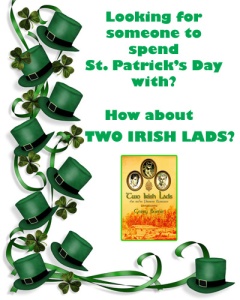
♣♣♣
If you would like to learn more about my other books, or to order copies, click on the specific cover below. Two Irish Lads and Nor All Thy Tears are available in both Kindle and Nook formats. Publisher’s price, $4.95.
♣♣♣
|
Notice to all those who have requested a book review Thank you for your interest, and my apologies for not responding to your request individually. I’m getting there, but the numbers have been overwhelming. Please extend your patience just a bit longer. Thanks again! |
Thanks for dropping by! I’ll have another novel ready for next week, same URL, so drop back soon.
 Story blurb: When Dick Hardesty is hired to look into threats against former priest Dan Stabile, possibly from someone whose confession Dan heard while still in the priesthood, it’s just another case. Then, on a stormy Sunday, on a rain-slick road, Dan is killed, Dick’s partner Jonathan is severely injured, and suddenly, it’s personal. Was the accident really an accident…or murder? Dick learns Dan’s secret could involve a child murderer, and now it seems the man is stalking Joshua and tormenting Jonathan. The objectivity so vital to Dick’s role as a private investigator goes out the window as he pursues one lead after another, and it begins to look like Dan wasn’t the target after all.
About the author: If it is possible to have a split personality without being schizophrenic, Dorien Grey qualifies. When long-time book and magazine editor Roger Margason chose the pseudonym “Dorien Grey” for his first book, it set off a chain of circumstances which has led to the comfortable division of labor and responsibility. Roger has charge of day-to-day existence, freeing Dorien—with the help of Roger’s fingers—to write. It has reached the point where Roger merely sits back and reads the stories Dorien brings forth on the computer screen.
♣♣♣
Review by Gerry Burnie
Reviewing a mystery novel is always a tricky business, especially one that has been so intricately constructed with plot and plot twists, etc. One is always afraid of giving out more than one should.
That is the case with Dorien Grey’s latest addition (#14, I believe) to the Dick Hardesty series, i.e., The Serpent’s Tongue [Zumaya Boundless, February 1, 2014]. Therefore, I will say in a general way that this is a good, solid mystery, superbly written (as are all of Grey’s stories), and clever enough to satisfy most mystery aficionados.
For those who are discovering the Dick Hardesty stories for the first time, this is a stand alone story that can be enjoyed on its own merits, and for those returning readers to the series, there are some character progressions that enhance what is previously known.
Bottom line: I found very little I could criticize about this story. It is an entertaining tale, written by a seasoned author, and bound to give you several hours of enjoyment. Five bees.
♣♣♣
♣♣♣
♣♣♣
If you would like to learn more about my other books, or to order copies, click on the specific cover below. Two Irish Lads and Nor All Thy Tears are available in both Kindle and Nook formats. Publisher’s price, $4.95.
♣♣♣
|
Notice to all those who have requested a book review Thank you for your interest, and my apologies for not responding to your request individually. I’m getting there, but the numbers have been overwhelming. Please extend your patience just a bit longer. Thanks again! |
Thanks for dropping by! I’ll have another novel ready for next week, same URL, so drop back soon.
 Story blurb: Two years before he goes to Walden Pond, Henry David Thoreau, 25, leaves Concord, Massachusetts, to live in New York, where the new America is bursting into life. But before he even gets there he falls in love—with a young man.
It’s 1843, a repressive puritanism still hangs over Concord, Massachusetts, and Henry Thoreau wants out. When his mentor, Ralph Waldo Emerson, gives him an opportunity to move to New York City, Henry leaves Concord with no thought of ever returning.
In his journals, 250-some pages about his trip to New York have been ripped out, the only substantial number of pages missing from the forty-seven journal volumes. What was so scandalous that Thoreau—or, more likely, his literary executor—decided no one should see it?
And why did Thoreau stay only six months in New York?
Thoreau’s biographers go out of their way to convince us that the writer was heterosexual, although he never married and wrote freely in his journal about the beauty of men. His poem “Sympathy,” one of the few published in his lifetime, is a love poem to a boy who was his student. (About that poem, one celebrated biographer went so far as to say, “When he wrote ‘he’ Thoreau really meant ‘she,’ and when he wrote ‘him,’ he really meant ‘her.’”) By denying Thoreau’s real sexuality, scholars have reduced him to a wooden icon.
Thoreau in Love imagines the time of the missing pages, when Thoreau emerged from his shell and explored the wider world and himself before he returned to Concord, where he would fearlessly live the rest of his life and become the great naturalist and literary giant.
About the author: Schuyler moved into the city as soon as he could, wrote plays at home and worked in the Letters Department at Newsweek until his total output for three months work was two letters; he decided he was possibly burned out…. His boss did too, but she then hired him as a proofreader at Sports Illustrated, where Schuyler enjoyed the great benefits and moved up rapidly to copyreader and then, because of a story he wrote for the magazine, to the exalted position of Late Reader, possibly the greatest job that ever existed: when the editors and reporters went to Schuyler to go over their stories it meant they were finished their week’s work, and more often than not, because of S.I.’s deadline, Schuyler worked one 35-hour day and made lots of money. All the while he was writing and mostly not sending things out…. but a couple of years ago he resolved to change that….
Two of Bishop plays were produced many years ago off-off Broadway, and he’s had stories published in Sports Illustrated, The New York Times and in Alyson’s Best Gay Love Stories 2005. After a couple of years at sea and in Florida, he’s happily back in New York City.
♥♥♥
Review by Gerry Burnie
 I don’t suppose there is anything more intriguing to a historian, or writer thereof, than to find 250 pages missing (ripped out) from a famous person’s personal journals. Why the possibilities are endless, and John Schuyler Bishop takes full advantage of this in Thoreau in Love [BookBaby; 1st edition, May 14, 2013].
Henry David Thoreau, an enigmatic and intriguing character in his own right, takes a trip to New York to tutor the children of Ralph Waldo Emerson’s relative William Emerson, in their Staten Island home. On the way he meets a breathtakingly handsome sailor, Ben Wickham, and despite Thoreau’s Puritan background and his (till-then) repressed sexual inclinations, he falls madly in love with this beguiling lad.
As the ‘captain’s boy’ Ben is experienced in the manly art of making love, and by the time they reach Staten Island a most touching and memorable love affair has evolved.
However, once separated, Thoreau begins to have second thoughts. He fervently wants to be ‘normal’ in order to avoid the recriminations of a mostly homophobic society, but at the same time he carries on a romantic correspondence with Ben. Finally the two spend a couple of weeks together, and afterward they separate with Ben urging him to find his true self.
Thoreau then returns to Concord, and Walden emerges.
All of this is Schuyler Bishop’s invention, of course, but it is wonderfully credible and in keeping with Thoreau’s complex nature. It also explores the misgivings that most gay men experience somewhere along the line in their careers; even in today’s more liberal society. Arizona and Uganda are proof positive that to be gay, or GBLT, is still far from mainstream in 2014.
There are some graphic sex scenes, but it is the story that predominates throughout—as it should be.
Altogether, I think this is a story that will appeal to most everyone who enjoys a well-written historical fiction. Five bees.
♥♥♥
Viewers of Gerry B’s Book Reviews – 64,229
♥♥♥
♥♥♥
If you would like to learn more about my other books, or to order copies, click on the specific cover below. Two Irish Lads and Nor All Thy Tears are available in both Kindle and Nook formats. Publisher’s price, $4.95.
♥♥♥
|
Notice to all those who have requested a book review Thank you for your interest, and my apologies for not responding to your request individually. I’m getting there, but the numbers have been overwhelming. Please extend your patience just a bit longer. Thanks again! |
Thanks for dropping by! I’ll have another novel ready for next week, same URL, so drop back soon.
 Story blurb: It’s 1919, and Frank Huddleston has survived the battlefields of the Great War. A serious head injury has left him with amnesia so profound he must re-learn his name every morning from a note posted on the privy door.
Gerald “Jersey” Rohn, joined the Army because he wanted to feel like a man, but he returned from the trenches minus a leg and with no goal for his life. He’s plagued by the nightmare of his best friend’s death and has nervous fits, but refuses to associate those things with battle fatigue. He can’t work his father’s farm, so he takes a job supervising Frank, who is working his grandparents’ farm despite his head injury.
When Frank recovers enough to ask about his past, he discovers his grandparents know almost nothing about him, and they’re lying about what they do know. The men set out to discover Frank’s past and get Jersey a prosthesis. They soon begin to care for each other, but they’ll need to trust their hearts and put their pasts to rest if they are to turn attraction into a loving future.
Cover art: Paul Richmond
About the author: John C. Houser’s father, step-mother, and mother were all psychotherapists. When old enough, he escaped to Grinnell College, which was exactly halfway between his mother’s and father’s homes—and half a continent away from each. After graduation, he taught English for a year in Greece, attended graduate school, and eventually began a career of creating computer systems for libraries. Now he works in a strange old building that boasts a historic collection of mantelpieces–but no fireplaces.
♥♥♥
Review by Gerry Burnie

THE BATTLE OF THE SOMME 1 JULY – 18 NOVEMBER 1916: The badly shelled main road to Bapaume through Pozieres, showing a communication trench and broken trees
As we approach the 100th anniversary of the start of WWI, July 28, 1914—one of the bloodiest wars in world history (to that date)—it is appropriate to remember the human sacrifice in both fact and fiction. Therefore, The Door Behind Us by John C. Houser [Dreamspinner Press; 1st edition, October 13, 2013] is a timely contribution.
Fiction, I believe, is a particularly effective way of dealing with a broad range of ills occasioned by the victims of war while giving them a human face, which Houser has done remarkably well. Likewise, the time (post war, 20th-century—a time of lost innocence) and place (conservative, mid-west America) are equally brought to the fore with admirable accuracy.
The well-written blurb provides a good synopsis of the plot line. Here we have two disabled veterans, one an amputee, and both suffering from psychological damage as well. Frank has lost all memory of his life before the war—even his name—and “Jersey” Rohn has not only lost a leg, but he also suffers from the so-called “shell-shock syndrome,” a term that prevailed until well after WWII. Today, we know it as PTSD.
Brought together as strangers, but with much in common, they quickly form a bond that is remarkable strong: A bond that is built on their strengths as apposed to their frailties. This includes both emotional and physical love, but given the circumstances one could hardly expect less.
They then go on a mission of discovery—Frank to discover his forgotten memories, and Jersey to find a prosthesis to bolster his physical self.
There are very few shortcomings to this well-crafted story. The main characters are both likeable and credible: In love, but not overtly so—in keeping with the times. The ‘villains’ are nasty but not threatening, and the sex is passionate but about the right balance with the rest of the story.
Altogether an engaging and enjoyable story. Five bees.
♥♥♥
Viewers to Gerry B’s Book Reviews – 63,767
♥♥♥
♥♥♥
If you would like to learn more about my other books, or to order copies, click on the specific cover below. Two Irish Lads and Nor All Thy Tears are available in both Kindle and Nook formats. Publisher’s price, $4.95.
♥♥♥
|
Notice to all those who have requested a book review Thank you for your interest, and my apologies for not responding to your request individually. I’m getting there, but the numbers have been overwhelming. Please extend your patience just a bit longer. Thanks again! |
Thanks for dropping by! I’ll have another novel ready for next week, same URL, so drop back soon.
An absolute must read for every man, woman and parent who wishes to see their children grow into healthy, well adjusted beings.
 Blurb: Despite popular belief, American boys tag behind girls in reading and writing ability, and they are less likely to go to college. Our young men are greatly at risk, yet the best-known studies and experts insist that it’s girls who are in need of our attention. The highly publicized “girl crisis” has led to many changes in American schools, politics, and parenting…but at what cost?
In this provocative book, Christina Hoff Sommers argues that our society has continued to overemphasize the troubles of girls while our boys suffer from the same self-esteem and academic problems. Boys need help, but not the sort of help they’ve been getting.
About the author: Christina Hoff Sommers is a resident scholar at the American Enterprise institute in Washington, D.C. She has a PhD in philosophy from Brandeis University and was formerly a professor of philosophy at Clark University. Sommers has written for numerous publications and is the author of Who Stole Feminism? How Women Have Betrayed Women. She is married with two sons and lives in Chevy Chase, Maryland.
♠♠♠
Review by Gerry Burnie
I have been lamenting, of late, that men are being regularly emasculated in most radio and television ads to an extent that would not be tolerated if the same thing were happening to women. In fact, “Advertisers degrade men about 19 times more often than women, and usually to a higher degree,” says the National Coalition for Men. Given the insidious nature of advertising, and the fact that such ads are not only ubiquitous, but are also repeated hundreds of times a day, it amounts to a subtle form of social brainwashing.
To some extent, and perhaps at a more insidious level, this ‘brainwashing’ is what Christina Hoff Sommers is getting at in her book The War Against Boys: How Misguided Feminism Is Harming Our Young Men [Simon & Schuster; Reissue edition, August 20, 2013]. In it, she addresses the very real problem of boys failing or dropping out of a school system that is, intentionally or unintentionally, biased toward girls. The rationale is often couched in terms of ‘equal opportunity,’ but as Sommers points out there is a marked difference between ‘feminist equality’ and ‘feminist gender’.
 In one of the more blatant examples, she describes in some detail how seventh-grade boys are told they will grow up to be abusers, even rapists. It is the sort of thing that men’s rights advocate, Warren Farrell, planned to talk about at the University of Toronto in December 2010, i.e. “the crisis among boys and how they were not doing well educationally,” when he was shouted down by about 100 feminists—as reported by Toronto Sun Newspaper columnist, Michael Coren:
There were around 100 of these fanatics, at the university before he spoke, ripping down posters, threatening and insulting anybody who tried to attend the lecture, and explaining as only heavily funded students can do, “You should be f—ing ashamed of yourself, you f—ing scum” to those with whom they disagreed. There is ample video evidence. ~ “Shrill backlash to men’s rights advocate,” December 8th, 2012.
Specifically, Sommers points out (with statistical verification) that girls tend to receive more academic attention, and go on to higher education in greater numbers than boys—even if feminists claim the opposite. The squeaky wheel gets the oil, after all, and complacency doesn’t grab headlines.
She also posits that boys are being feminized by discouraging traditionally masculine play, like physical competition and rough-housing, etc., for more feminine or unisex games. Moreover, this is being carried into the classroom by the choice of books like Jane Eyre, as apposed to more male oriented stories. Ergo, in terms of literacy, boys are being turned-off reading for lack of interest.
As a possible solution, Sommers suggests that boys would do better in a segregated system with other boys. It is not a new idea, England has had exclusive boys’ school for centuries. Moreover, private schools—such as St. Andrews College in Aurora, Ontario (Est. 1899), and Upper Canada College in Toronto (Est. 1829)—have both operated along this line for over a century with outstanding results.
Some people may feel intimidated by the title, i.e. the ‘war’* against boys, but to me it is quite appropriate. War has been declared, and is being waged against both boys and men, but it is only now that men are beginning to wake up to the fact. It is ironic, therefore, that it took a feminist—albeit an objective one—to sound the alarm.
An absolute must read for every man, woman and parent who wishes to see their children grow into healthy, well adjusted beings. Five bees.
*For those who still feel ‘war’ is too strong a term, see: “Men’s rights under fire,” ~ Toronto Sun Newspaper, February 7, 2014.
♠♠♠
Viewers to Gerry B’s Book Reviews – 63,414
♠♠♠
♠♠♠
If you would like to learn more about my other books, or to order copies, click on the specific cover below. Two Irish Lads and Nor All Thy Tears are available in both Kindle and Nook formats. Publisher’s price, $4.95.
♠♠♠
|
Notice to all those who have requested a book review Thank you for your interest, and my apologies for not responding to your request individually. I’m getting there, but the numbers have been overwhelming. Please extend your patience just a bit longer. Thanks again! |
Thanks for dropping by! I’ll have another novel ready for next week, same URL, so drop back soon.
 Story blurb: “Adventure, intrigue, faith, commitment, love and hate and everything between! Mark Tedesco has done it again, fashioning what is arguably his best work yet! He entices you on a phenomenal journey into the fascinating lives of two 4th century Roman soldiers, John and Paul, in a tale of loyalty and love that grabs you by the throat from the very first sentence and holds you spellbound, gasping for air as you’re swept from chapter to chapter with barely a moment to breathe. An unbelievable marriage of fact and fiction that will leave you applauding or appalled but never bored or indifferent. A must read!” Fox news.
♣♣♣
Review by Gerry Burnie
I can’t say that I am well versed in Roman history, about average I suppose, so the extensive research conducted by Mark Tedesco in his writing of I Am John I am Paul [Academia Publishing; Second edition, November 9, 2012] was a help.
The basic story follows the adventures of two Roman Soldiers, Ioannes Fulvius Marcus Romanus, and his brother-in-arms, Paulus. The time is during the reign of Constantine (306 – 337 A.D), and is typically full of political intrigue.
John and Paul meet during the Germanic wars, and form a loving bond that is put to the test when John is sent off to Alexandria by a tyrannical centurion. While in Alexandria, he becomes involved in Mithraism—a nice touch by the authorin order to explore this mystic religion—but, eventually, he is returned to Rome to rejoin Paul once again.
Another nice touch, and also a nice bit of drama, takes place when John and Paul undertake to successfully rescue the kidnapped daughter of the emperor, and in gratitude the emperor grants them both land and a house in Rome.
Not to be forgotten, either, is their experience with Christianity—i.e. “The Way.” After all, it was Constantine who converted Rome to Christianity (…and had “Great” added to his name), so historically it was an intriguing time that the author didn’t miss.
Technically speaking, this is not a gay story in the erotic sense—which doesn’t disturb me at all. It is romantic, given the love the two boys have for one another, but mostly it is a well-written historical novel with an emphasis on history. My kind of meat. Therefore, for people like myself, I’m going to go the full five bees.
♣♣♣
♠♠♠
♠♠♠
If you would like to learn more about my other books, or to order copies, click on the specific cover below. Two Irish Lads and Nor All Thy Tears are available in both Kindle and Nook formats. Publisher’s price, $4.95.
♠♠♠
|
Notice to all those who have requested a book review Thank you for your interest, and my apologies for not responding to your request individually. I’m getting there, but the numbers have been overwhelming. Please extend your patience just a bit longer. Thanks again! |
Thanks for dropping by! I’ll have another novel ready for next week, same URL, so drop back soon.
 Story blurb: Is it possible for two Civil War veterans to find their place in the world on the Kansas Prairie?
When the War Between the States ended in 1865 many Americans emerged from the turmoil energized by their possibilities for the future. Frank Greerson and Gregory Young were no different. After battling southern rebels and preserving the Union, the two men set out to battle the Kansas Prairie and build a life together. Frank yearned for his own farm, away from his family—even at the risk of alienating them. Gregory, an only child, returned home to claim his inheritance to help finance their adventure out west.
Between the difficult work of establishing a farm on the unforgiving Kansas prairie, and the additional obstacles provided by the weather, Native Americans and wild animals, will their love and loyalty be enough to sustain them through the hardships?
About the author: With inspiration from some historical tourism sites, the love of reading, and a desire to write a novel, L. Dean Pace-Frech started crafting his debut novel, A Place to Call Their Own, in 2008. After four years of writing and polishing the manuscript, he submitted it for publication and Musa Publishing offered him a contract in early 2013.
Dean lives in Kansas City, Missouri with his partner, Thomas, and their two cats. They are involved in their church and enjoy watching movies, outdoor activities in the warmer weather and spending time together with friends and family. In addition to writing, Dean enjoys
reading and patio gardening.
Prior to novels, Dean did some technical writing in his career. He has written another complete fiction manuscript and has a third manuscript outlined.
♠♠♠
Review by Gerry Burnie
To me, the American Civil War was a period of great upheaval, but it was also a time of great promise: the conviction that when the war was over, things would be better. That is the sentiment L. Dean Pace-Frech has captured in his debut novel A Place to Call Their Own [Musa Publishing, July 4, 2013].
Frank Greeerson and Gregory Young meet and fall in love in the midst of the conflict, and when the fighting is over they each stake a claim to free land (presumably under the Homestead Act of 1862) in the State of Kansas—the beginning of the American frontier.
 The story begins with Frank Greerson’s father, Paul, trying to talk him out of this adventure, but failing that, Frank and Gregory set out on their journey like two wide-eyed innocents—a little scared, and a whole lot excited.
The author takes us along with them, and that is the charming part of the story as we follow these two neophytes through their first years of homesteading on the vast, unspoiled prairie. He has also given them moments of bliss, and moments of hardship and challenge, but always shared between them.
The supporting cast is quite charming as well, refreshingly supportive as I think most pioneer communities were. They truly were communal in the sense that everyone pitched in to help their neighbours for the good of the community and of themselves.
In this regard it is a story that will appeal to most people: a romance set in an expansive setting, with likable characters and just enough tension to keep it interesting.
My minor quibble is with the vocabulary at times. Without going into chapter and verse on what I mean, here is an example. In the opening pages Frank says to his father, “I’ve considered all the scenarios, pa,” etc. Now, the difficulty I have with this choice of words is that they don’t fit the character of a farm boy, i.e. “scenarios” (formal) doesn’t fit with “pa” (informal). Perhaps a better fit might have been, “I’ve looked at it from all directions, pa,” etc.
However, this is my personal opinion.
Otherwise, there is nothing about this story not to like. Four and one-half stars.
♠♠♠
Views at Gerry B’s Book Reviews – 62, 574
♠♠♠
♠♠♠
If you would like to learn more about my other books, or to order copies, click on the specific cover below. Two Irish Lads and Nor All Thy Tears are available in both Kindle and Nook formats. Publisher’s price, $4.95.
♠♠♠
|
Notice to all those who have requested a book review Thank you for your interest, and my apologies for not responding to your request individually. I’m getting there, but the numbers have been overwhelming. Please extend your patience just a bit longer. Thanks again! |
Thanks for dropping by! I’ll have another novel ready for next week, same URL, so drop back soon.
No shoot-em-up, but a darned good story.
 Story blurb: On a scorching summer’s day in 1903 the sheriff of Creek County, Eugene Grey, unexpectedly finds himself partnered with feisty young Federal Marshal Forest O’Rourke. The marshal is hell-bent on capturing a wanted man—a man Eugene knows as nothing but an amiable old geezer living quietly in the hills.
But, of course, all is not as it seems. As the manhunt progresses, Eugene slowly works out the true nature of the marshal’s relationship to the old man. And something Eugene has long kept hidden begins to stir inside him. He finds it impossible to deny the desire he feels toward the determined young marshal.
Death and fiery destruction follow, but also passion and stolen moments of joy. Eugene’s journey takes him from his small town of Canyon Creek, Colorado, to the stately homes of Atlanta and Philadelphia. But it also pits him against the very laws he has sworn to uphold. He finds himself risking prison or even death—all in the name of love.
♠♠♠
Review by Gerry Burnie
As most people who visit this page know, I have a fondness for westerns. I think this is because they recreate a life and times that were basic. Not ‘basic’ in the sense of being crude, as they are often portrayed today, but a simpler life in terms of common sense and the ‘golden rule.’ For the most part, I think that Jon Wilson has captured this simplicity in his novel A Shiny Tin Star, [Cheyenne Publishing, November 19, 2012]. Certainly he has captured the laid-back cadence of the narrator, Eugene Grey.
Eugene Grey is a down-home country sheriff, confidant in what he knows from having lived it, seen it, or done it, and sceptical of anyone who hasn’t—especially those who think they know better. That includes Marshall Forrest O’Rourke.
O’Rourke is a cocky Federal Marshall, and worse still, an Easterner. That pretty well sets the tone of the first eight or ten chapters. [I particularly liked the knock-down-drag-em-out fight between O’Rourke and Rawley Scoggins.]
In a somewhat surprising turn, the story shifts east to the cultured life of Atlanta and Philadelphia, taking Eugene out of his rustic element and into Forrest’s element. It also takes them into a climate of artifice and bigotry, which threatens to destroy their simple relationship.
In the end, however, love prevails.
The story is cleverly written, with a keen grasp (however gotten) of the laid-back, country vernacular of the narrator. That was a strong point for me.
The eastern segment was well done, and I can understand why a shift in setting was introduced to add tension, but for me it was a disconnect from the western roots. Having said that, however, I don’t know how else it could have been written.
Altogether, though, I thought it was a good story, well written, and with enough unexpected twists to make it unique. Four and one-half stars.
♠♠♠
Views at Gerry B’s Book Reviews – 62,129
♠♠♠
♠♠♠
If you would like to learn more about my other books, or to order copies, click on the specific cover below. Two Irish Lads and Nor All Thy Tears are available in both Kindle and Nook formats. Publisher’s price, $4.95.
♠♠♠
|
Notice to all those who have requested a book review Thank you for your interest, and my apologies for not responding to your request individually. I’m getting there, but the numbers have been overwhelming. Please extend your patience just a bit longer. Thanks again! |
Thanks for dropping by! I’ll have another novel ready for next week, same URL, so drop back soon.
 Story blurb: When seventeen-year-old T.J. Parsell held up the local Photo Mat with a toy gun, he was sentenced to four and a half to fifteen years in prison. The first night of his term, four older inmates drugged Parsell and took turns raping him. When they were through, they flipped a coin to decide who would “own” him. Forced to remain silent about his rape by a convict code among inmates (one in which informers are murdered), Parsell’s experience that first night haunted him throughout the rest of his sentence.
In an effort to silence the guilt and pain of its victims, the issue of prisoner rape is a story that has not been told. For the first time Parsell, one of America’s leading spokespeople for prison reform, shares the story of his coming of age behind bars. He gives voice to countless others who have been exposed to an incarceration system that turns a blind eye to the abuse of the prisoners in its charge. Since life behind bars is so often exploited by television and movie re-enactments, the real story has yet to be told. Fish is the first breakout story to do that.
About the author: T.J. Parsell is a writer and human rights activist dedicated to ending sexual abuse against men, women and children in all forms of detention. He is currently President-elect of Stop Prisoner Rape and serves as a consultant to the National Prison Rape Elimination Commission. Parsell has testified before numerous government bodies and was instrumental in passage of the Prison Rape Elimination Act of 2003, the first ever federal legislation to address this issue. He lives in Amagansett, NY.
♠♠♠
Review by Gerry Burnie
Non-fiction books seem popular among the viewers, and so this week I have chosen one that is somewhat different. Fish: A Memoir of a Boy in a Man’s Prison by T.J. Parsell [Da Capo Press, November 2, 2006], is described as a memoir, but for the most part it reads like a coming out story.
It is not a pleasant recollection at times, although here, once again, there is a dichotomy. While prison life is brutal, the rape scenes especially, at times there seems to be a measure of relish involved.
The memoir part describes how the author as a 17 y.o entered the prison system, and what he encountered on the first night and onward. Raped by five men, and then ‘won’ in a lottery by one of them, it is a brutally frank story that pulls no punches. Indeed, the raw sexual activity, graphically described, dominates the first two-thirds of the book. [See my discussion on this point, below.]
The coming out part involves the discovery of his own sexuality, and the evolution of a romantic side to all the sex. It also leads, ultimately, to a happy ending.
Critically speaking, the overall story is both intriguing and revealing; however, the sexual activity in the first part is somewhat overwhelming—almost to the point of being super-saturating. Of course, one can argue that this is the way it happened, and you can’t second guess fact; nevertheless, a little less graphic description might have alleviated the super-saturation.
Which brings us around to editing. Oh, my! One reviewer speculated that an unedited version might have somehow made it to the printer, and if this is the case it would explain the inordinate number of typos, malapropisms, and otherwise obvious faux pas.
Taking all this into consideration, I still think it is a fascinating read. Three and one-half bees.
♠♠♠
Views at Gerry B’s Book Reviews – 61,716
♠♠♠
♠♠♠
If you would like to learn more about my other books, or to order copies, click on the specific cover below. Two Irish Lads and Nor All Thy Tears are available in both Kindle and Nook formats. Publisher’s price, $4.95.
♥♥♥
|
Notice to all those who have requested a book review Thank you for your interest, and my apologies for not responding to your request individually. I’m getting there, but the numbers have been overwhelming. Please extend your patience just a bit longer. Thanks again! |
Thanks for dropping by! I’ll have another novel ready for next week, same URL, so drop back soon.
A unique story in time and place, and superbly written –
 Book blurb: Written in the form of a diary, which genre was so popular in the 18th century and which sounds so comprehensible in our time of blogging/webdiaries/webjournals, the novella may be called a love story. A story of a sixteen-year-old damsel and her weird marriage. Time: 1764, a year after the Seven Years War. Europe.
[A novella – 134 pages, 818 KB]
About the author (in her own words): A middle-aged translator and an agent seeking writer, author of 7 books of fiction, essays, notes, and poems. Un poete maudit. Gay-admirer. Straight fetishist. Author of her own photies. Her given name has several derivatives and diminutives that she uses as a part of her pen-names. A big fan of history, English language and linguistic in general, who is always in online search, placing reliance on Facebook, the busy place like no other. “I believe in yesterday, loving the steep turns & junctions of times, besides, your own past is the only thing that nobody can take away.”
♥♥♥
Review by Gerry Burnie
Larisa Biyuts is a Facebook ‘friend,’ and as I was reading her novella A Handful of Blossoms, [Lara Biyuts; 2 edition, January 2, 2014] I could vision many of the interests that Larisa holds dear—history, fine art, classic times, etc—and which are reflected in her writing.
A Handful of Blossoms is set at the height of the Empire Period (1764), just a couple of decades before the French Revolution. Constance Otilia Alexandrine is a minor princess (which is to say, she is a ‘pawn’ in the imperial scheme of things), arranged in marriage to Constantine Leopold, Prince of Askanier-Hortz. Prince Constantine is himself a pawn of sorts, for tradition decrees that he marry and produce an heir, when, in fact, he prefers men—and makes no bones about it to his newly acquired wife.
This perplexes her, but it also gives her time to explore the lush countryside, and the rich folklore of Transylvania, while fulfilling (…at the prince’s suggestion) her ‘womanly needs’ with the prince’s steward.
This is where the story really takes off in a tapestry of colourful folktales and fantasies, masterfully presented in a vivid, and at times, poetic prose reminiscent of the times. It will be a delight to those who enjoy a period novel written in a period style.
My one small quibble is that, here and there, there are minor idiomatic differences in the translation, i.e. “Milord might talk to me.” might have been better stated as “Might m’lord speak to me?” However, when you remember that English is not the author’s first language, these are easily passed over.
Overall it is unique, both in time and location; different, inasmuch as it is a woman-character’s point of view of a gay situation; and, with the exception of the above, it is masterfully written. Four and one-half bees.
♥♥♥
Viewers to Gerry B’s Book Reviews – 61,221
♥♥♥
It is a collection of little-known people, facts and events in Canadian history, and includes a bibliography of interesting Canadian books as well. Latest post: Bedaux Canadian Sub-arctic Epedition: A truly fantastic adventure by an equally larger-than-life character
♥♥♥
If you would like to learn more about my other books, or to order copies, click on the specific cover below. Two Irish Lads and Nor All Thy Tears are available in both Kindle and Nook formats. Publisher’s price, $4.95.
♥♥♥
|
Notice to all those who have requested a book review Thank you for your interest, and my apologies for not responding to your request individually. I’m getting there, but the numbers have been overwhelming. Please extend your patience just a bit longer. Thanks again! |
Thanks for dropping by! I’ll have another novel ready for next week, same URL, so drop back soon.
Thank you everyone!
The WordPress.com stats helper monkeys prepared a 2013 annual report for this blog.

Here’s an excerpt:
The concert hall at the Sydney Opera House holds 2,700 people. This blog was viewed about 19,000 times in 2013. If it were a concert at Sydney Opera House, it would take about 7 sold-out performances for that many people to see it.

A well-balanced blend of story-telling and historical fact.
 Publisher’s blurb: From a hardscrabble fishing village in Nova Scotia to the collapsing trenches of France, a richly atmospheric debut novel about a family divided by World War I.
When adventurous Ebbin goes missing at the front in 1916, Angus defies his pacifist upbringing to join the war and search for his beloved brother-in-law. With his navigation experience, Angus is assured a position as a cartographer in London. But upon arriving overseas he is instead sent directly into the trenches, where he experiences the visceral shock of battle. Meanwhile, at home, his perceptive son Simon Peter must navigate escalating hostility in a fishing village torn by grief and a rising suspicion of anyone expressing less than patriotic enthusiasm for the war.
With the intimacy of The Song of Achilles and the epic scope of The Invisible Bridge, The Cartographer of No Man’s Land offers a lyrical and lasting portrayal of World War I and the lives that were forever changed by it, both on the battlefield and at home.
About the author: P.S. Duffy grew up in Baltimore, MD and spent summers sailing in Nova Scotia. She has a degree in History from Concordia University in Montreal, Quebec and a Ph.D. in Communication Disorders from the University of Minnesota. Currently, she is a science writer for the Mayo Clinic Rochester, MN where she lives with her husband. The Cartographer of No Man’s Land is her first novel.
♠♠♠
Review by Gerry Burnie
While this is not a GBLT novel, it could be with just a few minor twists. Set in Nova Scotia during WWI, The Cartographer of No Man’s Land: A Novel, by P.S, Duffy [Liveright, October 28, 2013], is an evocative story of human nature that also includes a stint in the hell-hole-trenches of France.
Angus MacGrath is a man caught in the centre of competing forces. He is a fisherman with artistic aspirations–contrary to his father’s idea of what a man should do–and a husband to a wife who’s affections have grown cold. To make matters worse, his brother-in-law, Ebbin, a headstrong youth, has gone missing somewhere in France.
With nothing compelling him to remain at home, Angus enlists as a cartographer with the idea of searching for Ebbin, but when he gets to England he is quickly transferred to the front lines. Needless to say, life in the trenches is a far cry from Snag Harbour, or cartography, and so Angus is transformed by the experience in many ways.
Meanwhile, back home, Angus’ son Simon is learning about the vagaries of life, as well. He, too, is caught-up in the midst of divergent forces: His grandfather’s pacifist sentiments, held by many of the older generation, versus the virulent form of patriotism that gripped nearly everyone at the beginning of WWI. Many eagerly answered the call, and many reluctantly died.
As I say, with a few simple twists this could have been a GBLT story, but even so it is a engrossing study of human nature, set in a turbulent time, and in a colourful and picturesque setting. Five bees.
♠♠♠
Viewers to Gerry B’s Book Reviews – 60,846
♠♠♠
It is a collection of little-known people, facts and events in Canadian history, and includes a bibliography of interesting Canadian books as well. Latest post: “Stonehenge Ontario”… Another of Canada’s hidden secrets.
♠♠♠
If you would like to learn more about my other books, or to order copies, click on the specific cover below. Two Irish Lads and Nor All Thy Tears are available in both Kindle and Nook formats. Publisher’s price, $4.95.
|
Notice to all those who have requested a book review Thank you for your interest, and my apologies for not responding to your request individually. I’m getting there, but the numbers have been overwhelming. Please extend your patience just a bit longer. Thanks again! |
Thanks for dropping by! I’ll have another novel ready for next week, same URL, so drop back soon.

 Ranger Cooper Heywood is on duty at the Rocky Mountain National Park during Christmas. It’s not a busy time of year, but there are some people he has to watch over including a photographer. In his experience photographers are a problem, but Cooper finds himself attracted to the handsome Latino who sets his blood on fire.
Alejandro Velez is an accomplished photographer with several coffee table books to his credit. He’s there to photograph the wintry landscape for his newest book. What he didn’t plan on is the instant desire he feels for Cooper who he always sees surrounded by an odd, golden shimmer. Alejandro doesn’t know what it means, but something tells him he’s going to find out.
Available in e-book format – 311 KB.
♠♠♠
Review by Gerry Burnie
Well, the Christmas book I ordered for this slot never did arrive, and so I scrambled around to find Rocky Mountain Christmas (formerly “Let it Snow”) by Michael Barnette [Silver Publishing, November 24, 2012].
It is a straightforward story with a bit of paranormal thrown in for a twist. Ranger Cooper Heywood is doing Christmas duty, looking after Rocky Mountain National Park, and Alejandro Velez is a Miami-based photographer come to capture some winter scenes for an upcoming book.
Not surprisingly, Cooper is a bit sceptical of Alejandro’s winter-survival skills, but once this is set aside, they begin to develop an attraction for one another; aided by their paranormal abilities. Winter plays a role in this as well, for they are trapped for a spell by a mountain blizzard.
This is a feel good story of romance in a romantic setting, and what could be more romantic than to be caught in a blizzard with a hunky ranger?
My only quibbles are that it is not overly original, and the paranormal sub-plot seemed a bit contrived, but otherwise it was a gentle love story for the season. Four bees.
♠♠♠
Viewers at Gerry B’s Book Review – 60,517
♠♠♠
Don’t just give a book this year. Now, you can give one with a personal dedication from the author.
… That is, if you choose one of mine and let me know the details—i.e. Who it is going to (name); your name; and any personal message you wish to include (15 words or less). I’ll create a PDF file that can be printed and placed between the pages, -or- if the book is in PDF format already, I can insert it as a title page. Please allow a week to ten days for processing, and this latter service is not available to Kindle formatted books.
Here’s a sample of what a finished dedication will look like:

♣♣♣
It is a collection of little-known people, facts and events in Canadian history, and includes a bibliography of interesting Canadian books as well. Latest post: Alexander “Molly” Wood: “One of Toronto’s most distinguished founding citizens.” ~ The Canadian Colonist, 1844.
♣♣♣
If you would like to learn more about my other books, or to order copies, click on the specific cover below. Two Irish Lads and Nor All Thy Tears are available in both Kindle and Nook formats. Publisher’s price, $4.95.
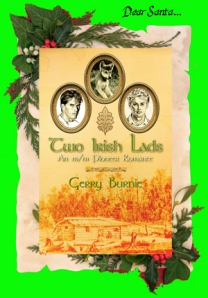
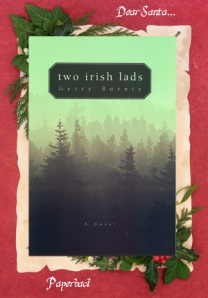
|
Notice to all those who have requested a book review Thank you for your interest, and my apologies for not responding to your request individually. I’m getting there, but the numbers have been overwhelming. Please extend your patience just a bit longer. Thanks again! |
Thanks for dropping by! I’ll have another novel ready for next week, same URL, so drop back soon.
| This book is on order but hasn’t arrived as yet. However, I do want to include some Canadian Christmas books while there is still time to order. I will add a review as soon as it arrives. |

Canadian Christmas Traditions (Amazing Stories) by DeeAnn Mandryk
Included in this book are 28 traditional recipes by Chef Jeff O’Neill, showcasing Canada’s multicultural heritage, plus a special section of 18 Christmas recipes from across the country, highlighting Canada’s regional diversity. The origin of a Canadian Christmas is a fascinating blend of different traditions and festivities. The stories behind the celebration originate from around the world, and paint a wonderful picture of a season of joy, faith, superstition, and celebration stretching back over thousands of years.
Note: Amazon only carries a hardcover edition of this book for a very expensive price. However it is available in e-book format for $7.95 CAD from the publisher, James Lorimer & Co.
♥♥♥
Here is another Canadian Christmas selection:
Christmas in Canada: A Collection of Heartwarming Legends, Tales and Traditions (Amazing Stories) by Megan Dumford
“But even as the darkness and chill settle in, there is a glimmer of hope, a feeling of growing excitement. For the start of winter also means the beginning of the Christmas season, a time of celebration that goes back to the earliest days of Canadian settlement and far beyond.” This book contains selections from the following Amazing Stories: Christmas in Atlantic Canada, Christmas in Quebec, Christmas in Ontario, Christmas in the Prairies, and Christmas in British Columbia Christmas is a time for celebrating with friends and family and for sharing stories, memories, and good cheer. This compilation brings to life the very best holiday stories from across Canada. From the early days of exploration to the modern day, and from heartwarming inspirational tales to dangerous escapades, this is a collection to treasure for many years to come.
It is only available as a hardcover edition from James Lorimer & Co. as well.
♥♥♥
 Also, see my review of Christmas in Ontario: Heartwarming Legends, Tales and Traditions (Amazing Stories) by Cheryl MacDonald
“Every year, he put on the red Santa suit. Every year, there were more sick and needy children to attend to. And every year, as word of his activity spread, Jimmy collected more money and gifts to distribute.” This book will be especially fascinating for all readers interested in: history and human interest stories. Christmas is a time for celebrating with friends and family and for sharing stories, memories, and good cheer. This compilation brings to life the very best holiday stories from across Ontario. From the early days of exploration to the modern day, and from heartwarming inspirational tales to dangerous escapades, this is a collection to treasure for many years to come.
Available in e-pub format, James Lorimer & Co.
♥♥♥
Also see my review of To Every Thing There Is a Season: A Cape Breton Christmas Story
 The story is simple, seen through the eyes of an 11-year-old boy. As an adult he remembers the way things were back home on the farm on the west coast of Cape Breton. The time was the 1940s, but the hens and the cows and the pigs and the sheep and the horse made it seem ancient. The family of six children excitedly waits for Christmas and two-year-old Kenneth, who liked Halloween a lot, asks, “Who are you going to dress up as at Christmas? I think I’ll be a snowman.” They wait especially for their oldest brother, Neil, working on “the Lake boats” in Ontario, who sends intriguing packages of “clothes” back for Christmas. On Christmas Eve he arrives, to the delight of his young siblings, and shoes the horse before taking them by sleigh through the woods to the nearby church. The adults, including the narrator for the first time, sit up late to play the gift-wrapping role of Santa Claus.
The story is simple, short and sweet, but with a foretaste of sorrow. Not a word is out of place. Matching and enhancing the text are black and white illustrations by Peter Rankin, making this book a perfect little gift.
Available in ebook format from McClelland and Steward
Do have a very Merry Christmas!
Another milestone from the dean of gay history in North America.
 Story blurb: In Love Stories, Jonathan Ned Katz presents stories of men’s intimacies with men during the nineteenth century—including those of Abraham Lincoln—drawing flesh-and-blood portraits of intimate friendships and the ways in which men struggled to name, define, and defend their sexual feelings for one another. In a world before “gay” and “straight” referred to sexuality, men like Walt Whitman and John Addington Symonds created new ways to name and conceive of their erotic relationships with other men. Katz, diving into history through diaries, letters, newspapers, and poems, offers us a clearer picture than ever before of how men navigated the uncharted territory of male-male desire.
Available in print format, only – 440 pgs.
 About the author: Jonathan Ned Katz (born 1938) is an American historian of human sexuality who has focused on same-sex attraction and changes in the social organization of sexuality over time. His works focus on the idea, rooted in social constructionism, that the categories with which we describe and define human sexuality are historically and culturally specific, along with the social organization of sexual activity, desire, relationships, and sexual identities.
Katz received the Magnus Hirschfeld Medal for Outstanding Contributions to Sex Research from the German Society for Social-Scientific Sexuality Research in 1997. In 2003, he was given Yale University’s Brudner Prize, an annual honor recognizing scholarly contributions in the field of lesbian and gay studies. His papers are collected by the manuscript division of The Research Libraries of The New York Public Library. He received the Bill Whitehead Award for Lifetime Achievement from Publishing Triangle in 1995.
[See also my review of Gay American History: Lesbians and Gay Men in the U.S.A. by Johathan Katz.]
♥♥♥
Review by Gerry Burnie
Over the centuries, Erotic love between men has had its ups and downs (no pun intended): From the socially-acceptable, Greco-Roman periods, to the reviled years under the predominantly Catholic-dominated-states of Europe; and from the relatively tolerated years following the Stonewall Raids in New York, and the Bathhouse Raids in Toronto, to the same-sex-marriage debates of today. We’ve come a long way, baby, but we’re not there yet.
In his superbly researched thesis, Love Stories: Sex between Men before Homosexuality, [University Of Chicago Press, June 15, 2003], Jonathan Ned Katz takes a look at one of these eras—the ultra-conservative, tradition-bound, 19th century.
The one constant throughout, of course, is that certain men are romantically drawn to one another in spite of all. Today, we call it being “gay” or “homosexual,” but having been around for less than a century these are relatively modern terms; therefore, what did the men of the 1800s call it, and how did this affect their attitudes towards themselves and others?
Katz attempts to answer these questions by delving into the letters, diaries, writings, etc. some 19th-century men left behind, and extracting such kernels of evidence as may be found.

Portrait of Joshua Fry Steed as a young man
He begins with the now famous (infamous?) friendship, and sleeping arrangements, of Abraham Lincoln and Joshua Fry Speed. The story goes that Lincoln rode into town with two saddlebags, and inquired at Speed’s store where he might purchase a “single beadstead.” Speed replied that he had a large room and bed, and that Lincoln was quite welcome to share it with him. Thus, began a twenty-eight-year friendship that Speed later described as, “No two men were ever more intimate.”
The term he used was “intimate,” which was quite acceptable because love was considered separate from sex. Platonic love between men was seen as idyllic (and still is by many) while erotic sex was labelled “sodomy,” “mutual masturbation,” and/or “a crime against nature.” In fact, it wasn’t until Freud (1856 – 1939) that the a-sexual relationships and erotic sex were thought to be connected. Having been reconstructed, therefore, even Platonic love became suspect.
Not surprisingly, however, men went on loving one another regardless of what society thought, so how did they choose to call themselves? Walt Whitman and others tried to transform an illicit sex story into a romantic sex-love story, and adopted terms like “associate” and “partner” to describe the players.
The point being that labels do matter, both to the individual and to society.
Besides Lincoln and Walt Whitman, other personalities are: John Stafford Fiske, the U.S. consul to Scotland in 1870; famous British cross-dresser Ernest Boulton; noted Harvard mathematician James Millis Peirce, writer Charles Warren Stoddard, and English philosopher Edward Carpeter Katz. All of these men have one thing in common: they all indulged in a deeply loving and erotic relationship during the 19th century.
This is such a fascinating and educational book on many levels, and Katz is the undisputed dean of gay, historical studies in North America; therefore, it comes with my highest recommendation. Five bees.
♥♥♥
Viewers to Gerry B’s Book Reviews – 60,145 (A new milestone!)
♥♥♥
Don’t just give a book this year. Now, you can give one with a personal dedication from the author.
… That is, if you choose one of mine and let me know the details—i.e. Who it is going to (name); your name; and any personal message you wish to include (15 words or less). I’ll create a PDF file that can be printed and placed between the pages, -or- if the book is in PDF format already, I can insert it as a title page. Please allow a week to ten days for processing, and this latter service is not available to Kindle formatted books.
Here’s a sample of what a finished dedication will look like:
♣♣♣
It is a collection of little-known people, facts and events in Canadian history, and includes a bibliography of interesting Canadian books as well. Latest post: Charles William “C.W.” Jefferys: Canada’s chronicler of the pioneer past.
♣♣♣
If you would like to learn more about my other books, or to order copies, click on the specific cover below. Two Irish Lads and Nor All Thy Tears are available in both Kindle and Nook formats. Publisher’s price, $4.95.
|
Notice to all those who have requested a book review Thank you for your interest, and my apologies for not responding to your request individually. I’m getting there, but the numbers have been overwhelming. Please extend your patience just a bit longer. Thanks again! |
Thanks for dropping by! I’ll have another novel ready for next week, same URL, so drop back soon.
Words to describe The Boy I Love: Intense, complex, starkly realistic, and superb.
 Story blurb: A compelling debut novel [at the time] set in the aftermath of World War I, exploring the complex relationships of Paul. On his return he finds himself torn between desire and duty; his lover Adam awaits, but so too does Margot, the pregnant fiancée of his dead brother. Paul has to decide where his loyalty and his heart lie.
About this author (…from her blog): December 6, 2013 – “I was asked to give a talk to a group of Creative Writing MA students last night. ‘Talk about how to find an agent or publisher,’ I was told. Well, you’d think I would know how to do this, wouldn’t you? I’ve had four agents (it’s a long story) and I’ve been published – short stories, poems and novels. I’ve even self-published. I called myself Ragged Blackbird Books, after a ragged blackbird that used to hop around our garden until one day it didn’t. So there you are: I am experienced.”
♣♣♣
Review by Gerry Burnie
There are several words that could be used in describing The Boy I Love by Marion Husband [Accent Press Ltd., April 11, 2012]. Among these are intense, complex, starkly realistic, and superb.
The story line is set in a period just after WWI, and revolves around Paul Harris. He is a returning soldier who has spent several months in a psychiatric ward, recovering from “shell shock”—PTSD, as it is called today. He is also “queer” (in the terminology of the time), and so he picks up where he left off with Adam, his lover from before the war.
In the meantime, he has a chance encounter with Margot—the pregnant fiancée of his recently deceased, much-cherished older brother—and in a remarkably chivalrous act, he proposes to her. This doesn’t displace Adam, however, for Paul continues to see him, too.
Also in a supporting role is Paul’s army sergeant, Patrick, who has a crush on Paul as well, and at one point Paul is having individual sex with all three of them.
This in no way detracts from Paul’s character, or cheapens the story. Indeed, I think it is the flaws in all four characters that make them especially appealing, in a vulnerable way, and the story all the more believable. Ms Husband has a remarkable ability to give her characters depth, be it psychological or physical, and this carries the reader’s interest throughout.
Given the melancholy tenor of the story and setting, like a rainy day, I thought the ending was appropriate. In fact, I couldn’t see it resolve in any other way. However, for those who prefer a ‘happy ever after’ ending, it isn’t. Highly recommended. Five bees.
♣♣♣
Viewers of Gerry B’s Book Reviews – 59,781
♣♣♣
Don’t just give a book this year. Now, you can give one with a personal dedication from the author.
… That is, if you choose one of mine and let me know the details—i.e. Who it is going to (name); your name; and any personal message you wish to include (15 words or less). I’ll create a PDF file that can be printed and placed between the pages, -or- if the book is in PDF format already, I can insert it as a title page. Please allow a week to ten days for processing, and this latter service is not available to Kindle formatted books.
Here’s a sample of what a finished dedication will look like:
♣♣♣
It is a collection of little-known people, facts and events in Canadian history, and includes a bibliography of interesting Canadian books as well. Latest post: Dionne Quintuplets: Five children and a media circus.
♣♣♣
If you would like to learn more about my other books, or to order copies, click on the specific cover below. Two Irish Lads and Nor All Thy Tears are available in both Kindle and Nook formats. Publisher’s price, $4.95.
Thanks for dropping by! I’ll have another novel ready for next week, same URL, so drop back soon.
Short Story notification – 34 pages (201 KB)

Story blurb: Brace is none too happy to find a greenhorn building a sod house at the base of his mountain. In fact, he’s determined to run the little fellow right off his land. Unfortunately for Brace, Gaylord Quinn has nowhere else to go, and he has a patent from the US Land Office saying he has full rights to the land. Quinn is scared to death of Brace, but he’s even more scared of having to return to a life he managed to escape. He needs the security of a new home. His dire circumstances might convince Brace to help him, but it will be the friendship that springs up between the men that endures. Will the friendship turn into something more?
About this author: Kiernan’s stories of gay romance envelop diverse themes, varying from paranormal, to fantasy, and science fiction to contemporary romance, with thirteen novels currently in print and ebook, and over sixty shorter works available in both mediums. She has published with a variety of houses, including Torquere Press, Dreamspinner Press, MLR Press, Loose-Id, Starbooks Press, Cleis Press,and Circlet. Her horror short story release, “Cletus,” appears in the Coscom Publishing’s book “Bits of the Dead.”
♠♠♠
Review by Gerry Burnie
With thirteen novels to her name, including Homesteads and Horseradish (Spice it up) [Torquere Press, Inc., March 19, 2009], it is obvious that Kiernan Kelly likes to write. And it shows. There is a sort of ‘ease’ to her writing that catches the reader up in the mood, as well.
In this tale she pits a tenderfoot from New York City, Gaylord Quinn, against a seasoned leatherneck of the Old West, Brace Andrews, in a storyline that is solid but not overly unique. For the purposes of the plot, Quinn leaves New York to find a new life where ‘men are men’ and the boys are glad of it. He has a land patent in hand, and a destination in mind, but the first man he encounters is an unwelcoming Brace Andrews with ‘squatter’s rights’ on his side. Nonetheless, Quinn is sort of cute (in a nerdy way), and, well … Brace has sequestered himself away on account of his hankerin’ for cute nerds.
As you can tell from just this wee bit of plot, it has a tongue-in-cheek, wink-wink, aspect to it, but to her credit Kiernan never lets is get away from her. To the two main characters this is serious business, and at one level it is, but on another it is smile-provoking as well.
It’s a quick read for those who: a) have a medium commute, b) like a western flavour, c) like western-style man-sex, and d) quite a few smiles. However, the mix had just a bit too much ‘sarsaparilla’ in it to make an A-1 story. It was fun, though, and so it gets my strong recommendation. Four bees.
♠♠♠
Viewers to Gerry B’s Book Reviews – 59,374
♠♠♠
Don’t just give a book this year. Now, you can give one with a personal dedication from the author.
… That is, if you choose one of mine and let me know the details—i.e. Who it is going to (name); your name; and any personal message you wish to include (15 words or less). I’ll create a PDF file that can be printed and placed between the pages, -or- if the book is in PDF format already, I can insert it as a title page. Please allow a week to ten days for processing, and this latter service is not available to Kindle formatted books.
Here’s a sample of what a finished dedication will look like:
♠♠♠
It is a collection of little-known people, facts and events in Canadian history, and includes a bibliography of interesting Canadian books as well. Latest post: Kate Aitkin, Pioneer Woman Broadcaster
♠♠♠
If you would like to learn more about my other books, or to order copies, click on the specific cover below. Two Irish Lads and Nor All Thy Tears are available in both Kindle and Nook formats. Publisher’s price, $4.95.
♠♠♠
Thanks for dropping by! I’ll have another novel ready for next week, same URL, so drop back soon.
 Story blurb taken from Ken Shakin’s preface: These stories were published before a certain Hollywood movie made the wild west famous for gay romance and frustration. But cowboys in love are nothing new, to say nothing of the Indians. The history and poetry of the region give evidence of the ways of real men, braves and pardners, with their origins in the tribal practices explored by some thirsty settlers and loving Mormons. You only have to look at an oil painting from the period to see naked boys quenching their thirst at the local swimming hole. You won’t find boys swimming naked together anymore, unless you go looking for it. Much has been written about the impossibility of gay life in the American desert. I wanted to write about all the sex you could have anyway.
I also wanted to show the desert in the mind of anyone with a sexual habit, searching for love in a man, woman, or beast. The west with its wide open spaces seemed the perfect setting for digging into the entrails of human behavior, far away from the holes in the walls in Sleaze City, but maybe just as foul.
When I left New York for good I didn’t know where to go. I toured around the States for a while, before going south of the equator and later settling in the old world across the ocean. These stories are based on my experiences going west, to a place as foreign to me as anything I would find in the rest of the world.
About the author: Ken Shakin has been called the most flippant man in fiction. His irreverent books stain the shelves of the public library, including the highly acclaimed Love Sucks (1997), Grandma Gets Laid (2008), and most recently Thrillerotica (2010). Thrillerotica.com is home to his unique genre, “calculated to send a shiver down even the most desensitized spine” (Omnilit). The New York native is a graduate of the Juilliard School, with a degree in piano. He lives in Berlin.
“Shakin’s darkly humorous and perverse works have earned him an underground following, largely due to the fact that he flaunts every standard of decency.” —Contemporary Authors
♠♠♠
Review by Gerry Burnie
This is a book of vignettes I read some time back, but didn’t attempt to review because I wasn’t certain how I could do it justice. Nonetheless, I think Ken Shakin’s zany style, his off-the-wall imagination, his tell-it-like-it-is starkness—as demonstrated in his Real Men Ride Horses [Thrillerotica.com, September 12, 2012]—has affected my thinking about gay westerns ever since.
Regarding his style: Shakin writes in stark, black and white, with no shades of grey, and yet he is not judgemental. Rather, he simply shines his light on the various characters and situations, one after another, for the readers to judge for themselves. For example from Real Men Ride Horses:
I look around the bar and I know I’m in Sodom. A small town somewhere in America. This could be a Hollywood set. The bar pretends to be western. In the middle of the wild west. The sign above the swinging doors says saloon. The jukebox is twanging. The whole place is made of wood and smells like beer, but there’s a picture of Cher over the mirror that says it all. There are more cowboy hats than cowboys in here. Welcome to the pink desert.
I look at the boy in the cowboy hat next to me. It’s only been a few minutes and already we’re acting like we’ve known each other since we were kids. Playing a game. Cowboys and Indians. As a native New Yorker, I must be the Indian. My arrow aimed straight at the cowboy’s heart.
“Don’t be fooled by the hat,” he says. “Ain’t no cowboys no more. Not real ones.”
He takes a long swig on his piña colada, careful to push the umbrella out of the way with his pinky. Johnny’s old enough to drink. Young enough to fuck. He’s awfully jaded for such a fresh face. The new generation. Wise at an early age, but just as stupid. When I was his age, thrills came in books. Now they have a virtual world to wander. Lost cowboys, shooting it with a joystick.
“Let’s go to your motel,” he says.
That is just one example of many, for it is difficult to know which ones to choose, and yet it is impossible to summarize them all. So, here’s another from Bingo Cowboy:
The anonymous man heads for the toilet. For more stimulating conversation. A man follows him in. Standing next to each other at the urinal there’s nothing to say. They stare at each other’s dicks. The man slips a hand down the back of his jeans and grabs his ass. They leave together. The toilet. The bar. He follows the man into his van and in no time the man is fucking his ass. But half way through the ass changes his mind. Maybe it’s that hit of E he swallowed on his way in the bar. Suddenly the man looks like a human toilet. He doesn’t like the smell of him. Medicinal. Shitty. Maybe it’s just the lube in his ass but he decides he’s had enough of this shit. To get it over with he pretends he’s gonna shoot and the guy responds. By shooting. Bingo!
The thirteen essays Shakin has included read like stories of characters he has either met, heard about or stories he’s been told, and some of them have the ring of historic authenticity. For example, from the essay Little Hero:
The record will show that the boy was arrested in the year 1900. For vagrancy. I find the citation in a dusty book in a library in the middle of a wasteland. The fruity librarian explains that vagrancy meant something else back then. Like loitering. Standing on the corner. Selling your body.ether. The fruity librarian brings out a handful of dusty books, relics from an out-dated criminal justice system, reformed schools that have long since burned down. He seems to have made this boy his hobby. The rest of the boy’s life went from bad to worse. Until one day he disappeared from the records. Maybe he joined the oil rush or struck gold. Or maybe he ended up in the gutter. All I can do now is read the citations. And with a bit of imagination, fill in the details. The story of his young life. And of the boy who shared his cell.
When they pick up the vagrant, he’s got nothing but the clothes on his back and a piece of charcoal in his pocket. Nothing to his name except unspoken emotions and a price list, evidence of his crime. He likes to draw. The wild west graffiti artist. Always carries a piece of charcoal in his pocket so he can draw on a wall or a floor. The price list itemizes his prize possession. His youth. His body. His boyhood for sale.
Ken Shakin packs a lot of meaning and imagery into every phrase, every sentence, and even every word, so if you are looking for an anthology with a refreshing difference I can guarantee you won’t find one like it. Five bees.
♠♠♠
Viewers to Gerry B’s Book Reviews – 58,982
♠♠♠
It is a collection of little-known people, facts and events in Canadian history, and includes a bibliography of interesting Canadian books as well. Latest post: Kate Aitkin, Pioneer Woman Broadcaster
♠♠♠
If you would like to learn more about my other books, or to order copies, click on the specific cover below. Two Irish Lads and Nor All Thy Tears are available in both Kindle and Nook formats. Publisher’s price, $4.95.
♠♠♠
Thanks for dropping by! I’ll have another novel ready for next week, same URL, so drop back soon.
A charming time capsule set in rural Wales
 Story blurb: The Second World War. It’s not all fighting and glory; there are battles on the Home Front, too, and some are not exactly heroic. That’s what injured naval officer Harry discovers when he befriends conscientious objector Jim – a friendship frowned upon in their small Welsh valley even before they begin to fall in love. But they both have secrets to conceal, and it takes a bizarre sequence of events before the full truth can be uncovered.
A novel about healing, compromise, making the best of it and just plain managing to survive.
About the author: Imaginist and purveyor of tall tales Adam Fitzroy is a UK resident who has been successfully spinning male-male romances either part-time or full-time since the 1980s, and has a particular interest in examining the conflicting demands of love and duty.
♠♠♠
Review by Gerry Burnie
Coming so close after Remembrance Day, I’ll admit that another wartime story may not be ideal timing, but Make Do and Mend by Adam Fitzroy [Manifold Press, May 4, 2013] is more of a gentle love story than a war tale per se. In fact, given that it deals (in part) with the topic of a conscientious objection, one could say it is ‘anti-war’ in nature.
As the story opens, the Second World War is already underway, and Navy Commander Harry Lyons has been sent home on medical leave. Home is a family farm in rural Wales, where enigmatic farmhand, Jim Byrnawell, a conscientious objector, is making himself handy. This is the simple beginning to a story that, happily, stays simple, even though there is much happening at the same time.
Through Harry and Jim, we are invited behind the war scene to a quiet corner of Wales where the inhabitants are ‘making do’. Rationing and sacrifice are the accepted norms, and yet it is this communal sacrifice that brings people together; our two protagonists included.
To add a bit of angst to the mix, the author has introduced a hypothetical debate around the topic of conscientious objection; as discussed from the point of view of various characters. It is a somewhat unique perspective—certainly one I have not encountered before—and Fitzroy has done a fine job of keeping the discussion balanced.
The other elements of the story have a balance to them, as well. Harry and Jim’s relationship comes together with a naturalness that sits well with the reader, and the physical aspects are in keeping with the novel’s understated style.
Mention should also be made of the charming setting, and of the quaintness of the Welsh villagers. It reads with all the credibility of opening a time capsule. Five bees.
♠♠♠
Viewers to Gerry B’s Book Reviews – 58,571
♠♠♠
It is a collection of little-known people, facts and events in Canadian history, and includes a bibliography of interesting Canadian books as well. Latest post: Johnny Fauquier – DSO (Double bar): Probably Canada’s greatest bomber pilot.
♠♠♠
If you would like to learn more about my other books, or to order copies, click on the specific cover below. Two Irish Lads and Nor All Thy Tears are available in both Kindle and Nook formats. Publisher’s price, $4.95.
|
Notice to all those who have requested a book review Thank you for your interest, and my apologies for not responding to your request individually. I’m getting there, but the numbers have been overwhelming. Please extend your patience just a bit longer. Thanks again! |
Thanks for dropping by! I’ll have another novel ready for next week, same URL, so drop back soon.

Edition of Gerry B’s Book Reviews
  |
Some interesting facts
|

If you never read another historical account of this era, read this one! Outstanding!
 Story blurb: This major study chronicles the struggle of homosexuals in the U.S. military during WW II who found themselves fighting on two fronts: against the Axis and against their own authorities who took extreme measures to stigmatize them as unfit to serve their country. From 1941 to 1945, more than 9000 gay servicemen and women purportedly were diagnosed as sexual psychopaths and given “undesirable” discharges. Based on documents obtained under the Freedom of Information Act, augmented by 75 interviews with gay male and female veterans, social historian Berube recounts the purges in the military into the Cold War era when homosexuality was officially equated with sin, crime and sickness. The book reveals that the first public challenge to the military’s policy came not from the gay-rights movement but from military psychiatrists who studied gay servicemen and women during World War II. This evenhanded study brings into sharp focus an important chapter in American social history.

About the author: Allan Ronald Bérubé (December 3, 1946 – December 11, 2007) was an American historian, activist,independent scholar, self-described “community-based” researcher and college drop-out, and award-winning author, best known for his research and writing about homosexual members of the American Armed Forces during World War II He also wrote essays about the intersection of class and race in gay culture, and about growing up in a poor, working class family, his French-Canadian roots, and about his experience of anti-AIDS activism.
Coming Out Under Fire earned Bérubé the Lambda Literary Award for outstanding Gay Men’s Nonfiction book of 1990 and was later adapted as a film in 1994, narrated by Salome Jens and Max Cole, with a screenplay by Bérubé and the film’s director, Arthur Dong. The film received a Peabody Award for excellence in documentary media in 1995. Bérubé received a MacArthur Fellowship (often called the “genius grant”) from the John D. and Catherine T. MacArthur Foundation in 1996. He received a Rockefeller grant from the Center for Lesbian and Gay Studies in 1994 to research a book on the Marine Cooks and Stewards Union, and he was working on this book at the time of his death. From Wikipedia, the free encyclopedia.
Review by Gerry Burnie
If I were asked to design a definitive course on the history of Gays and Lesbians in North America, I would include three books as required reading: Gay American History, by Jonathon Katz; From the Closet to the Courtroom, by Carlos Ball; and Coming out Under Fire, by Allan Bérubé [Free Press, 1990]. Moreover, I think the students would thank me afterward for choosing books that are authoritative, informative and relatively easy to read.
For me personally, Allan Bérubé’s seminal work represents an eye-opener like few others I have read. Indeed, I was moved from profound sadness to outright rage when I learned the systematic
persecution that these innocent men and women had to endure in the service of their country. That, perhaps, is the greatest benefit that this retrospective can provide, for those who cannot
remember the past are condemned to repeat it.
The following is a précis of Bérubé’s thesis, but it is by no means complete or in depth. To really appreciate the full story of coming out under fire I urge you to read the original.
***
 When the war clouds started to descend over Europe in the 1930s the United States military did not exceed two hundred thousand soldiers, and so to overcome this Congress passed the nation’s first peacetime conscription act. Consequently, conscripts began to fill the Army’s ranks in astonishing numbers (16 million in 1940-41).
With so many men available, the armed forces decided to exclude certain groups, including women, blacks, and—following the advice of psychiatrists—homosexuals (although this term was not yet widely used). Traditionally the military had never officially excluded homosexuals, but in World War II a dramatic change occurred. Seeing a chance to advance their prestige, influence, and legitimacy of their profession, psychiatrists promoted screening as a means of reducing psychiatric casualties before they became military responsibilities.
In 1941, therefore, the Army issued a directive which disqualified “homosexual proclivities” as a “psychopathic personality disorder.” This was in keeping with the prevailing belief that homosexuality was a neurological disorder—i.e. the first signs of a brain-disease caused by heredity, trauma, or bad habits such as masturbation, drunkenness and drug addiction.
Moreover, the military encased this idea in “characteristics that were considered inferior or “degenerative” by virtue of their deviation from the generally white, middle-class, and
native-born norm.” (Location 536).
“The framers of the Army’s interwar physical standards listed feminine characteristics among the “stigmata of degeneration” that made a man unfit for military service. Males with a “degenerative physique,” the regulation explained, “may present the general body conformation of the opposite sex, with sloping narrow shoulders, broad hips, excessive pectoral and public adipose [fat] deposits, with lack of masculine hirsute [hair] and muscular markings.”” (Location 536).
Bérubé then goes on to explain, “The reason for excluding these as psychopaths was that, like other men in this “wastebasket” category, they were considered to be irresponsible troublemakers who were unable to control their desires or learn from their mistakes and thus threatened the other men.” (Location 568).
To make matters worse, this sort of quackery was widely promulgated in training seminars for recruiters and physicians throughout the United States, and even published in medical journals for wider distribution.
On the other hand, because of women’s marginal status in the military prior to WWII, neither the Army nor the Navy had developed policies and procedures concerning lesbians. Therefore, women
recruits were never asked the homosexual question, and were therefore able to enter the military undetected.
 After Pearl Harbor was bombed, however, the rules were relaxed to accommodate the demands of war, and the military was forced to accept and integrate most gay selectees. In fact, it was privately acknowledged that gay men had become vital members of the armed forces. Moreover, the gay recruits found ways to fit in and even to form close and lasting relationships with “buddies.”
Sexual activity was at a minimum until the recruits learned the rules, and then discrete opportunities could be found where there was a will.
“Not all trainees who approached other men for sex were gay. Heterosexual recruits who had had the most sexual experience with women or who felt strong sex drives could initiate sex without being afraid that they were queer, especially if their partner was gay and played the “passive” role. Teenage recruits who were just fooling around with each other, especially if they had been drinking, found themselves unexpectedly becoming sexual. Some older soldiers with more sexual experience in the military taught younger men how to have sex without getting caught. On the other hand, recruits who knew they were gay before entering the service were sometimes the most reluctant to have sex.” (Location 1103).
Meanwhile, Army and Navy officials struggled with how to manage the homosexual behaviour, and several approaches were developed. When challenged from the outside, particularly by concerned
parents or clergy, their public stance was to condemn behaviour considered to be immoral in the wider culture, including profanity, drunkenness, erotic pictures, extramarital sex, lesbianism, homosexuality, and prostitution. Within the organization, however, military officials took a more understanding approach—forced into it by the need to hang onto trained personnel.
Trainees usually learned on their own how to put up with one another’s differences in order to get through basic training. They also received pleas for tolerance from the war propaganda which
portrayed American soldiers as defending the ideals of democracy, equality, and freedom against the totalitarian Axis. But inspired more by necessity than idealism, male trainees responded to the demands of basic training by developing their own pragmatic ethic of tolerance: “I won’t bother you if you don’t bother me.”
 One of the areas where blatant effeminacy was tolerated—even applauded—was in the “all-soldier variety show.” These began as a diversion, but soon became a popular form of frontline entertainment even under fire. These were all-male shows to entertain each other that almost always featured female impersonation, and coincidentally provided a temporary refuge for gay males to let their hair down and entertain their fellows.
“The impulse to put on shows and perform in dresses generally came from the men themselves—soldiers without women, as well as gay men, had long traditions of spontaneously dressing up in women’s clothes. But during World War II, the military officials, pressured by GIs, their own morale personnel, and leaders in the civilian theatre world …found themselves not only tolerating makeshift drag but officially promoting female impersonation.” (Location 1677).
In 1941, strained by the demands of a massive war mobilization that included a large influx of gay soldiers, the military could no longer handle its homosexual discipline problems by sending all offenders to prison as required by the Articles of War.[1] Therefore, based on the belief that homosexuality was a mental illness, there was a concerted effort to discharge homosexuals without trial while retaining those whose services were deemed essential. However, this policy ran contrary to the common law that held homosexuality as “an infamous and unspeakable crime against nature,” and that the military had a responsibility “to prevent such crimes with severe punishment
and to protect the morals of the nation’s young people under their jurisdiction.”
Underlying all this was a sort of political upmanship among various factions of the military bureaucracy. For example, having sodomites released into the care of psychiatrists would greatly enhance the standing of psychiatry as a legitimate science, and for their part the generals resented the interference of the legals in the Judge Advocate’s office. Therefore, the unfortunate men and women awaiting jusice were helplessly caught somewhere in the middle.
There was also the question of what sort of discharge would apply–i.e. honourable medical discharge or dishonourable? An honourable discharge, it was argued, might lead to homosexual activity or declaration in order to escape compulsory service. Dishonourable discharge (so-called “section eights” or “blue cards”), on the other hand, were generally used only for men who had been convicted of a crime and who had served their sentences. These had been used successfully to eliminate social misfits–alcoholics, chronic liars, drug addicts, men who antagonised everyone—but technically did not include homosexuals. In the end (1943), however, the military issued a directive that steered a compromise inasmuch as sodomy was still deemed a criminal offence, but it allowed for an exception where force or violence had not been used. These individuals would be examined by a board of officers “with the purpose of discharge under the provisions of Section Eight.
It was intended as a more humane way of dealing with “offenders” but, as gay men and women would soon find out, it was fraught with difficulties of its own.
 As officers began to discharge homosexuals as undesirables, the gay GIs who were their targets had to learn how to defend themselves in psychiatrists’ offices, discharge hearing rooms, hospital wards, and in “queer stockades.” There they were interrogated about their sex lives, locked up, physically abused, and subjected to systematic humiliations in front of other soldiers.
“The discharge system could drag any GI whose homosexuality became known or even suspected into seemingly endless maze of unexpected humiliations and punishments. Some gay male and lesbian GIs first entered the maze when they voluntarily declared their homosexuality, fully expecting to be hospitalized
and discharged. But others, following the advice in basic training lectures to talk over their problems with a doctor, psychiatrist, or chaplain, were shocked when medical officers betrayed their confidences by reporting them for punitive action ad “self-confessed” homosexuals, or were disappointed and frustrated when more sympathetic psychiatrists could not help them at all. Caught during their processing for discharge in battles between friendly and hostile officers, they found themselves thrown around like footballs in a game over which they had no control.” (Location 4442).
Nor were things to improve when they were returned home to civilian life. Gay veterans with “blue” or undesirable discharges where stripped of his service medals, rank, and uniform, then given a one-way ticket home where they had to report to their draft board to present their discharge papers. The stigma attached to these discharges was not an accident. Rather, it was intended to punish homosexuals and prevent malingering, and the requirement that the GI report to his draft board ensured that his community would find out the nature of his discharge. Therefore, they were forced to come out to their families and communities. Wherever blue-discharge veterans lived, employers, schools, insurance companies, veterans’ organizations, and other institutions could use their bad discharge papers to discriminate against them.
One of the most vindictive punishments meted out to these veterans was the denial of GI benefits that included federally subsidized home loans; college loans with allowances for subsistence, tuition, and books; unemployment allowances; job training and placement programs; disability pensions and hospital care. Top officials at the Veterans Administration were responsible for this denial, contrary to Army policy and Congress, but nonetheless the VA refused to drop its anti-homosexual prohibition. Consequently, many blue-discharge veterans found it difficult (impossible) to find employment, and when they applied for unemployment insurance, or small
business loans, or college assistance, they were denied in a Catch-22 situation.
One of the side effects of this discrimination was that having survived fear and death on the battlefield, some gay combat veterans began to cast off the veil of secrecy that so seriously
constrained their lives. For them, “coming out” to family and friends was not nearly as terrifying as facing the enemy in battle. Moreover, the popular press began to take notice of the blue-ticket discharges, and their plight, and started to publish columns on the “Homosexual Minorities,” characterizing them as “anther minority which suffers from its position in society in somewhat the same way as the Jews and Negroes.”
Unfortunately, this period of ‘liberal’ attitude was short-lived, for in the late 1940s a preoccupation with conformity brought a fearful scapegoating of those who deviated from a narrow idea of the
nuclear family and the American way of life. However, you will have to read this most remarkable book to learn the outcome of this.
***
What I have included above only covers a small portion of this fascinating, sometimes heart rending, story. If you never read another history of this period, I urge you to read this one. Five Bees, and if I could give ten I would!
[1]
Under the Articles of War, the maximum penalties for Army enlisted men and
officers convicted of sodomy were five years confinement at hard labour,
forfeiture of all pay and allowances, and dishonourable discharge or dismissal.
Under the Articles for the Navy, the maximum penalties for enlisted men were
same but with ten years of confinement at hard labour.
News
Visitor count to Gerry B’s Book Reviews – 15,978
***
To order any of my books, click on the cover below. Two Irish Lads and Nor All Thy Tears are now available in Kindle and Nook formats. The publisher’s price is $4.95 exclusive of tax where applicable.

Thanks for dropping by! Please come back soon.
 Story blurb: Set in war-torn Norway during the German Occupation, Klaus, a young national, finds that he has caught the attention of Axel, a rising Nazi officer in the élite Fallschirmjäger paratroopers. While the battle for territory is rife with bloodshed, the battle for heavy water – crucial for making an atomic bomb – is just as intense. An almost impregnable factory is the target, nestled in the side of a mountain, beneath a plateau. The Enigma machine has been decoding signals that the Norwegians plan on sabotaging it in the deepest winter. As Axel and Klaus’ mutual attraction turns to near obsession, old rivalries threaten to expose the impossible seduction between the two, and the inevitable clash in the fierce ice and snow of battle rises to a harrowing confrontation.
Cover design by Fiona Jayde
Editing by Mary Harris
About the Author: Poet and novelist, Anthony Kobal is the author of many articles in LGBT publications internationally. This is his first novel.
♠♠♠
Review by Gerry Burnie

The Vemork electrolysis building appears here in a photo taken during the plant’s inauguration. After descending from the plateau, the attackers crossed the gorge behind where this photographer stood and approached the plant from alongside the turbine hall (upper left).
Given that next Monday is “Armistice Day,” or “Remembrance Day” as we now call it, The Second Ring, a first novel by Anthony Kobal, [Solferino Press; 1 edition, October 28, 2013] is topical indeed. The story is based in part on the Nazi regime’s failed attempt to build a nuclear bomb during WWII, and the sabotaging of the Vemork heavy water plant near Rjuken, Norway, February 28, 1943.
As a good historical novel should, I think, the author has stuck quite closely to historical facts. For example, he brings to the fore the bitterness felt by the German people with the signing of the Treaty of Versailles (1919), which imposed heavy penalties on them in retribution for WWI. This, and the burden of rebuilding the country, were two of the factors that led to Hitler’s successful takeover with a promise of an Aryan Nation.
The protagonist in this story is a young German, Axel, who shortly after his introduction becomes the sex slave of a kinky baron. It seems the baron is into BDSM and likes to have a naked lapdog on a leash. Enter a second slave (Bruno, for the purposes of later on), who happens to be Axel’s nemesis from their school days.
Axel seems content being a slave, for, although he is not held hostage, he tolerates the baron’s depraved proclivities until he is literally thrown out. Nonetheless, he picks himself up to become one of the young lions in the Nazi’s crack paratrooper outfit.
The story really begins when Axel’s company is assigned to assist and protect the Vemork Electrolysis Plant, located among the formidable peaks and cliffs of the Hardanger Plateau, from the fierce Norwegian Resistance Movement. Needless to say, given the Nazi’s persecution of homosexuals, Axel is very guarded regarding his true sexual orientation, but fate is fickle, and before long he finds himself in love with Klaus, a Norwegian freedom fighter.
Then, in another fatalistic twist, Bruno show up in a senior command position, and promptly abducts Klaus for himself.
Being a historical fact, the fate of the Vemork heavy water is known—a fascinating story in its own right:
Surrounding their boss Leif Tronstad (front row, center) are most of the Vemork saboteurs, including (front row left to right) Jens Anton Poulsson and Joachim Ronneberg, and (back row left to right) Hans Storhaug, Fredrik Kayser, Kasper Idland, Claus Helberg, and Birger Stromsheim.
Conscious that every minute was now crucial, Ronneberg and Kayser climbed a short ladder and crawled as silently as possible down the shaft on their hands and knees over a mass of wires and pipes, pushing their sacks of explosives ahead of them as they went. Through an opening in the ceiling they could see the target beneath them. At the end of the tunnel the pair quickly slid down a ladder into an outer room before rushing the night watchman inside the high-concentration area.
“They immediately locked the doors and Kayser held his gun to the night watchman, who was quivering uncontrollably. Ronneberg had laid about half of the 18 charges when he heard a shattering of glass, and he spun around to see Sergeant Birger Stromsheim climbing in through a window from the back of the plant. Kayser also swung around and prepared to load his gun before he realized they were in good company.
Just before they lit the fuses, the guard said, “Please, I need my glasses. They are impossible to get in Norway these days.” It was a surreal moment and the request stopped the three raiders in their tracks, bewildered by this change to the script, this brief snapshot of civilian anxiety at the critical point of a crucial military operation. There followed a few curious moments as the saboteurs politely rummaged around his desk for his glasses. “Takk” (thank you) said the smiling guard as he put the spectacles on his nose. As he spoke, the four of them heard the sound of footsteps approaching. Was this one of the German guards making his rounds? To their relief, a Norwegian civilian walked into the room and almost fell backwards as he saw what appeared to be three British commandos and his colleague with his hands above his head.
The Vemork heavy water plant after the allies’ sabotage.
The four members of the demolition party immediately took cover, waiting for a reaction from the German barracks hut. They lay or stood stock-still as the door of the hut swung open and a soldier appeared, only half dressed, flashing a torch around the factory yard. He walked slowly in the direction of Haukelid, who was hiding behind some empty drum caskets.
When he was five yards away he stopped and swept the beam of the torch no more than a few inches above the Norwegian’s head. Had it been a windless night, he might have been able to hear his heavy breathing, if not the rapid hammering of his heart. At that exact moment, three tommy guns and four pistols were pointing straight at the back of the unsuspecting German. A couple of inches lower with his torch and he would have been riddled with several dozen bursts of Allied firepower. But he turned on his heel and walked slowly back to the hut, and as the door shut the order for withdrawal was given. ~ Nova – http://www.pbs.org/wgbh/nova/hydro/resistance.html
Regarding the fictional characters, I will leave the ending for the readers to discover for themselves. I will say this, however; it is somewhat unexpected (although not entirely), but fortunately not self-indulgent.
A good read. Congratulations, Anthony Kobal, on your first novel. Four bees.
♠♠♠
Viewers to Gerry B’s Book Reviews – 57-737
♠♠♠
Coming soon – I will be launching a new blog shortly, Authors in Depth, dedicated to introducing new and established authors. This will be a free forum to talk about themselves, their books, and any personal interests and anecdotes they may wish to share. It is open to anyone (and all) with one or more published books to their credit. Authors who are interested can contact me at: gerrybbooks@yahoo.ca
♠♠♠
It is a collection of little-known people, facts and events in Canadian history, and includes a bibliography of interesting Canadian books as well. Latest post: Barbara Ann Scott: “Canada’s Sweetheart”.
♠♠♠
If you would like to learn more about my other books, or to order copies, click on the specific cover below. Two Irish Lads and Nor All Thy Tears are available in both Kindle and Nook formats. Publisher’s price, $4.95.
Now you can get a free, signed inscription, to go along with my e-books,
Two Irish Lads and Nor All Thy Tears Simply by clicking on the logo below
|
Notice to all those who have requested a book review Thank you for your interest, and my apologies for not responding to your request individually. I’m getting there, but the numbers have been overwhelming. Please extend your patience just a bit longer. Thanks again! |
Thanks for dropping by! I’ll have another novel ready for next week, same URL, so drop back soon.
A Masterpiece of the writer’s art – tender, evocative and sensitive
 Story blurb: The story of two young lovers whose passion for one another is exclusive, lyrical, tender and subject to the tensions that any intense romantic relationship is liable to.
A love affair between a thirteen-year-old schoolboy (Tony Sandel) and a nineteen-year-old undergraduate (David), written and published at time before moral panic set in and the false dogma was established that all such relationships damaged the younger partner for life. Sandel is an evocative portrait of boarding-school and Oxbridge life and the intense, often romantic friendships that flourish there. It is also a novel of sexual awakening, whose light touch disguises the profound emotions that such friendships generate; the relationship portrayed is partly of equals and partly, as often happens, one where it is the younger partner who decides whether and how it should persist.
About the author: Angus Stewart’s [1936 – 1998] first published work was ‘The Stile’, which appeared in the 1964 Faber anthology Stories by New Writers. He won the Richard Hillary Memorial Prize in 1965. His breakthrough to public and critical attention came in 1968 with his first novel, Sandel. Set in the pseudonymous St Cecilia’s College, Oxford, the book revolves around the unorthodox love between a 19-year-old undergraduate, David Rogers, and a 13-year-old chorister, Antony Sandel. The novel appears to have been based on real events, recounted by Stewart in an article under the pseudonym ‘John Davis’ in the 1961 anthology Underdogs, edited for Weidenfeld and Nicolson by Philip Toynbee. The story is treated with delicacy and sensitivity, and has a place in English literature comparable in importance to Roger Peyrefitte’s treatment of the same subject in his 1943 novel Les amitiés particulières. Over the past forty years Sandel has become a cult gay novel.
After Sandel Stewart moved to Tangier in Morocco, partly as a project in self-discovery and partly to experiment with drugs in a sympathetic environment. His Moroccan experiences resulted in two further books, a novel entitled Snow in Harvest (1969) and a travel diary entitled Tangier: A Writer’s Notebook (1977). He also wrote poetry, some of which was published as Sense and Inconsequence (1972), with an introduction by his father’s longstanding friend W. H. Auden.
After his mother’s death in 1979 Stewart returned to England, living for the final twenty years of his life in an annex to his father’s home at Fawler outside Oxford. He was an accomplished portrait photographer. For much of his life he suffered from clinical depression.
♥♥♥
Review by Gerry Burnie
 There is currently a controversy raging over Amazon.com’s decision to arbitrarily exclude certain types of erotic novels from its catalogue. However, to the best of my knowledge it has yet to define in specific terms which novels are unacceptable, beyond some broad-stroke classifications—i.e., underage sex, depictions of rape and incest, or bestiality, etc.
To say the least, this is an ambitious undertaking given the millions of indie books alone (for these seem to be the ones targeted the most), so I expect there are many ‘babies’ thrown out with the bath water—certainly some of my friends have complained of this already.
My reaction is that it is a backdoor approach to censorship by a monopoly that has little regard for its authors anyway. This has been my personal experience, and if asked I will gladly provide chapter and verse regarding the details.
Part of this purge can also be attributed to a hypocritically-prudish North America that prohibits an author from writing about sexual activity with a minor under the age of eighteen, but sets the bar for consensual sex at sixteen, and adolescent-to adolescent sex at thirteen, i.e.
163.1 (1) In this section, “child pornography” means
(b) any written material, visual representation or audio recording that advocates or counsels sexual activity with a person under the age of eighteen years that would be an offence under this Act;
(c) any written material whose dominant characteristic is the description, for a sexual purpose, of sexual activity with a person under the age of eighteen years that would be an offence under this Act; or
Age of consent:
From 1890 until recently, the age at which a youth could consent to nonexploitative sexual activity was 14 years. With the recent change to the criminal code of Canada, the age of consent for nonexploitative sexual activity is now 16 years.
Nonexploitative activity is defined as sexual activity that does not involve prostitution or pornography, and where there is no relationship of trust, authority or dependency between the persons involved (1). A coach, spiritual leader, teacher, school principal, guidance counsellor or family member are all examples of persons in a position of trust or authority with youth.
For exploitative sexual activity (prostitution or pornography, or where there is a relationship of trust, authority or dependency), the age of consent is 18 years.
The spirit of the new legislation is not to regulate consensual teenage sexual activity. To this effect, there are a few notable exceptions to the law:
- Youth 12 or 13 years of age can consent to nonexploitative sexual activity with peers when the age difference is no more than two years. For example, a 12-year-old child is deemed capable of consenting to sexual activity with a 14-year-old, but not a 15-year-old.
- Youth 14 or 15 years of age can consent to nonexploitative sexual activity when the age difference is no more than five years. For example, a 15-year-old can consent to having sexual intercourse with a 20-year-old, but not with a 21-year-old.
Children younger than 12 years of age can never consent to sexual activity with anyone, of any age, regardless of whether they say they do. (Canadian Paediatric Society – http://www.ncbi.nlm.nih.gov/pmc/articles/PMC2532909/)
With all this in mind I immediately ordered a copy (from Amazon) of the late Angus Stewart’s much acclaimed novel, Sandel, [Pilot Productions, August 10, 2013]. Like it’s equally acclaimed predecessor, Les amitiés particulières, by Roger Peyrefitte (1943), it deals with younger/older love in a tender, evocative and sensitive way. In fact, they are both masterpieces of the writer’s art.
 Sandel tells the story of Anthony Sandel, a choir boy at St Cecilia’s College, Oxford, and an undergraduate organist (David Rogers). At first their relationship focuses on their mutual love of religious music, but over time it progresses logically and with great credibility into an erastes and eronomous type of love. However, remembering that it was first written and published in the 1960s, this aspect is more implied than explicit; to the extent that the Daily Telegraph wrote of it: “A love not despicable.”
However, as one reviewer has pointed out, the 60s may have been quite ‘liberal’ compared to today, and I quote:
“It is merely difficult to imagine today an aunt who would think or dare to rescue from their outraged school her 13-year-old nephew caught in his master’s bed, and dispatch the lovers on a ten-week honeymoon in Italy. It is impossible though to imagine anything but imminent catastrophe if today a choirboy being interviewed by newsmen were to tell them about his love for his teacher and the latter punched one of them to the floor for making snide remarks about it. The threat “You shouldn’t have done that,” couldn’t possibly sound “unconvincing.” The newsmen would know only too well that a visit to the police would ensure an investigation almost bound to wreck the lives of both man and boy.”
Or,
“One wonders how long it will be before the child abuse lobby succeeds in imposing on productions of Romeo and Juliet the interruption of the most romantic scenes with sour warnings that despite the strongest contrary indications love involving a pubescent is always really no more than false cover for a satanic plot to satisfy selfish lust. ~ – Edmund Marlowe, author of Alexander’s Choice, an Eton boy’s love story.
I agree wholeheartedly. To Sandel – Five Bees for a true masterpiece.
♥♥♥
Viewers of Gerry B’s Book Reviews – 57,278
♥♥♥
Interested in Canadian history? Want to know more? Then visit my new page: In Praise of Canadian History.
It is a collection of little-known people, facts and events in Canadian history, and includes a bibliography of interesting Canadian books as well. Latest post: Springhill Nova Scotia Mine Disaster – Oct. 23, 1958: “The Springhill Bump”
♥♥♥
If you would like to learn more about my other books, or to order copies, click on the specific cover below. Two Irish Lads and Nor All Thy Tears are available in both Kindle and Nook formats. Publisher’s price, $4.95.
♥♥♥
Get an autographed copy of my e-books, Two Irish Lads and Nor All Thy Tears through Authorgraph. Click on the link below to learn how.

|
Notice to all those who have requested a book review Thank you for your interest, and my apologies for not responding to your request individually. I’m getting there, but the numbers have been overwhelming. Please extend your patience just a bit longer. Thanks again! |
Thanks for dropping by! I’ll have another novel ready for next week, same URL, so drop back soon.
 Story blurb:Hadrian’s Lover is a stunning novel about a dystopian society disguised as a utopian one…it raises difficult questions about right and wrong, government control, and an individual’s right to express himself freely and be accepted for his sexual preference, regardless of what it is.” – Tyler R. Tichelaar, PH.D. and author of the award-winning Narrow Lives What if you lived in a world where homosexuality was the norm and all forms of heterosexual behavior were illegal? In the near future the human population has grown to such excess that the earth is no longer able to sustain humanity’s astronomical numbers. Poverty, starvation, and disease are rampant. Only the country of Hadrian seems able to defend itself against the ravages of overpopulation by restricting its growth and encasing its country behind a defensive wall. Procreation does not happen by chance in Hadrian. There are no unwanted pregnancies. No accidents. All pregnancies occur through in vitro fertilization, and every citizen is responsible for rearing one of Hadrian’s children. Heterosexuality is deemed the ill that has led humanity to the brink. In Hadrian, no one dares to express interest in the opposite sex; to do so would result in exile or re-education. Hadrian’s Lover tells the story of Todd Middleton, a teenage boy struggling to keep the secret of his heterosexuality. Read on, and feel with him as he suffers the indignities of a society determined to “cure” him of his plight.
About the author: Patricia Marie Budd is a high school English teacher living in northern Alberta, Canada. She has been a safe zone for her LGBT students throughout her twenty year career. Hadrian’s Lover is her third novel.
♣♣♣
Review by Gerry Burnie
I must admit that sci-fi, fantasy stories are not my first choice, but occasionally one comes along that peaks my interest, and Hadrian’s Lover by Patricia Marie Budd [New Generation Publishing, September 10, 2013] is one of them.
This is a ‘what if’ story set sometime in the twenty-second century, and supposes a world in which GBLT individuals rule, and heterosexuals have been declared both deviant and illegal in an independent nation, called, ‘Hadrian.’
In the surrounding world the heterosexual population has screwed itself into a crisis with overcrowding, disease, starvation and chaos, but emerging out of this morass is a sort of Shangri La of balance and proportion—albeit micro managed to the nth degree. However, to belong to it one must be homosexual. Reproduction is allowed, but only selectively and by in vitro fertilization.
The main character of the story is Todd Middleton, a young man who has the misfortune to be born *shock* heterosexual. It is with him that the ‘point’ of the story comes to the fore; for Todd at first tries to conceal his sexuality, and then suffers the same sort of bullying harassment that some homosexual men and women continue to experience today. The difference being, of course, that now the majority has become the minority.
Fantasy stories of this nature are fun to write because the sky’s the limit for imagination; however, it seems the publisher’s and editor’s respective ‘skies’ were a lot lower regarding this story. This raises some issues with me, not to mention the hackles on the back of my neck.
Under the Canadian Criminal Code, the definition of child pornography regarding written material is as follows:
163.1 (1) In this section, “child pornography” means
(b) any written material, visual representation or audio recording that advocates or counsels sexual activity with a person under the age of eighteen years that would be an offence under this Act;
(c) any written material whose dominant characteristic is the description, for a sexual purpose,* of sexual activity with a person under the age of eighteen years that would be an offence under this Act; [Emphasis mine.] *Note the qualification.
It is probably best, therefore, to play it safe by aging your characters 18 years or older, but any publisher or editor (or vendor) who gets squeamish after that, I would personally tell to go pee in their hat. After all, who is writing this novel, you or the publisher, etc.?!
Over all, however, I thought the story was interesting, a bit pedagogical in places (…a occupational habit for teachers), but certainly thought provoking. Three and one-half bees.
♣♣♣
Viewers to Gerry B’s Book Reviews – 56,871
♣♣♣

Coming of Age on the Trail – I am very happy to announce that I am within ten pages of completing the above manuscript. It has been a long ‘gestation period,’ four and one-half years, but I can say with confidence that it is a unique western genre novel, set in British Columbia, and with a mythological twist. Anticipated release date, March 2013.
♣♣♣
Coming soon – I will be launching a new blog shortly, Authors in Depth, dedicated to introducing new and established authors. This will be a free forum to talk about themselves, their books, and any personal interests and anecdotes they may wish to share. It is open to anyone (and all) with one or more published books to their credit. Authors who are interested can contact me at: gerrybbooks@yahoo.ca
♣♣♣
Interested in Canadian history? Want to know more? Then visit my new page: In Praise of Canadian History.
It is a collection of little-known people, facts and events in Canadian history, and includes a bibliography of interesting Canadian books as well. Latest post: Hurricane Hazel – Oct. 15 – 16, 1954. Canada’s perfect storm.
♣♣♣
If you would like to learn more about my other books, or to order copies, click on the specific cover below. Two Irish Lads and Nor All Thy Tears are available in both Kindle and Nook formats. Publisher’s price, $4.95.
♣♣♣
|
Notice to all those who have requested a book review Thank you for your interest, and my apologies for not responding to your request individually. I’m getting there, but the numbers have been overwhelming. Please extend your patience just a bit longer. Thanks again! |
Thanks for dropping by! I’ll have another novel ready for next week, same URL, so drop back soon.
 Story blurb: THE YEAR was 1882, and the last of the native tribes had dropped to their knees and slipped on their yokes under the boots and guns of the US Cavalry. The Blackfoot were the last, and then the buffalo hunt failed. The vast plains were barren and empty, and the people began to starve. Desperation spread like poison across the land. Evil men, seeing their chance, fed on the hunger, ate the clean hearts of the people. The blood that was spilled in 1882 has not been avenged today. The ghosts are waiting for someone to set them free.
Robert looked over to the corner of the porch. Their old fishing poles were leaning against the screen. He carried them back to his chair, started untangling the nylon fishing line. Val’s pole was for serious fishermen, a supple thin Orvis fly rod with a reel full of braided yellow nylon. His pole was cheap, from Wal-Mart, with a soft cork handle and a reel with a sticky thumb button. Val laughed when he saw it, said it was for little boys fishing at reservoirs.
He put Val’s pole back in the corner, carried his down the slope to the river bank. It took him a little while to find his balance again. He didn’t try to get into the water. That would probably be too much for his shaky leg. But after a few casts he got his rhythm again, let the weight fly out low over the water.
There was a splash a bit upriver, and a moment later a young man appeared, walking down the middle of the shallow river from rock to rock in green hip waders, dressed in the dark green uniform of Fish and Wildlife. He had a fishing pole over his shoulder and a woven oak creel. From the weight of it on his shoulder, Robert could see he’d had some luck. He was Indian, Blackfoot, maybe, and his long hair was tied back at his collar. He raised a hand in greeting.
Robert nodded back. “Evening.” He reeled in his line, and the man watched the red and white bobber bouncing across the water in front of him.
The man’s face was impassive, but he blinked a couple of times when he watched the line come out of the water, bobber, lead weight, no hook. No fish. “I guess I don’t need to ask you if you have a fishing license,” the man said. “Since you aren’t really fishing.”
Robert nodded to the creel over the man’s shoulder. “Looks like you’ve had some luck.”
The man eased the basket off his shoulder, dipped it down into the icy river water. “Yes, I sure did.” He slapped the Fish and Wildlife patch on his uniform shirt. “Course, I don’t need no stinkin’ license! Just another example of the generalized corruption of the Federal Government.”
Robert grinned at him. “Wonder how many times you hear that in the course of a week? We must be in Idaho! I’m Robert Mitchell.”
The man reached for his hand and they shook. “I’m Cody Calling Eagle.
♣♣♣
Review by Gerry Burnie

Three Piegan Blacckfoot chiefs on the prairies of Montana.
And speaking of shared dreams (…as does the story of Wild Onions by Sarah Black) I believe she and I may have shared a couple of visions as well. My latest work-in-progress-novel deals with forgotten legends and unsettled spirits too, and so I read this story with particular interest,
It is a lovely story—a true romance—and somewhat unique inasmuch as it deals with love across cultural lines.
The story opens poignantly with Robert Mitchell visiting the cabin he frequently visited with his deceased lover, Val. The cabin goes way back in Val’s ancestry, but beset with medical bills Robert is now thinking of selling it to get out from under these. However, once he gets there and surrounded by memories, he has a change of thought.
Enter Cody Calling Eagle [my main character’s name is ‘Cory’], a Blackfoot descendent who is still as fresh-faced and unaffected as the wilderness around Salmon River, where he is employed as a conservation officer.
He is like a breath of fresh air that fans the embers of love within Robert, and Cody is open to it as well. Then, as mentioned above, they began experiencing visions of a disturbing past connected to the cabin and Val and Cody’s ancestry. These also begin to have an affect on their relationship, and so Robert has to work hard to overcome this.
At another level, Ms Black weaves into the storyline some of the history of the Piegan Blackfeet, i.e. the 1882 disappearance of the buffalo, and the ‘Winter of Starvation” (1883-84), during which 500 Blackfeet died of starvation.
Despite this it is a story of hope and dedication, as well as a gentle love story. Five bees.
♣♣♣
Viewers to Gerry B’s Book Reviews – 56,523
♣♣♣
Presenting the revised cover for my upcoming novel: Coming of Age on the Trail – Part One
Presenting the revised cover for my forthcoming novel: ComiNG of Age on the Trail – PART ONE.
♣♣♣
Interested in Canadian history? Want to know more? Then visit my new page: In Praise of Canadian History.
It is a collection of little-known people, facts and events in Canadian history, and includes a bibliography of interesting Canadian books as well. Latest post: “Spadina House: One of the great houses of Canada.
♣♣♣
If you would like to learn more about my other books, or to order copies, click on the specific cover below. Two Irish Lads and Nor All Thy Tears are available in both Kindle and Nook formats. Publisher’s price, $4.95.
♣♣♣
|
Notice to all those who have requested a book review Thank you for your interest, and my apologies for not responding to your request individually. I’m getting there, but the numbers have been overwhelming. Please extend your patience just a bit longer. Thanks again! |
Thanks for dropping by! I’ll have another novel ready for next week, same URL, so drop back soon.
An engaging and unique memoir that will charm as well as entertain…
 Story blurb: Alison Wearing led a largely carefree childhood until she learned, at the age of 12, that her family was a little more complex than she had realized. Sure her father had always been unusual compared to the other dads in the neighbourhood: he loved to bake croissants, wear silk pyjamas around the house, and skip down the street singing songs from Gilbert and Sullivan operettas. But when he came out of the closet in the 1970s, when homosexuality was still a cardinal taboo, it was a shock to everyone in the quiet community of Peterborough, Ontario—especially to his wife and three children.
Alison’s father was a professor of political science and amateur choral conductor, her mother was an accomplished pianist and marathon runner, and together they had fed the family a steady diet of arts, adventures, mishaps, normal frustrations and inexhaustible laughter. Yet despite these agreeable circumstances, Joe’s internal life was haunted by conflicting desires. As he began to explore and understand the truth about himself, he became determined to find a way to live both as a gay man and also a devoted father, something almost unheard of at the time. Through extraordinary excerpts from his own letters and journals from the years of his coming out, we read of Joe’s private struggle to make sense and beauty of his life, to take inspiration from an evolving society and become part of the vanguard of the gay revolution in Canada.
Confessions of a Fairy’s Daughter is also the story of “coming out” as the daughter of a gay father. Already wrestling with an adolescent’s search for identity when her father came out of the closet, Alison promptly “went in,” concealing his sexual orientation from her friends and spinning extravagant stories about all of the “great straight things” they did together. Over time, Alison came to see that life with her father was surprisingly interesting and entertaining, even oddly inspiring, and in fact, there was nothing to hide.
About the author: Alison Wearing is the author of the internationally acclaimed travel memoir Honeymoon in Purdah – an Iranian journey and the writer/performer of two award-winning one-woman plays.
♣♣♣
Review by Gerry Burnie
One of the common bug-a-boos run up the flagpole by conservative Christians and other homophobic fear mongers is the so-called ‘risk’ to children that homosexuality and same-sex marriage allegedly represent. Everything from paedophilia to psychological maladjustment. The fact is, as demonstrated by Alison Wearing in her recent memoir-in four-parts, Confessions of a Fairy’s Daughter: Growing Up with a Gay Dad, [Knopf Canada , May 7, 2013], homophobia probably has a greater negative impact on the offspring of a gay parent than the sexual orientation ever could have.
Her engaging memoir is uniquely structured into four perspectives. Her early life in a somewhat avant-garde family, where the mother—a talented musician and marathoner—chose to reasonably follow her personal pursuits, while the father—a professor at Trent University in Peterborough, Ontario—was quite happy to pick up the domestic side of things. Nonetheless, young Alison had no problem with this … Except for one rather disastrous birthday party, featuring a birthday fare of “Gruyère soufflé, waxed beans in tarragon butter, and crème brûlée,” which for a seven-year-old speaks for itself.
This part also included her father’s coming out, but because of the prevailing homophobic attitude of the time (1980s) Alison goes into denial.
The second part is written by the father, and relies on a journal he maintained at the time; plus some newspaper clippings having to do with homosexuality. I personally appreciated this approach because it gave me a deeper insight into a complex situation than I would have gotten from the author’s single POV. It also provided a brief insight into the social mores of the era.
The third part is written by the mother. It is quite short, but charming, and it completes the main character’s perspectives.
Lastly, the fourth part is an update of how things are today.
I like autobiographies, biographies and memoirs, but I particularly like this one. Adding the other two points of view is a unique approach—to me, anyway—and it added so much to my understanding of an otherwise complex situation. Moreover, on a personal level, Peterborough is only a few miles from my original home town, and the 1980s was a transition period for me as well a gay society: from the dark ages of the ‘Bath House Raids’ to more modern liberalism.
For these reasons I recommend it most highly, but as always this is my opinion. Five bees.
♣♣♣
♣♣♣
Interested in Canadian history? Want to know more? Then visit my new page: In Praise of Canadian History.
It is a collection of little-known people, facts and events in Canadian history, and includes a bibliography of interesting Canadian books as well. Latest post: John Damien: Too gay for Canadian Racing.
♣♣♣
If you would like to learn more about my other books, or to order copies, click on the specific cover below. Two Irish Lads and Nor All Thy Tears are available in both Kindle and Nook formats. Publisher’s price, $4.95.
♣♣♣
|
Notice to all those who have requested a book review Thank you for your interest, and my apologies for not responding to your request individually. I’m getting there, but the numbers have been overwhelming. Please extend your patience just a bit longer. Thanks again! |
Thanks for dropping by! I’ll have another novel ready for next week, same URL, so drop back t
A break through topic, a mentor’s example, and a good news story rolled into one.
 “Older Man/Younger Man” is a memoir of the relationship between a middle-aged man and a man thirty years his junior, from their first meeting, through the challenges of living together across a wide age-gap, to a climactic confession of shame and regret, the terror of loss from a life-threatening disease—and, ultimately, the triumph of love. This is a passionate, bittersweet story of a powerful love that transcends gender, bridges generations, defies convention, and brings to the partners the richness of spiritual fulfillment.
The relationship between an older man and a younger man is one of the last taboos left in our culture’s sexual closet. “Older Man/Younger Man” is the first book to address an inter-generational gay male relationship as a path of spiritual redemption.
What makes this book unique and special is its presentation of the pairing between an older man and a much younger man as a healthy, successful relationship and as a spiritual journey.
♣♣♣
Review by Gerry Burnie
I grew up in a rural community of less than one thousand inhabitants, where everyone knew everyone back to their second-great grandfather, and where the first question asked was always, “What will the neighbours think?” Moreover, I too have had lovers who were decades younger than myself, and so I can relate in several ways to Joseph Dispenza’s personal memoirs in Older Man Younger Man [Sept 2011].
A personal- experience book of this nature is tricky write, for it has to straddle a narrow line between self indulgence and ‘author as example.’ Dispenza does this fairly well, with only a few examples of overworking certain parts with personal detail: such as the bathroom regimen preceding the detection of prostate cancer. Nevertheless, I can well understand how such a traumatic discovery would stand out in one’s mind.
One of the aspects of Older Man Younger Man to which I could particularly relate was the first introduction of the other to parents, relatives, and/or friends. Almost invariably this is an awkward time of ‘double whammy’: Your friend/partner/lover is male, gay, and also young enough to be your son—or father, as the case may be.
After this it is the ‘smirky’ looks of strangers and certain business associate until everyone gets used to it.
All of these Despenza and his partner experienced, but the rather cool part is that he doesn’t dwell on them. Yes, age differentiation is a regrettable part of an older/younger relationship, but Dispenza chose to talk more about the ordinary routines of living together, and the joys and challenges that entails.
While it is a fascinating story, well written, and insightful to read, it is difficult to categorize. It is a break through topic of sorts (inasmuch as there are few older-perspective, gay stories out there); it is a mentor’s example for those faced with a similar situation; and it is a good news saga because love prevails in the end. Take your pick. Four and one-half bees.
♣♣♣
Viewers to Gerry B’s Book Reviews to date – 55,835
♣♣♣
Interested in Canadian history? Want to know more? Then visit my new page: In Praise of Canadian History.
It is a collection of little-known people, facts and events in Canadian history, and includes a bibliography of interesting Canadian books as well. Latest post: Benedict Arnold – A Canadian Connection.
♣♣♣
In spite of worldwide condemnation, GBLT individuals are still suffering mental and physical abuse in Russia. Please do whatever you can to protest the Sochi 2014 Olympics by boycotting the sponsors: Coca Cola, Samsung, MacDonald’s, Visa, etc. Yours may only be one voice, but if you speak out others will join you.

♣♣♣
If you would like to learn more about my other books, or to order copies, click on the specific cover below. Two Irish Lads and Nor All Thy Tears are available in both Kindle and Nook formats. Publisher’s price, $4.95.
♣♣♣
|
Notice to all those who have requested a book review Thank you for your interest, and my apologies for not responding to your request individually. I’m getting there, but the numbers have been overwhelming. Please extend your patience just a bit longer. Thanks again! |
Thanks for dropping by! I’ll have another novel ready for next week, same URL, so drop back then.
 Story blurb: Minerva True is a River Dweller and mystic who lives deep in the forested hills of a river valley on the fringes of the world. She is the only person who sees the ancient danger that resides on a nearby chapel grounds. Most pay little heed to her warnings, and in the end only a small band of friends stand beside her. A tale of love and duty ensues, challenging the destinies of Minerva, the young hero Leith, his lover Aubrey, and the mute boy, Deverell. Leith’s half-crazed mother Calpurnia has her own aspirations, however, that prove detrimental not only to Minerva, but to everyone she comes in contact with.
About the author: Eric Arvin resides in the same sleepy Indiana river town where he grew up. He graduated from Hanover College with a Bachelors in History. He has lived, for brief periods, in Italy and Australia. He has survived brain surgery and his own loud-mouthed personal demons. Eric is the author of WOKE UP IN A STRANGE PLACE, THE MINGLED DESTINIES OF CROCODILES & MEN, SUBSURDITY, SIMPLE MEN, and various other sundry and not-so-sundry writings. He intends to live the rest of his days with tongue in cheek and eyes set to roam.
♠♠♠
Review by Gerry Burnie
Lately I have been ruminating on a trend that has GBLT novels reading like variations on a single, repetitive theme: That is until I came across Eric Arvin’s (…get ready for it) The Mingled Destinies of Crocodiles and Men [Wilde City Press, LLC, April 24, 2013].
Now, with a title like that you just know it’s going to be unique, even if it has to dip into the world of fantasy to do it, and so it is with a wonderful romp through mystic times, good v. evil, insidious dark forces (including religion, science and progress), and a prophetess by the name of Minerva.
Then we have a witch-like eccentric—appropriately named ‘Calpernia’—and a loyal vanguard of yeomen: Leith, his lover Aubrey Avonmore, and Deverell.
As you can probably tell, one of the particularly strong points of this novel is the character development, and that includes the names given to each one. It is surprising how a character’s personality can be enhanced by an unique and colourful name, or burdened by the alternative. I mean, “Helen True” just wouldn’t cut it.
The author has also done a superb job of portraying the mystic setting so that it becomes an integral part of the story. After all, a lost valley in a land far, far away, dripping with ancient mystery and forgotten lore, deserves not to be passed over lightly.
And what fantasy would be complete without an evil villain to hiss at (in your mind, anyway), and in this case it is “Dark Eyes:” a sort of allegory for religion (the destroyer of legend and myth), science, the nemesis of imagination, and progress which has its own agenda. Therefore, every time people turn away from the fantasies of old (youth), Dark Eyes becomes stronger.
There have been some aspects left in abeyance, like the further development of Azrael, in anticipation of the sequel, Azrael and the Light Bringer.
This is an unique and fully refreshing story that I think can be enjoyed by anyone who reads it. Five bees.
♠♠♠
Viewers to Gerry B’s Book Reviews – 55,518
♠♠♠
|
Notice to all those who have requested a book review Thank you for your interest, and my apologies for not responding to your request individually. I’m getting there, but the numbers have been overwhelming. Please extend your patience just a bit longer. Thanks again! |
♠♠♠
In spite of worldwide condemnation, GBLT individuals are still suffering mental and physical abuse in Russia. Please do whatever you can to protest the Sochi 2014 Olympics by boycotting the sponsors: Coca Cola, Samsung, MacDonald’s, Visa, etc. Yours may only be one voice, but if you speak out others will join you.
Thank you!
♠♠♠
Interested in Canadian history? Want to know more? Then visit my new page: In Praise of Canadian History.
It is a collection of little-known people, facts and events in Canadian history, and includes a bibliography of interesting books as well. Latest post: Benedict Arnold – A Canadian Connection.
♠♠♠
If you would like to learn more about my other books, or to order copies, click on the specific cover below.Two Irish Lads and Nor All Thy Tears are available in both Kindle and Nook formats. Publisher’s price, $4.95.
Thanks for dropping by! I’ll have another novel ready for next week, same URL, so drop back then.
 Story blurb: Vali Florescu, heir to a powerful local boyar, flees his father’s cruelty to seek his fortune in the untamed Carpathian forests. There he expects to fight ferocious bandits and woo fair maidens to prove himself worthy of returning to depose his tyrannical father. But when he is ambushed by Mihai Roscat, the fearsome Crimson Outlaw, he discovers that he’s surprisingly happy to be captured and debauched instead.
Mihai, once an honoured knight, has long sought revenge against Vali’s father, Wadim, who killed his lord and forced him into a life of banditry. Expecting his hostage to be a resentful, spoiled brat, Mihai is unprepared for the boy to switch loyalties, saving the lives of villagers and of Mihai himself during one of Wadim’s raids. Mihai is equally unprepared for the attraction between them to deepen into love.
Vali soon learns that life outside the castle is not the fairy tale he thought, and happy endings must be earned. To free themselves and their people from Wadim’s oppression, Vali and Mihai must forge their love into the spear-point of a revolution and fight for a better world for all.
Cover art by Simoné
Layout by L.C. Chase
File length: 524 KB
Print Length: 95 pages
♠♠♠
Review by Gerry Burnie
Although I was already familiar with Alex Beecroft’s outstanding writing (having reviewed several of her books before), I must admit that when I first saw The Crimson Outlaw [Riptide Publishing, August 10, 2013], it was the luscious cover by Simoné that caught first my eye. Happily, the writing matched the cover, so it made it a delightful package indeed.
The story blurb capsulizes the plot quite well, and so I will focus on the other aspects of the story that made it such a delightful read for me.
The first, of course, has to be the unique setting. Off hand, I can’t think of another GBLT novel set in Romania; certainly none that I have ever come across. In a way this is surprising because it has so many romantic aspects going for it—the rich and colourful Magyar traditions, and the fierce gentry for example.
Second, the castle intrigue. I mean, a castle just isn’t a castle unless it has some intrigue surrounding it. So, in this case we have Vali trying to save Stela (his sister) from an arranged marriage with a much older and homely man; Vali against Wadim (his cruel and tyrannical father); and finally Vali and Mihai, the handsome outlaw, both of them against Wadim.
Finally there is the character develop that kept me convinced right down to the minor supporting cast. It made them both real and understandable.
Altogether this novel answered my quest for a somewhat unique story that didn’t involve vampires and werewolves, and that wasn’t preoccupied with the perils of coming out and/or self-introspection. So bravo … or in Ms Beecroft’s case, Brava! Five bees.
♠♠♠
♠♠♠
|
Notice to all those who have requested a book review Thank you for your interest, and my apologies for not responding to your request individually. I’m getting there, but the numbers have been overwhelming. Please extend your patience just a bit longer. Thanks again! |
♠♠♠
It is a collection of little-known people, facts and events in Canadian history, and includes a bibliography of interesting books as well. Latest post: Piper James Richardson: Recipient of the Victoria Cross for valour
♠♠♠
If you would like to learn more about my other books, or to order copies, click on the specific cover below.Two Irish Lads and Nor All Thy Tears are available in both Kindle and Nook formats. Publisher’s price, $4.95.

Story blurb: It takes a pissed-off Brahma bull named Shockwave to show rodeo pickup man Marty Fairgrave the cold hard truth about champion bull rider Tripp Colby: Tripp will never leave the safety of his closet or acknowledge Marty in public. Sometimes loving someone just isn’t enough, and after a year of hiding what they are, Marty finally sees the light—and it’s no longer shining on Tripp.
Tripp Colby would do anything for Marty. Well . . . almost. He’s never loved anyone before, and isn’t quite sure how to handle it now. But he knows Marty is his everything, and in order to win him back, Tripp will have to overcome his darkest fears and step into the light.
But no matter Tripp’s intentions, the cost might be too high and the effort too late for these two cowboys to ride off into the sunset.
Cover design: L.C. Chase
Review by Gerry Burnie
Who said a cover can’t sell a book? In my search for this week’s featured novel, which I do a week-or-so in advance of my review, my eye fell upon L.C. Chase’s luscious design for Pickup Men (Volume 1) [Riptide Publishing; 1 edition, July 8, 2013]. The rodeo scene, the hunky model, and the elaborate font, all fit together to make a most evocative whole.
I liked the story too, although it stuck pretty much to the ‘road-well-travelled-genre’ of gay novels. Marty Fairgrave is a likeable, straightforward guy, out of the closet, and respected for it. He is also blessed with a pair of loving, supportive parents, and a couple of equally supportive, male friends.
On the other hand, his erstwhile lover (…of sorts), Tripp Colby, is locked in the closet from the inside, and is loathe to come out of it. As it turns out he has some justification on account of a homophobic and domineering father, but this isn’t doing a thing for Marty’s devotion.
Things finally come to a head when Marty risks serious injury to save Tripp from a rampant bull, but Tripp doesn’t have the courtesy to visit him in the hospital. Even so, after Marty has pulled the plug on their relationship, Tripp decides to make an effort to win him back.
In spite of all this, Tripp isn’t a complete heel—as we discover when he makes a trip to San Francisco, but whether he can redeem himself to the point where he regains Marty’s love is the crux of the story.
I try not to be too critical of a story simply because it sticks to the middle road, but, by the same token, there is very little to get excited about, either. Jane Jacobs once described modern, urban subdivisions as suffering from “The great blight of sameness,” and I am beginning to think the same applies to gay fiction.
More specifically I found that the writing style in this one tended to jump topics rather abruptly, making for a bumpy read, and that some of the sex scenes were just a bit loquacious for my taste. Mind you, I scan sex scenes anyway, so that is a minor quibble.
Bottom line: Would I recommend it? Yes, definitely. These are merely my opinions, and they may not reflect the tastes and opinions of others. Three bees.
♠♠♠
♠♠♠
|
Notice to all those who have requested a book review Thank you for your interest, and my apologies for not responding to your request individually. I’m getting there, but the numbers have been overwhelming. Please extend your patience just a bit longer. Thanks again! |
♠♠♠
It is a collection of little-known people, facts and events in Canadian history, and includes a bibliography of interesting books as well. Latest post: Sir Mathew Ballie Begbie (Judge): The so-called ‘hanging judge.’
♠♠♠

Boycott Russia’s attack on human rights. October 5, 6 & & 7 boycott Coca Cola and MacDonald s.
♠♠♠
If you would like to learn more about my other books, or to order copies, click on the specific cover below.Two Irish Lads and Nor All Thy Tears are available in both Kindle and Nook formats. Publisher’s price, $4.95.


 Gerry B's Book Reviews